Аңыз

Spirits of Nature and Home

Iesi, peri and su peri, Ak Ana, Ot Ana, Su Ana, ui iesi, the yurt and the shanyrak.

Everything in nature has its own masters, the iesi.

Text by: Bekzada ISHEKENOVA, Dias KUMARBEKOV

Mountains, a river, fire and a shanyrak

In this section

  1. Iesiler, Masters of Mountains and RiversLegend · 2 min
  2. Zhirensakal MountainLegend · 2 min
  3. PeriLegend · 2 min
  4. Su PeriLegend · 1 min
  5. Ak AnaLegend · 2 min
  6. Ot AnaLegend · 2 min
  7. Su AnaLegend · 1 min
  8. Ui Iesi, Master of the HomeLegend · 1 min
  9. The Yurt, Kiiz UiHistory · 1 min
  10. ShanyrakHistory · 2 min
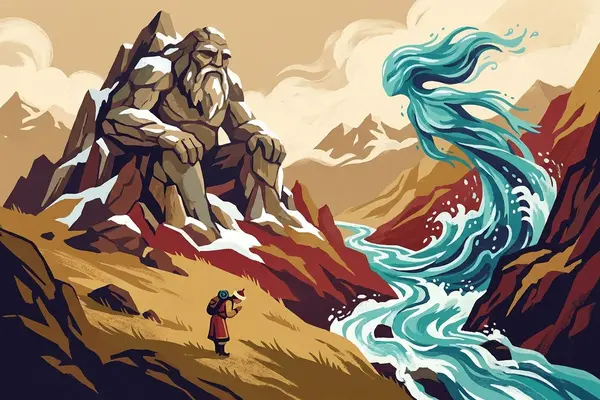
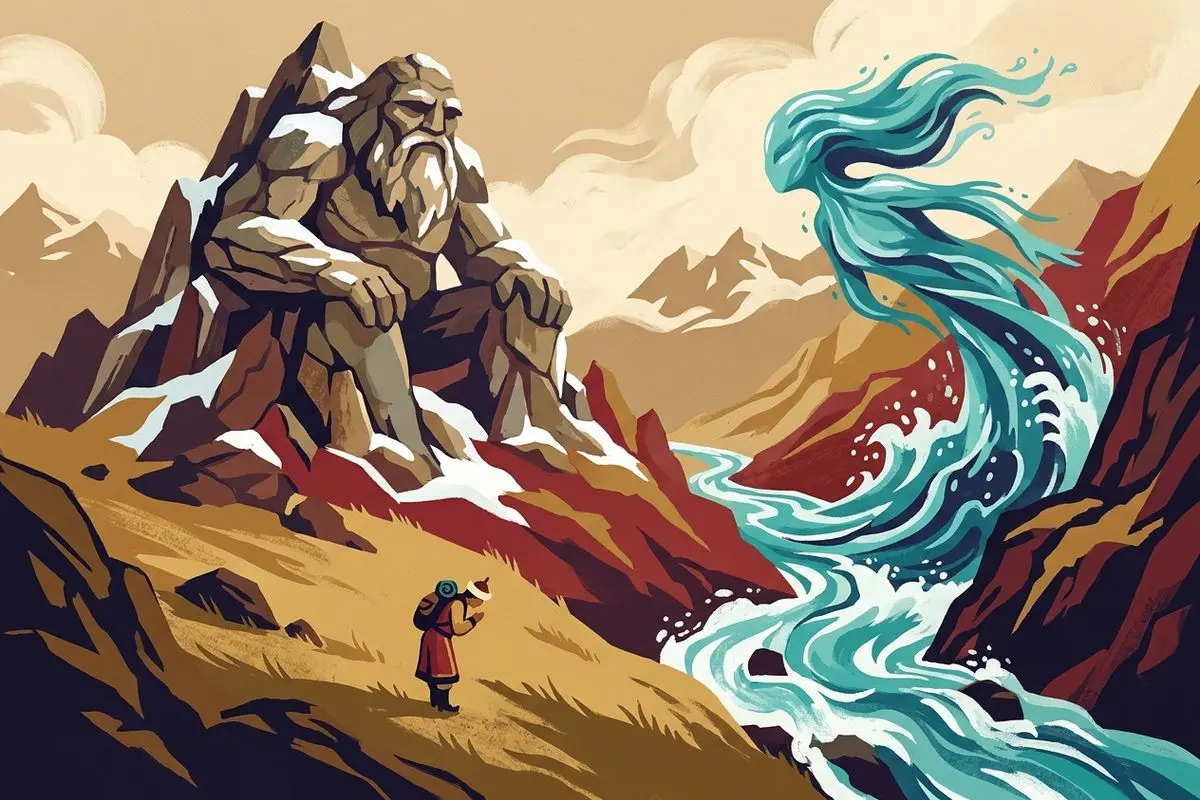
A stone old man, the spirit of the mountain, sits on the peak; beside him a water spirit rises from the river; a traveler below
Illustration made by AI: Google Generative AI.

Chapter 1 of 10 · 2 min read

Iesiler, Masters of Mountains and Rivers

Kazakhs believed that everything in nature has its own guardian spirits. They are called iesilerMasters, the guardian spirits of places in nature., “the masters.” Usually they are kind protectors of their places, but if you make them angry, you could die.

Tau iesi. Usually every mountain has its own spirit-master. It watches over the land and everyone who lives there. It can come to a person as an old man in white clothes or as a wild animal, such as an argali sheep.

People believed that the mountain masters protect their lands from poachers. Hunting when you need food or supplies is fine, but hunting out of greed or for fun is wrong: the animals could disappear, and with them the very life of these places. The mountain masters punished hunters like that.

Su iesi. Rivers and lakes have protectors too. Su iesi is the master of the water and the land around it. These spirits usually guard underwater cities and rule them. The su periWater peri who live in the Lower World. live in the underwater world.

Depending on the tale, su iesi might take a person away forever or let them go back home.

But they aren’t evil, more like neutral. What matters most to them is protecting their territory.
Next Zhirensakal MountainRandom legend
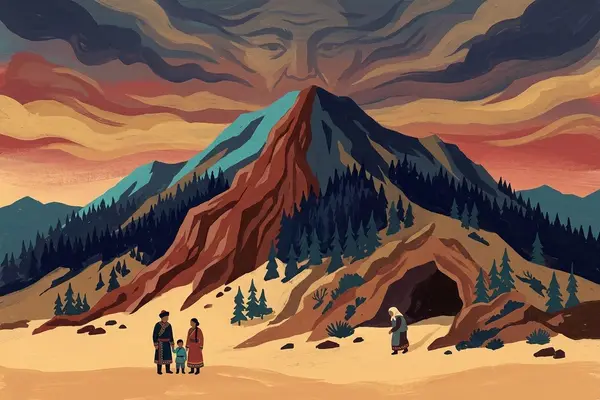
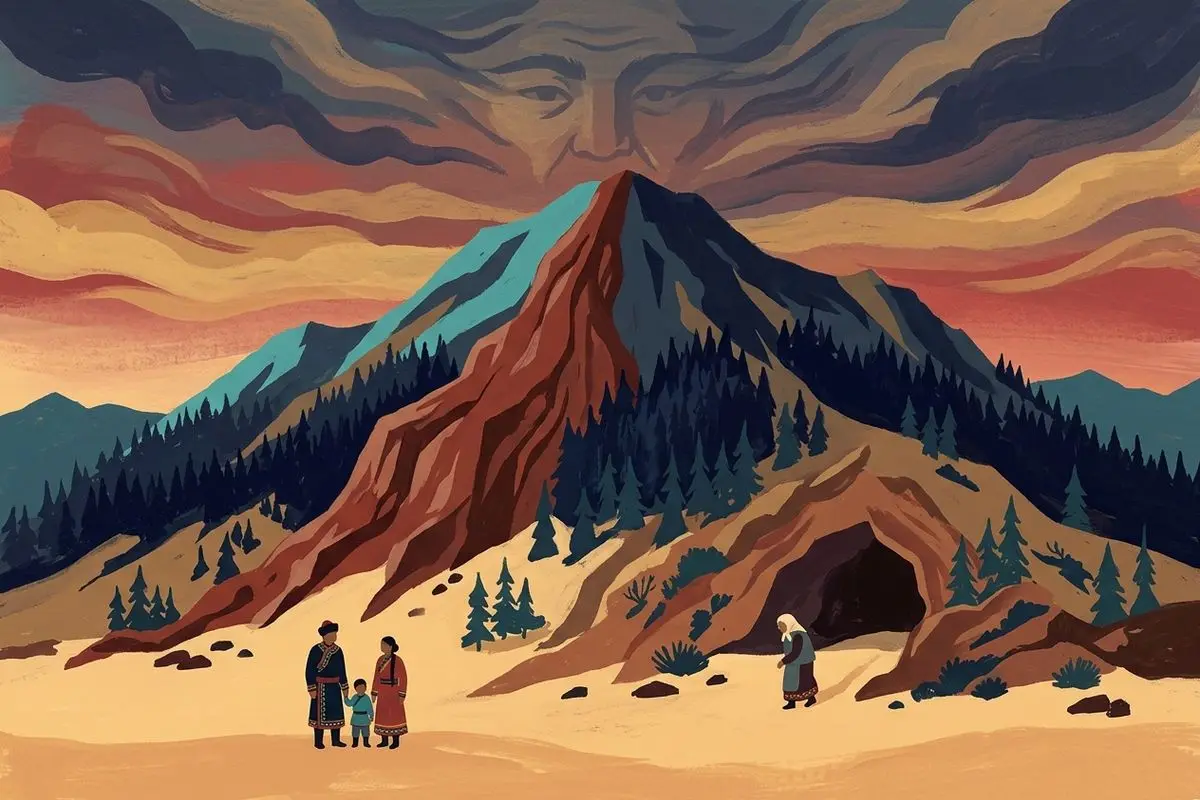
A mountain with a reddish slope and a cave, a family at its foot, and the face of the mountain spirit in the clouds
Illustration made by AI: Google Generative AI.

Chapter 2 of 10 · 2 min read

Zhirensakal Mountain

Mountain masters can also grant wishes. Local historian Yerlan Mustafin told a legend about Zhirensakal Mountain in Karkaraly National Park.

Long ago, a family lived at the foot of the mountain: a father, a mother, and their son. They learned that a mountain spirit lived there. One day the old mother went to a cave and met the master of the mountain. She asked to be young again and got her wish. But then she looked at her old husband and left the family.

The father went to the mountain and asked to have his wife back, and they both grew even older. Then the son went to the mountain and asked for everything to be the way it was before any wishes were made. And everything went back to how it had been.

The lesson: think every wish through down to the smallest detail, and leave no loopholes for anyone who might take your words too literally or play a joke on you.

Mustafin also said that the mountain is named after the saint Zhirensakal, who spent the rest of his days there. People believe the mountain has healing powers, so visitors come from all over. There are several mountains like this in Kazakhstan, and each one has its own protector.

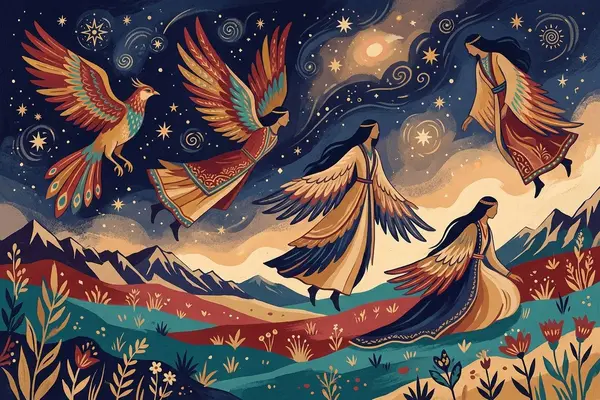
Winged peri come down from the starry sky to a mountain meadow
Illustration made by AI: Google Generative AI.

Chapter 3 of 10 · 2 min read

Peri

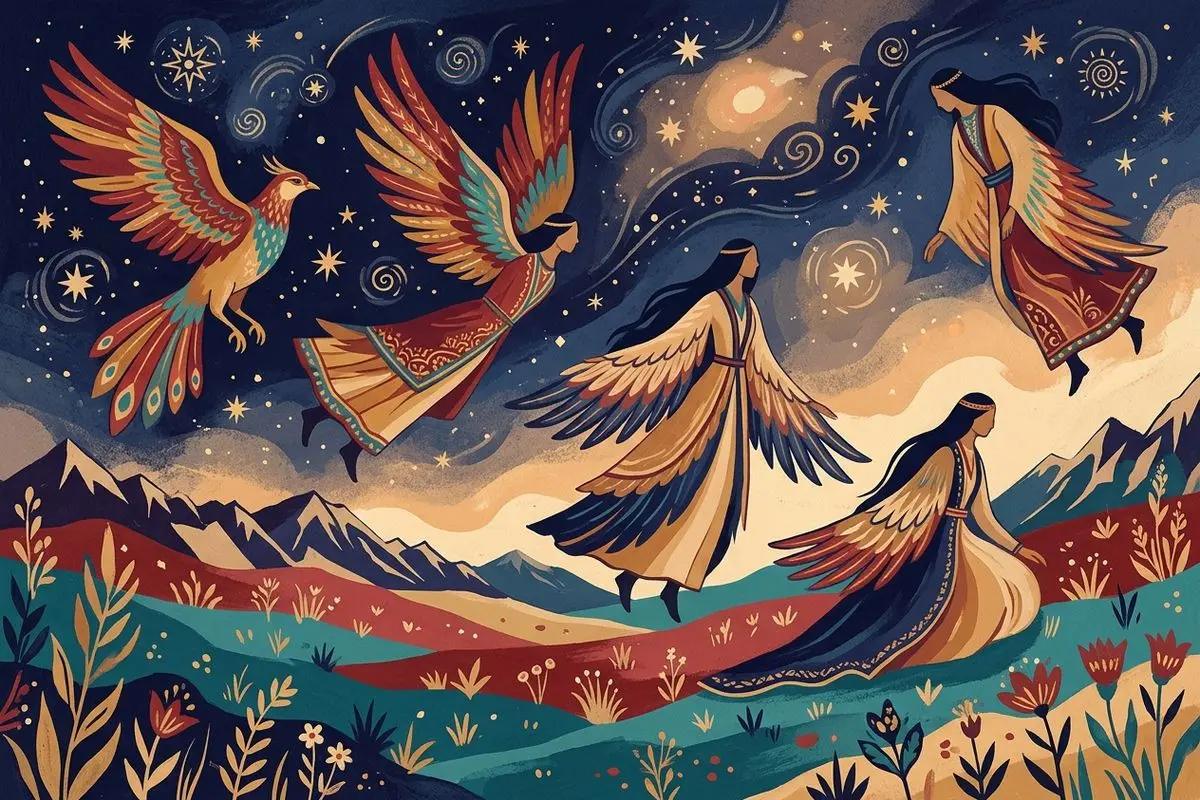
Imagine tall, beautiful people with magical powers. Winx fairies or Tolkien’s elves? In Kazakh mythology, they are the periA magical people who look like very beautiful humans.. Among other Turkic peoples they can be evil, but for Kazakhs the peri are a special race, and some of them are evil while others are kind.

Peri look like very beautiful people and can turn into birds. Usually they live apart from humans, in their own kingdoms, in the upper or the lower world.

When humans and peri marry, batyrsA hero. The title was usually given by the people themselves. are born: the sons are incredibly strong, and the daughters are very smart and beautiful. Magical powers show up more often in girls.

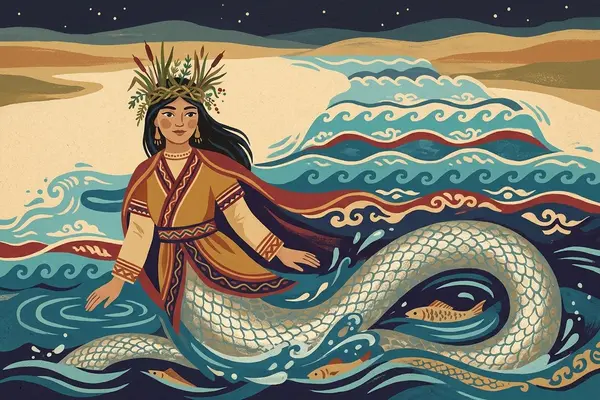
The lady of the lake in a crown of reeds; her body turns into a snake’s tail
Illustration made by AI: Google Generative AI.

Chapter 4 of 10 · 1 min read

Su Peri

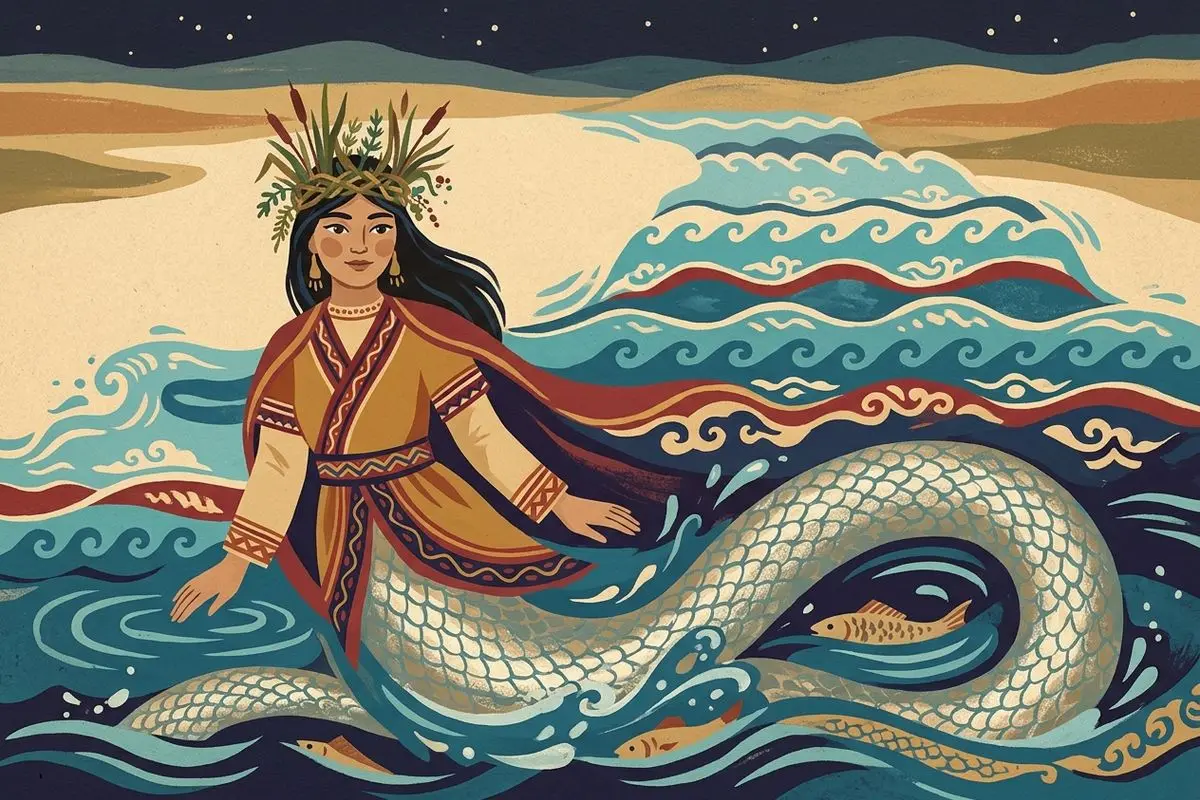
Bodies of water belong to the lower world, and the beings who live there are the su periWater peri who live in the Lower World.. They can turn into snakes.

In a fairy tale, a su periA magical people who look like very beautiful humans. may turn out to be the queen of a lake and its generous mistress, who helps the heroes but sends a flood when she gets angry. It can also be a whole underwater people.

In these tales, the hero might end up serving UbbeA water spirit, in some tales the ruler of an underwater kingdom., and after many years of hard work earn a better position and marry the king’s daughter. Children from such marriages grow up strong and smart.

You can read more about Ubbe, the ruler of the underwater kingdom, in the “Scary Creatures” section.

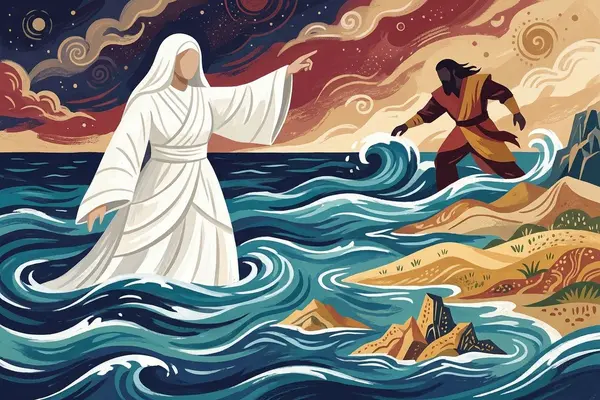
The White Mother in white robes points at the water, where land is rising
Illustration made by AI: Google Generative AI.

Chapter 5 of 10 · 2 min read

Ak Ana

In Turkic mythology, the forces of nature have both male and female forms. Very often they are linked to the word “ana,” which means mother.

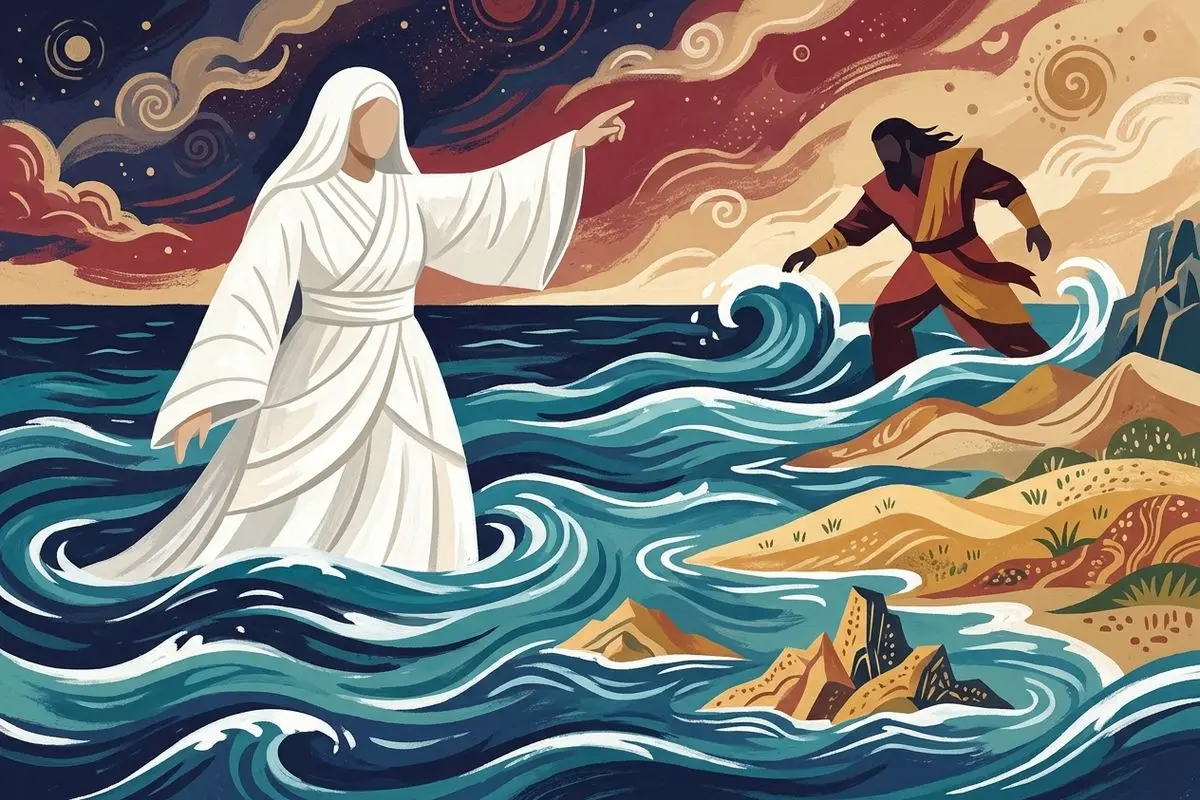
Ak Ana (White Mother) is a creator goddess in the mythology of the Turks and the Altai peoples. She is the wife of Kaira (Kara Khan), the creator god, who in some versions is the son of TengriThe supreme god of the sky..

The legend says that Kaira was flying over an endless ocean in the form of a white bird, and he felt lonely and sad. Then Ak Ana rose out of the water and told him to create land. When he obeyed, she created all living things.

On her advice, Kaira planted the tree of life. The first people appeared from its branches, and nine races came into being. By the way, Kaira taught people how to make arak, an alcoholic drink.

Ak Ana is also often the goddess of water and the older sister of the Earth. She has fair hair.

Turkic peoples have other legends about how all living things were created. This is just one of many.

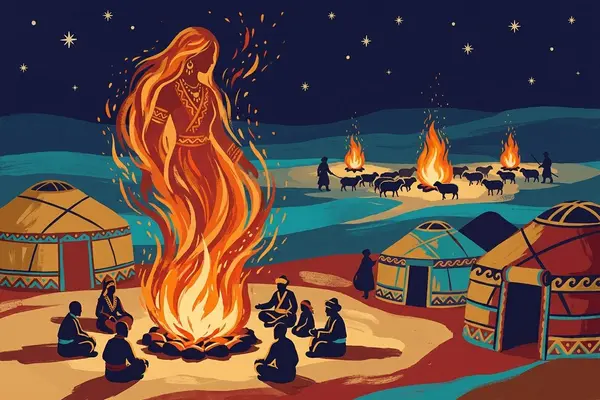
A night bonfire in a village with a woman’s figure in the flames; in the distance, sheep are led between fires
Illustration made by AI: Google Generative AI.

Chapter 6 of 10 · 2 min read

Ot Ana

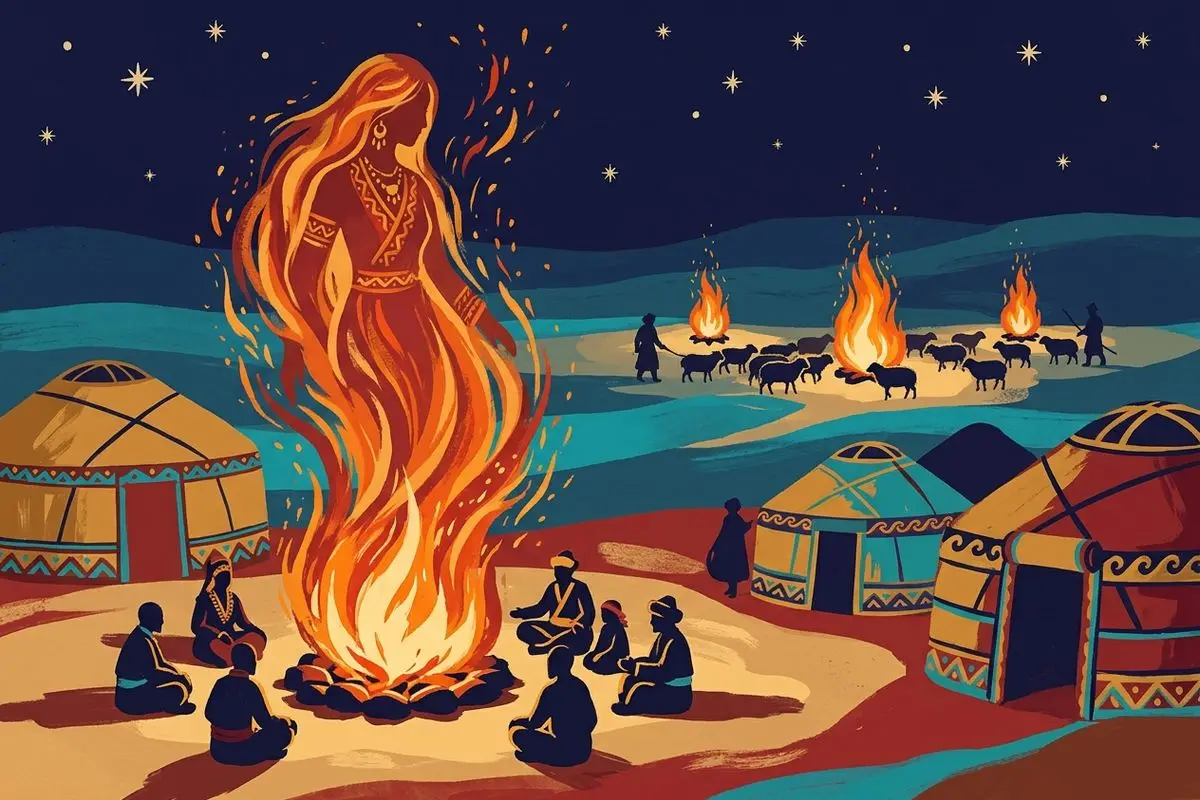
Ot Ana (Mother Fire) was especially honored. She is the guardian of fire who protects people, families, and the whole nation. The legend says she appeared from UmaiThe supreme goddess, protector of the Middle World.’s footprint and lives in fire.

Fire plays an important role in the life of nomads: it gives life and protects from harm. People believed that the alastauA ritual where fire is carried around to cleanse and drive away evil forces. ritual, when fire is carried around someone or something, breaks spells and the evil eye and drives away evil forces. For example, if a horse refused to move, it meant evil spirits had tangled up its legs: a traveler would pass a lit match along them to break the invisible threads, and then go on. To cleanse a winter camp, people lit two fires and drove their livestock between them, and people walked between the fires too.

People believed that fire must be treated with respect: you must not step on it, spit into it, or put it out with water.

When a bride came into the groom’s home, she bowed to the fire. The groom’s mother poured oil into the fire, warmed her palms, and passed them over her daughter-in-law’s face to bless her, so that Ot Ana would protect the new family from harm.

This element also has a male form, Ot Ata (Father Fire), who protects the family in the same way. The elements always had both male and female forms: it is a symbol of balance.

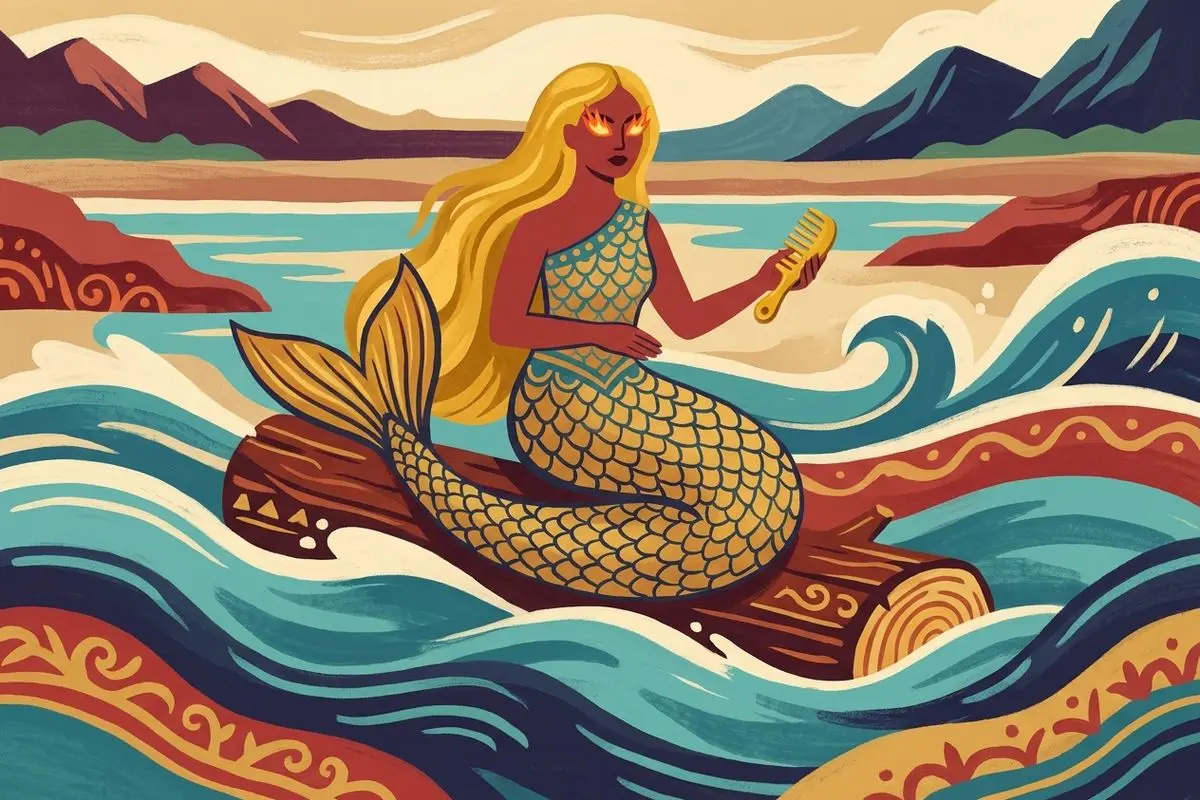
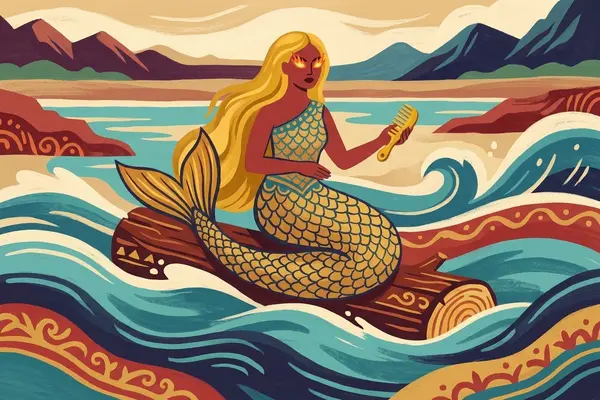
A water goddess with a fish tail and a golden comb floats on a log down a rushing river
Illustration made by AI: Google Generative AI.

Chapter 7 of 10 · 1 min read

Su Ana

Another guardian is Su Ana (Mother Water). She is described as a beautiful young woman with long golden or white hair covered in fish scales. She has a fish tail, and her eyes blaze like fire.

She rides down the river on a log, and her mood decides whether the river stays calm and smooth or floods its banks. But she also helps people: she brings rain and saves them from drought.

Water opens a passage to the lower world, so it’s wise to be careful near rivers and lakes.

Su Ana combs her hair with a golden comb. If you take her comb, she will come back for it. So don’t take Su Ana’s comb.

Su Ata (Father Water) has a beard, and his body is covered in waterweed. He does the same things she does.

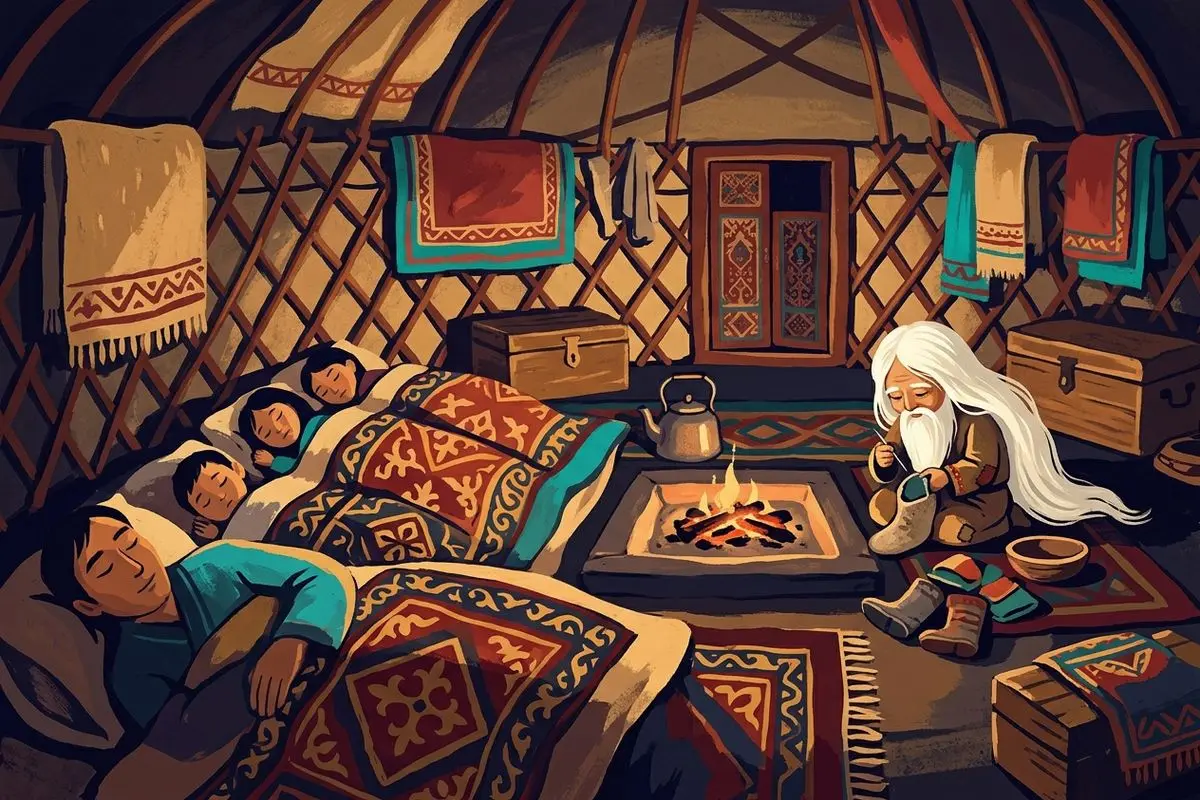
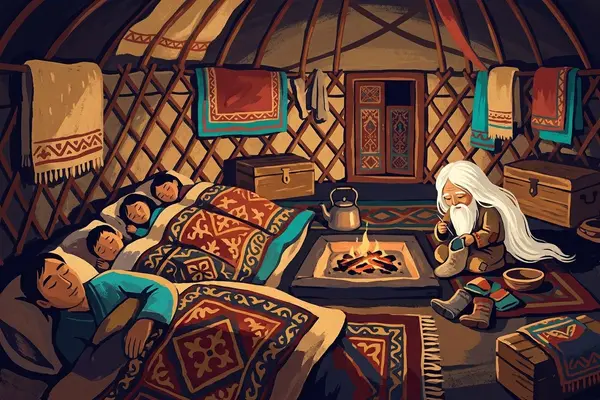
Night in a yurt: the family is asleep, and the gray-haired spirit-master of the home sits by the hearth
Illustration made by AI: Google Generative AI.

Chapter 8 of 10 · 1 min read

Ui Iesi, Master of the Home

Ui iesiThe master of the house, the guardian spirit of the home., the master of the home, is a spirit that watches over a house and protects it.

Among Turkic peoples, this invisible spirit could be imagined as an old man with long hair who comes out at night and works. There are female forms too. Among Kazakhs, it could appear as a little white snake. To keep it happy, people left out a small treat.

People believed that a good house spirit moves with the family to their new home.

For Kazakhs, the home was a special place, protected from anyone outside. The threshold of the yurtKiiz ui, the ancient home of nomads that can be taken apart and moved. was seen as a border and a shield against evil forces outside, so stepping on it was not allowed: you could break the border and let unfriendly spirits in. And in practical terms, the threshold could break, and that would be wasteful. That’s how learning to take care of things began.

Next The Yurt, Kiiz UiRandom legend
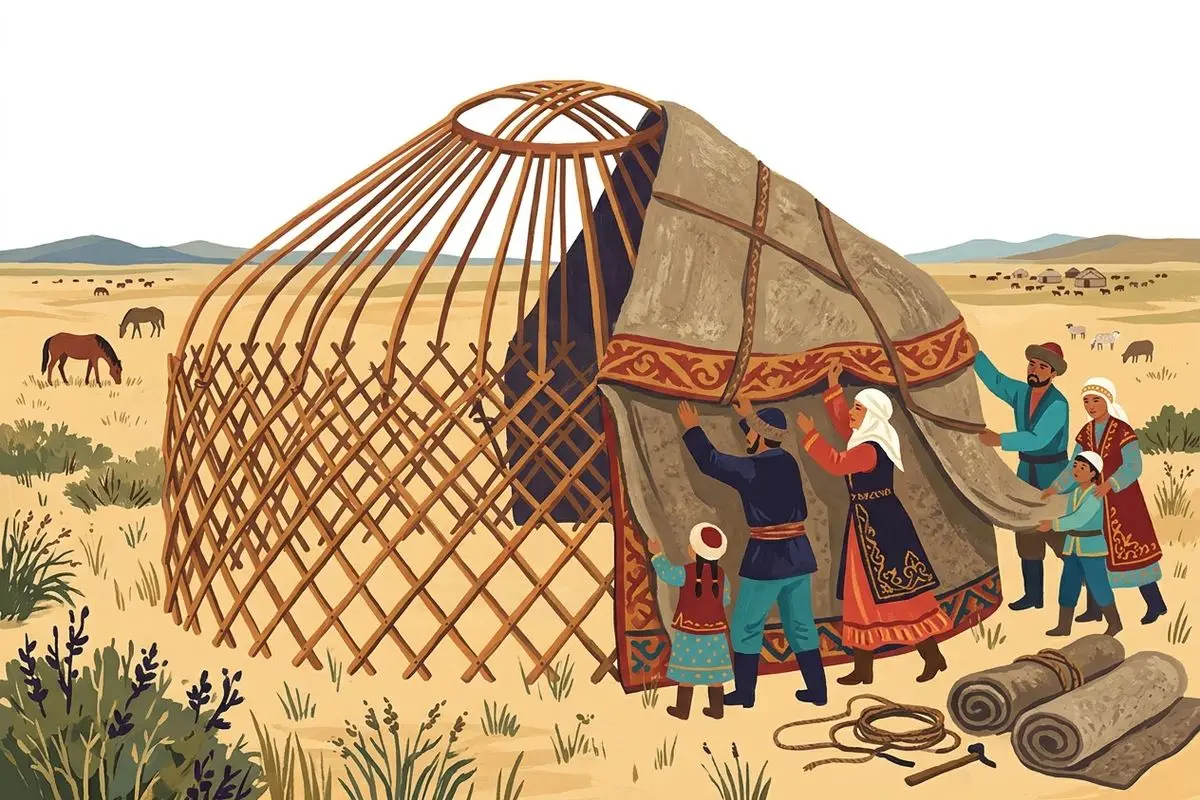
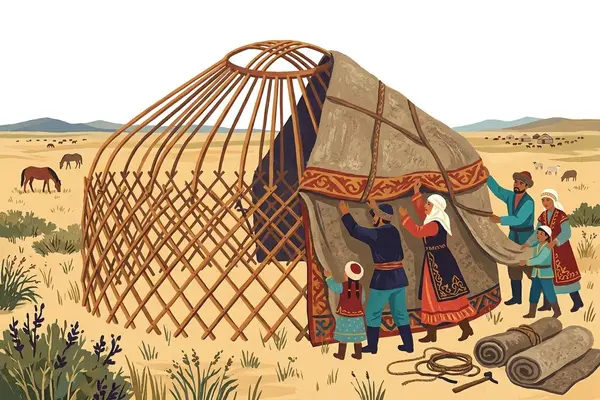
A family puts up a yurt: you can see the lattice walls, the dome poles and the shanyrak
Illustration made by AI: Google Generative AI.

Chapter 9 of 10 · 1 min read

The Yurt, Kiiz Ui

The yurtKiiz ui, the ancient home of nomads that can be taken apart and moved., or kiiz ui, is the ancient home of Turkic nomads, and it is easy to put up. It keeps in the warmth in winter and the cool in summer. It’s all thanks to the way it’s built and to the felt, which works like thermal fabric and protects against rain and snow.

What a yurt is made of:

  • keregeThe folding lattice walls of a yurt. — folding lattice walls; they are tied with rawhide straps called “kok”;
  • uykThe poles that form the dome of a yurt. — the poles that form the dome;
  • shanyrakThe ring at the top of a yurt’s dome, a symbol of family and home. — the ring at the top of the dome that holds the poles together;
  • ergenekThe little door into a yurt. — the entrance door;
  • koshmaThe felt that covers a yurt. — the felt that covers the whole structure.
Next ShanyrakRandom legend
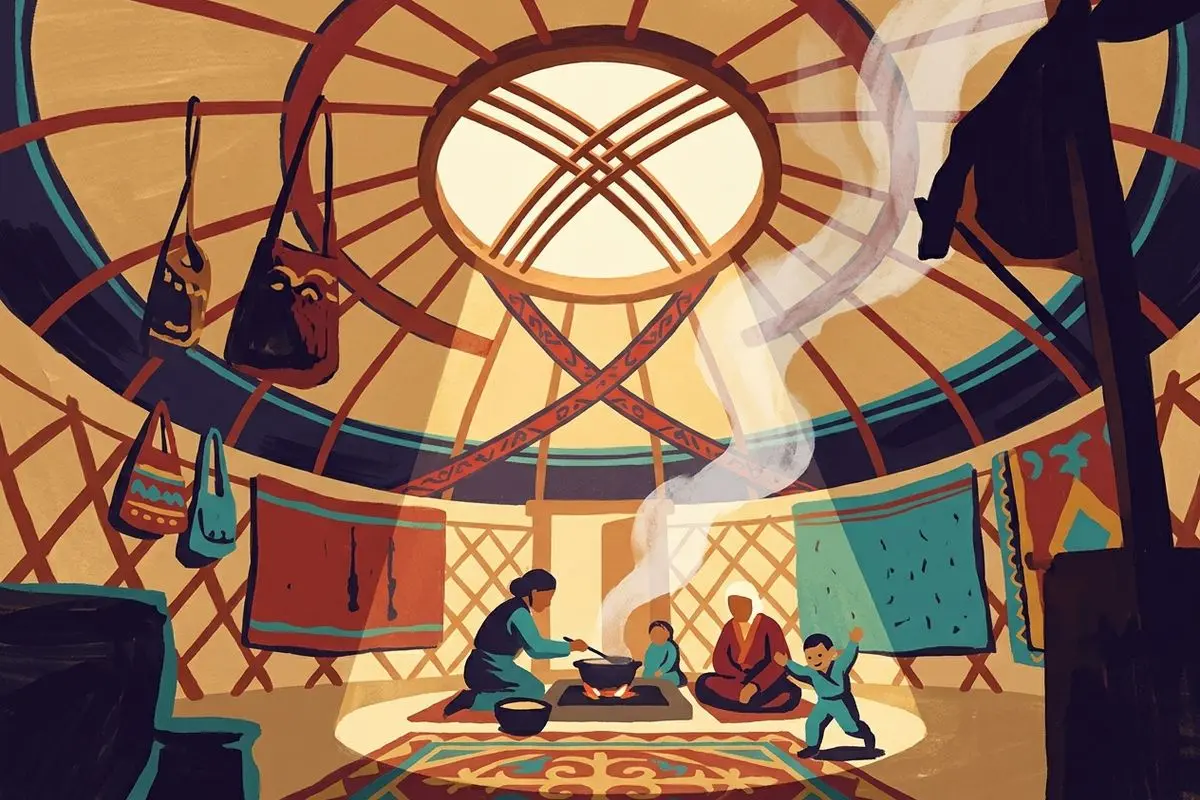
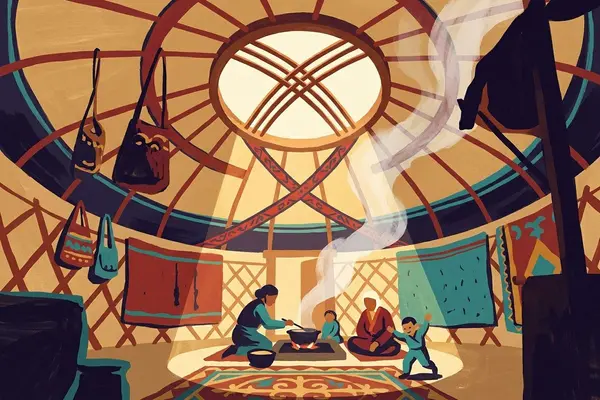
Looking up from inside a yurt at the shanyrak: a sunbeam falls through it and smoke rises out
Illustration made by AI: Google Generative AI.

Chapter 10 of 10 · 2 min read

Shanyrak

The shanyrakThe ring at the top of a yurt’s dome, a symbol of family and home. is more than just a ring at the top of a yurtKiiz ui, the ancient home of nomads that can be taken apart and moved.. It was useful in everyday life and was a family’s sacred treasure.

Useful in everyday life: you could tell the time by it, and it let smoke out from the hearth and let light in, yet the yurt didn’t heat up in hot weather the way a room with ordinary windows does.

A family’s sacred treasure: the shanyrak is the foundation of the home and the family, a symbol of unity and protection. It was a family heirloom, and no one was allowed to turn it upside down or drop it. The descendant who inherited it was called the shanyrak iesiMasters, the guardian spirits of places in nature.: they became the one who carried on and kept the family line.

When someone wishes you a high or big shanyrak, they are wishing you a happy, thriving family.

There are many rituals and superstitions connected with the shanyrak. You should handle it with care and keep it clean, and then all will be well at home.

Check yourself

Three questions about this section. Each answer shows where the story tells it.

1. What does the legend of Zhirensakal Mountain teach?
2. By custom, how should you treat fire?
3. When someone wishes you a high shanyrak, what are they wishing you?