Аңыз

Words with Secrets

Why is a rainbow a kempirkosak, money aksha and a bear aiu? Where did the words for dusk, gratitude and shame come from? Like legends, words can have several versions.

“Altyn alma, algys al!”: “Don’t take gold, take gratitude!”

Text by: Bekzada ISHEKENOVA, Dias KUMARBEKOV

A speaking person, a band of dots and a star above

In this section

  1. Why a Rainbow Is a KempirkosakLegend · 1 min
  2. Aksha and Tenge: Silver WordsHistory · 1 min
  3. Aiu: Why the Bear Is Called ThatHistory · 1 min
  4. Ainalaiyn: the Warmest WordLegend · 2 min
  5. Azhe: the EldestHistory · 1 min
  6. Baiterek and Baisheshek: “First” WordsHistory · 1 min
  7. Zhol: the Road That Leads to HappinessHistory · 1 min
  8. Inir and Tun: Words for EveningHistory · 1 min
  9. Algys: Gratitude Worth More Than GoldHistory · 1 min
  10. Uiat and Ot: Shame and FireHistory · 1 min
  11. Oshak: a Little Fire That Means “Home”History · 1 min
  12. Kus Zholy: the Road of BirdsLegend · 1 min
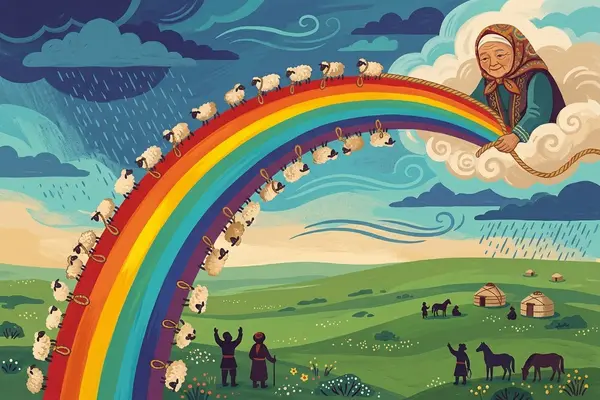
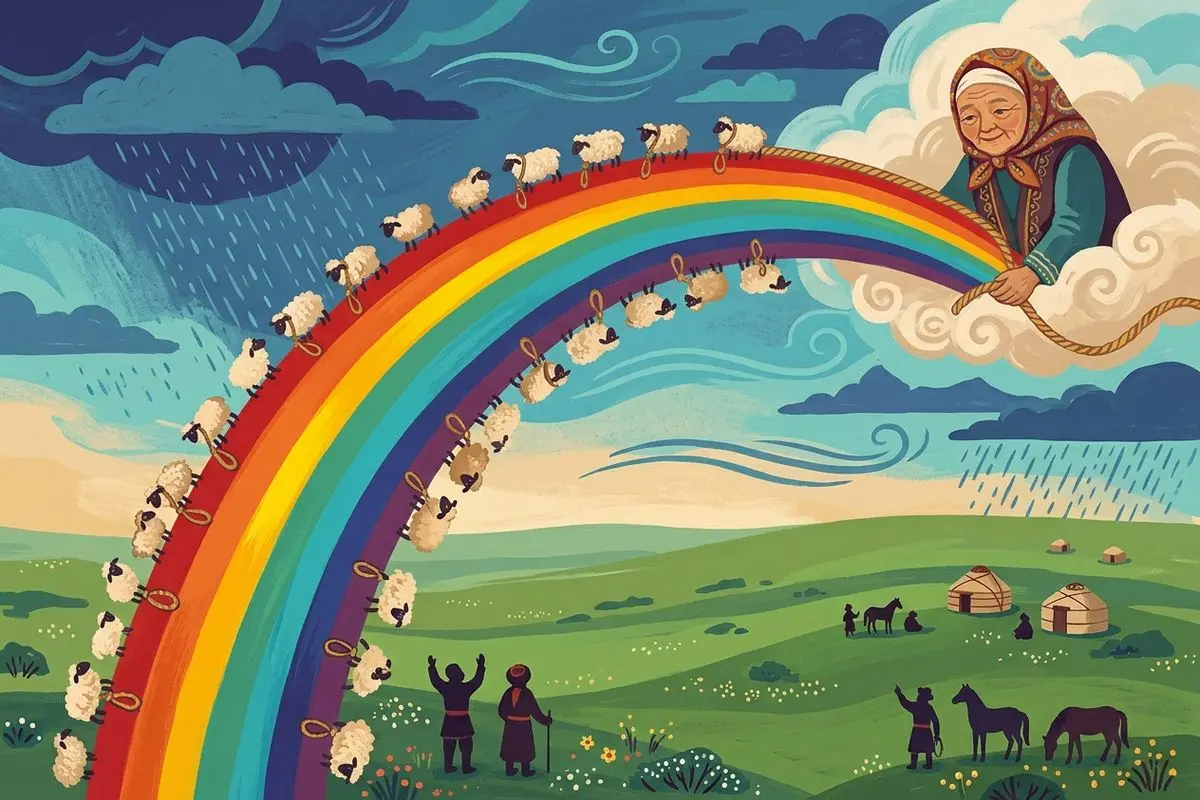
A rainbow over the green steppe with sheep tied along it in loops, a grandmother in the clouds holding the end of the rainbow, and shepherds below looking up at her
Illustration made by AI: Google Generative AI.

Chapter 1 of 12 · 1 min read

Why a Rainbow Is a Kempirkosak

In Kazakh a rainbow is called kempirkosak. Word for word it means “the old woman’s kosak”.

Shokan Valikhanov explained it in his work “Traces of Shamanism among the Kyrgyz”: a kosak is a rope to which sheep are tied with loops on both sides. A rainbow really does look like such an arc stretched across the whole sky. And a heavenly old woman holds it.

According to beliefs, other people live in the sky too. Valikhanov wrote that we, the inhabitants of the middle world, wear a belt around the middle. Heavenly people wear the belt under the throat, and people of the underworld wear it on their legs.

Next Aksha and Tenge: Silver WordsRandom legend
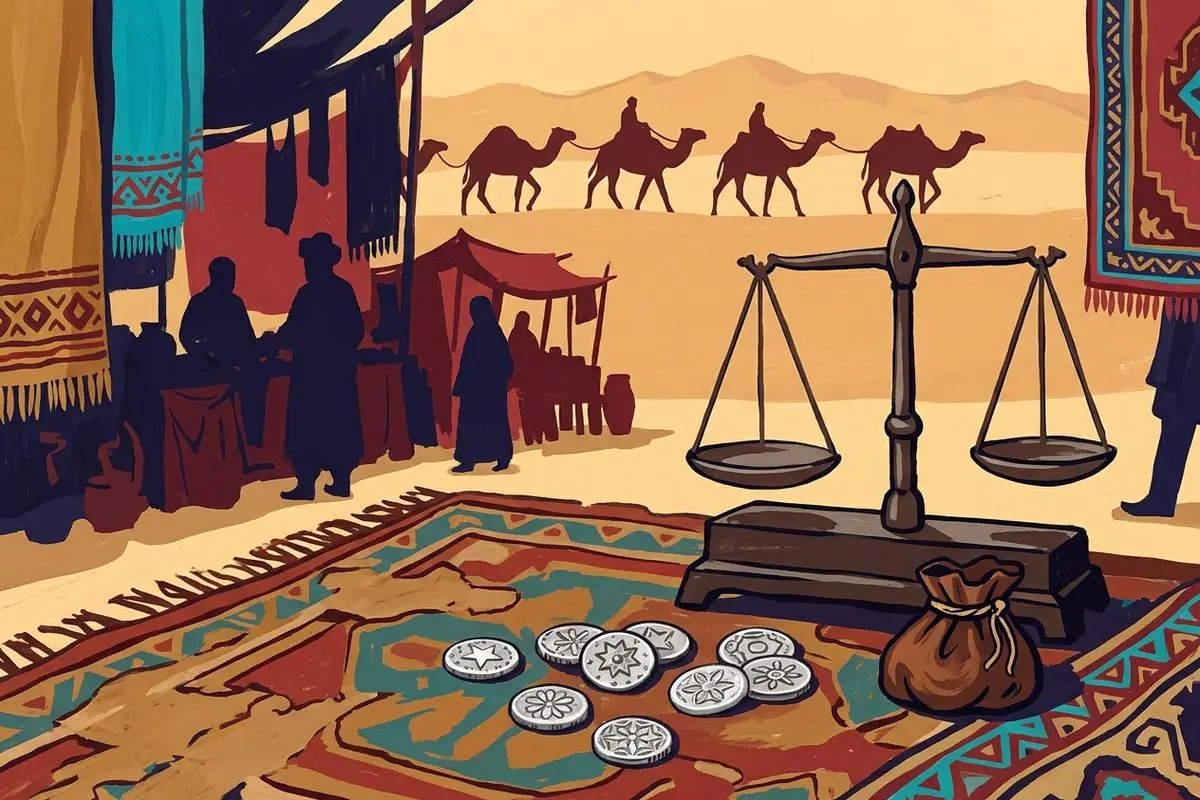
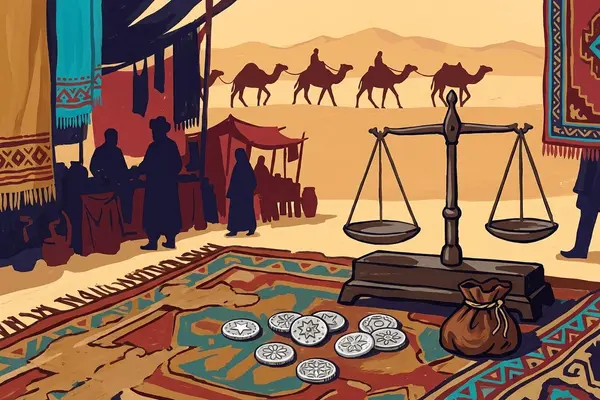
Silver coins with patterns on a rug, scales and a leather pouch beside them, and a camel caravan passing behind the bazaar
Illustration made by AI: Google Generative AI.

Chapter 2 of 12 · 1 min read

Aksha and Tenge: Silver Words

Money in Kazakh is aksha. The word hides ak, “white”. And this is no accident.

In the records of the Golden Horde and the Kipchaks, aksha already meant “money”. Among neighbouring Turkic peoples the word was used for a silver coin: in the Ottoman Empire a small silver coin was called akce, and in the Crimean Khanate it was akcha. Silver is white, after all. Aksha is a native Turkic word that replaced the Arabic word “dirham”.

The name of Kazakhstan’s currency, tenge, is also linked to a silver coin. The linguist Marlen Adilov says that in the Middle Ages a silver coin was called tenke. And according to one version, the Turkic word tenge also gave rise to the Russian word “dengi”, money.

Next Aiu: Why the Bear Is Called ThatRandom legend
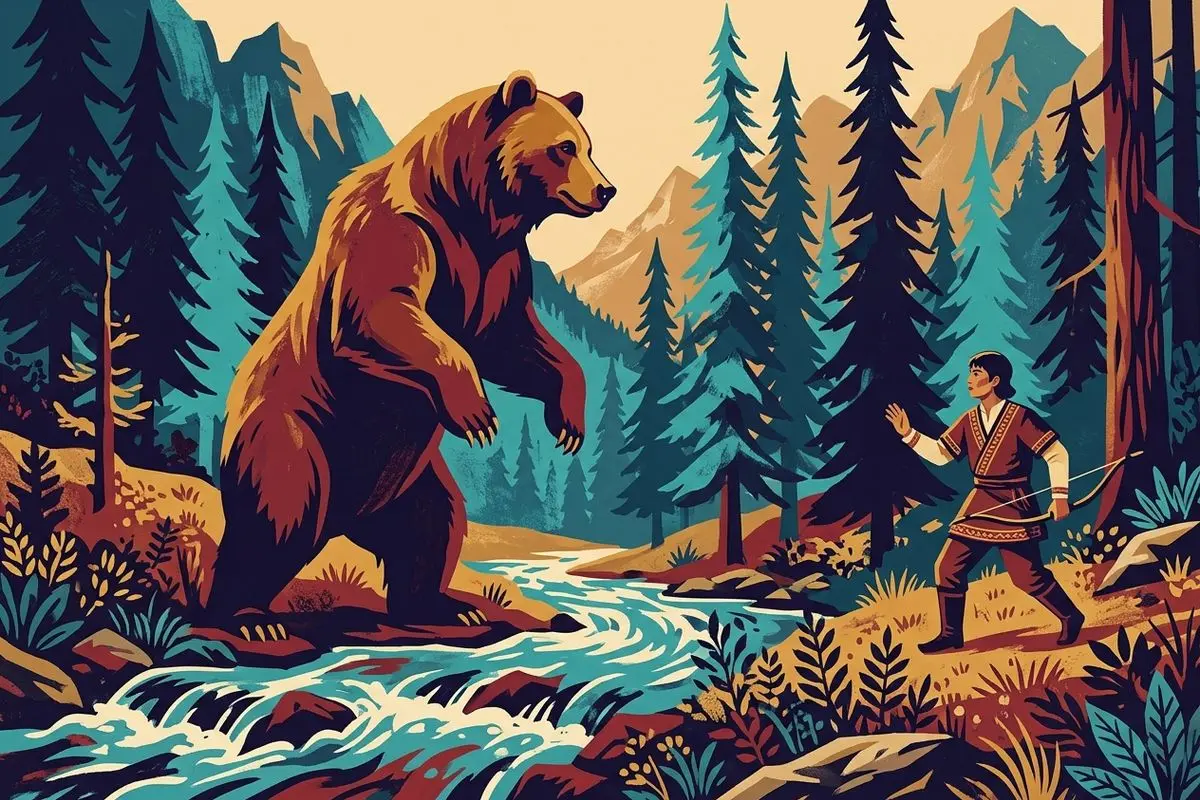
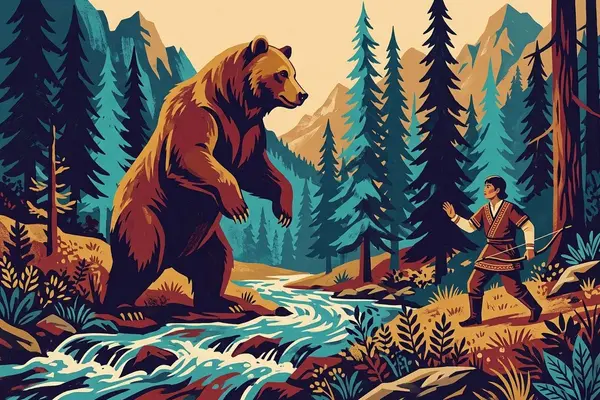
A big brown bear stands on its hind legs by a mountain stream in a spruce forest, and a young hunter with a bow carefully steps back
Illustration made by AI: Google Generative AI.

Chapter 3 of 12 · 1 min read

Aiu: Why the Bear Is Called That

A bear in Kazakh is aiu. It sounds cute, but its meaning is not cuddly at all.

In many Turkic languages the word appears as aiuv, aiyg, aiyv, azyg, adyg. In ancient written records aiyg meant “angry, furious”, and aiyn meant “terrible, dangerous”.

Similar words are still alive today: in Tuvan aiyyldyg means “dangerous”, and in Khakas aidas means “strong, big, powerful”. So it turns out our ancestors simply named the bear “the Dangerous One”.

Next Ainalaiyn: the Warmest WordRandom legend
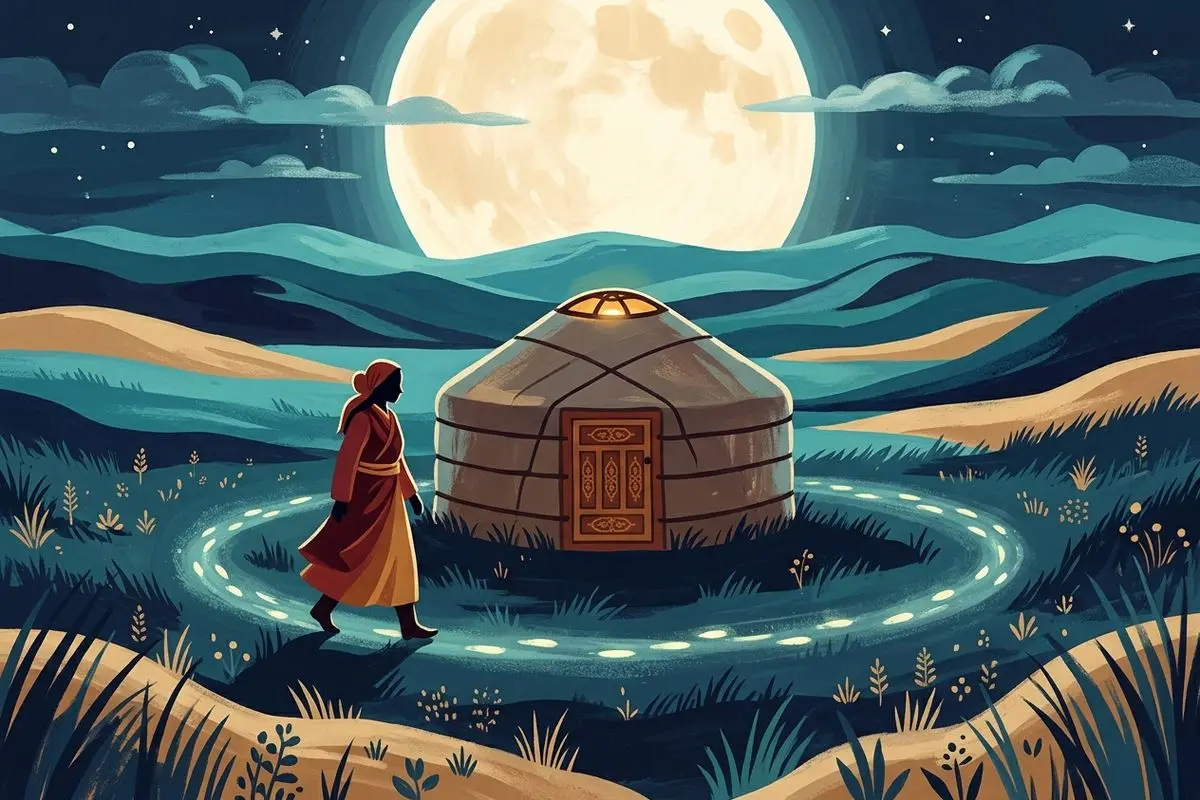
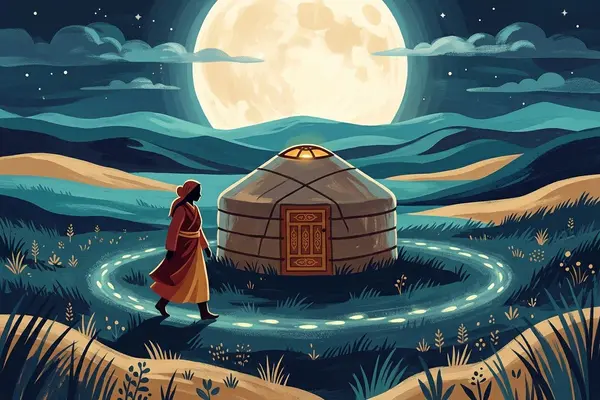
Night and a full moon: a mother walks in a circle around the yurt where her child sleeps, and her path glows on the grass
Illustration made by AI: Google Generative AI.

Chapter 4 of 12 · 2 min read

Ainalaiyn: the Warmest Word

Ainalaiyn is one of the tenderest Kazakh words. It is what people call a child or a loved one. It is hard to translate with one word. Where did it come from? There are different explanations.

Which version do you like better? Both say the same thing: I wish you health and happiness.

Next Azhe: the EldestRandom legend
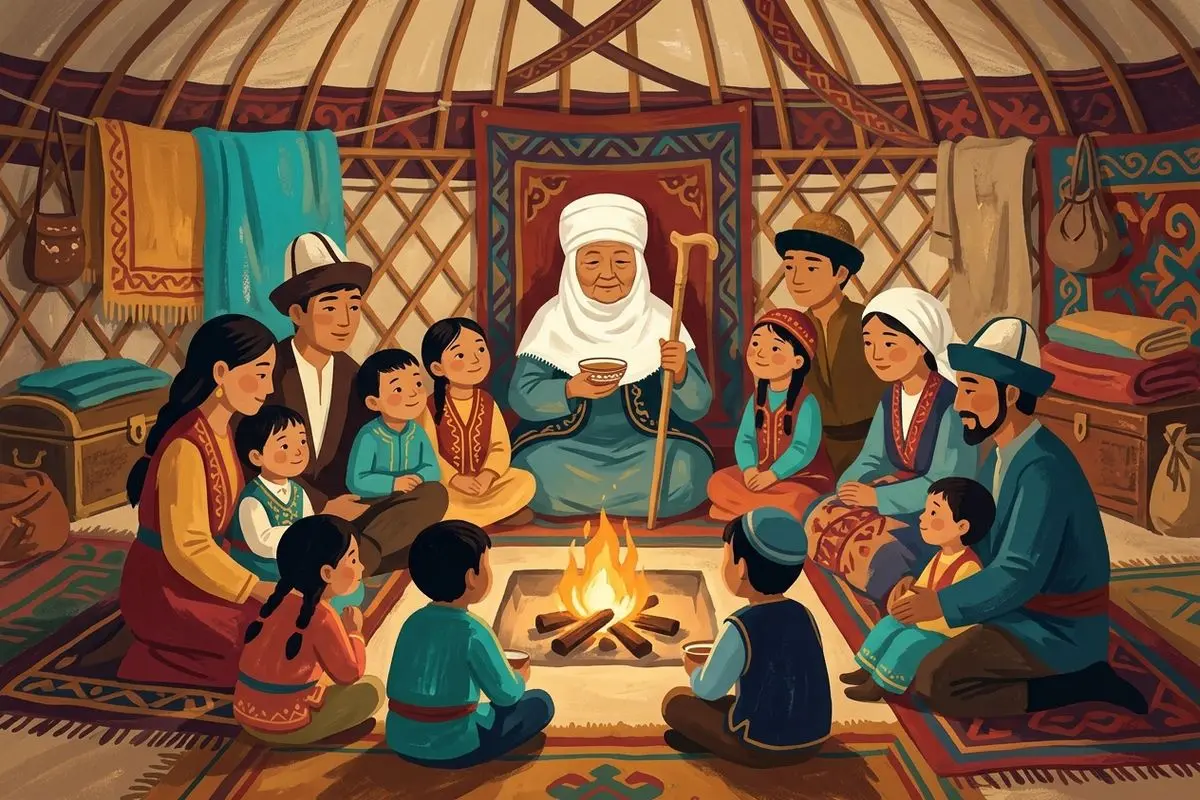
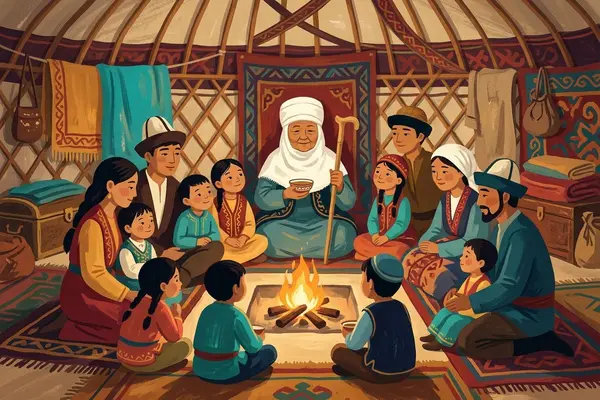
A grandmother in a white headdress, with a staff and a cup, sits in a yurt at the center of a big family by the hearth
Illustration made by AI: Google Generative AI.

Chapter 5 of 12 · 1 min read

Azhe: the Eldest

Grandmother in Kazakh is azhe. The word has a very old history.

The mythologist Serikbol Kondybai wrote that azhe means “the eldest of the women in a family”, “the father’s mother”. And azha is the respected head of a family, an aul or a clan.

In the dictionary of Mahmud Kashgari, an 11th-century scholar, there are related Old Turkic words: eshe, “elder mother”; ashy, “elderly woman”; ishi, “first mother”; age, “elder sister, elder mother”.

So in Kazakh a grandmother is not just an old woman but the eldest one, with whom everything in a family begins.

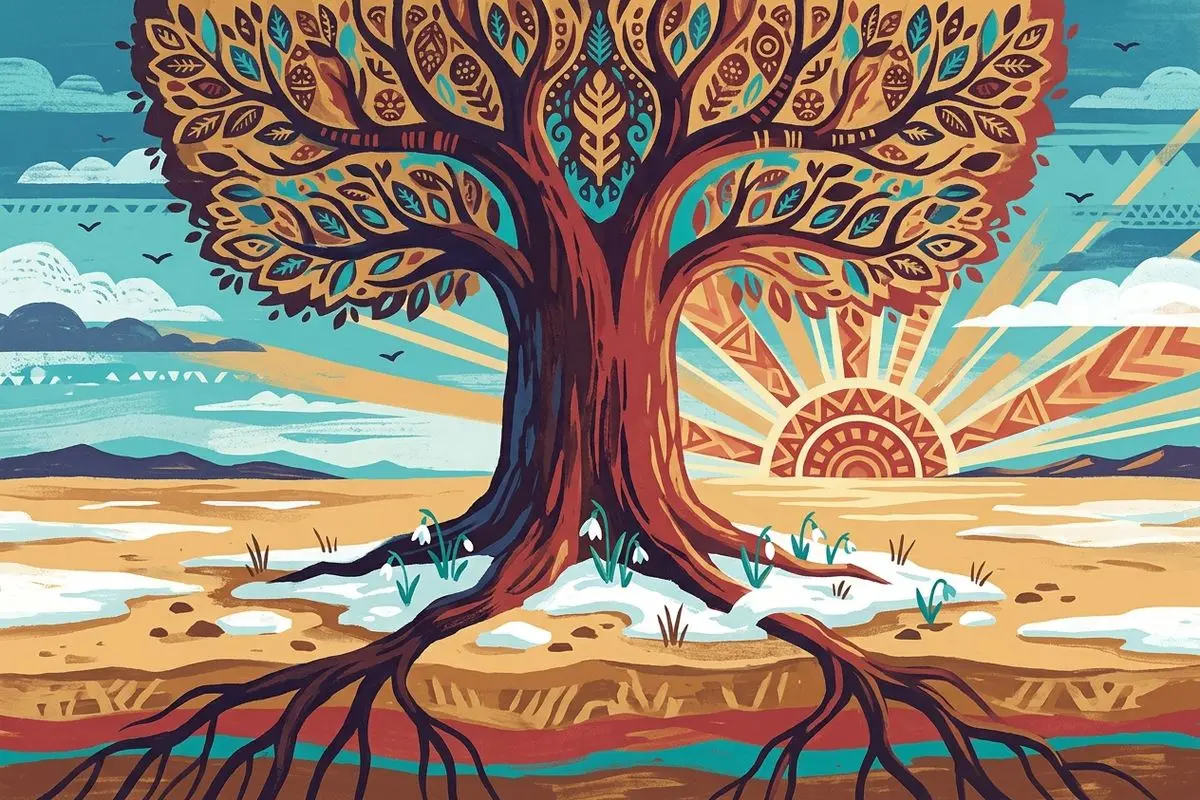
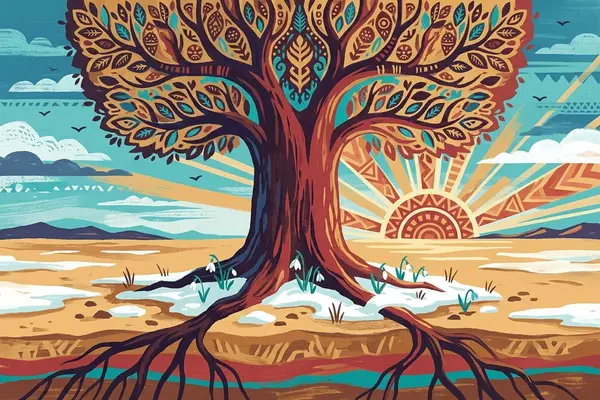
A huge patterned tree with roots in the earth, snowdrops blooming in the melting snow at its foot, and the sun rising behind it
Illustration made by AI: Google Generative AI.

Chapter 6 of 12 · 1 min read

Baiterek and Baisheshek: “First” Words

In Kazakh legends the world tree is called BaiterekThe world tree, the tree of life where all the worlds meet. In Kazakh, it’s also a word for a poplar tree.. Why?

Bai means “ancient, original, first, great”. And terek is linked to the word tirig, “giving life”; it is also the word for a tree. So Baiterek is “the great tree of life”, “the first tree”.

The same bai is in the word baisheshek, the snowdrop. It is spring’s “first flower”: sheshek used to mean “flower”.

Next Zhol: the Road That Leads to HappinessRandom legend
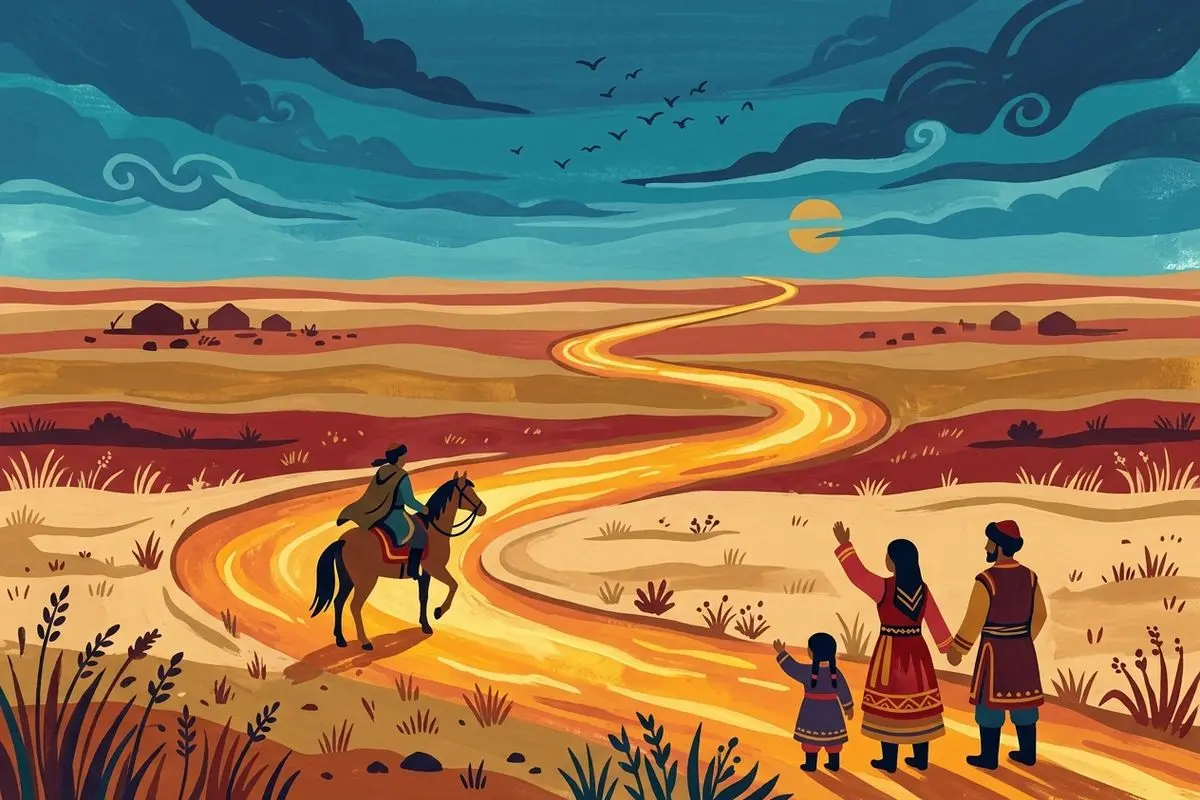
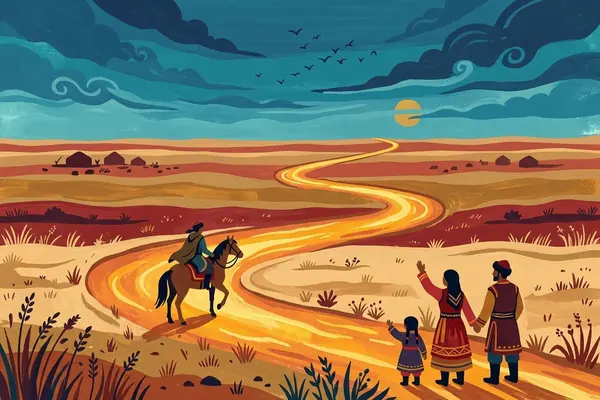
A rider sets off along a winding golden road across the steppe, and a family waves goodbye
Illustration made by AI: Google Generative AI.

Chapter 7 of 12 · 1 min read

Zhol: the Road That Leads to Happiness

Road in Kazakh is zhol. It is a very old word: it already existed in Proto-Turkic, the language spoken by the ancestors of all Turkic peoples.

Scholars compare it with a Mongolian word that sounds similar and means “happiness”. However, Wiktionary cautiously notes that the Mongolian word is most likely borrowed.

Remember how Kazakhs wish someone luck: “Zholyn bolsyn!”, “May you have a road!”

Next Inir and Tun: Words for EveningRandom legend
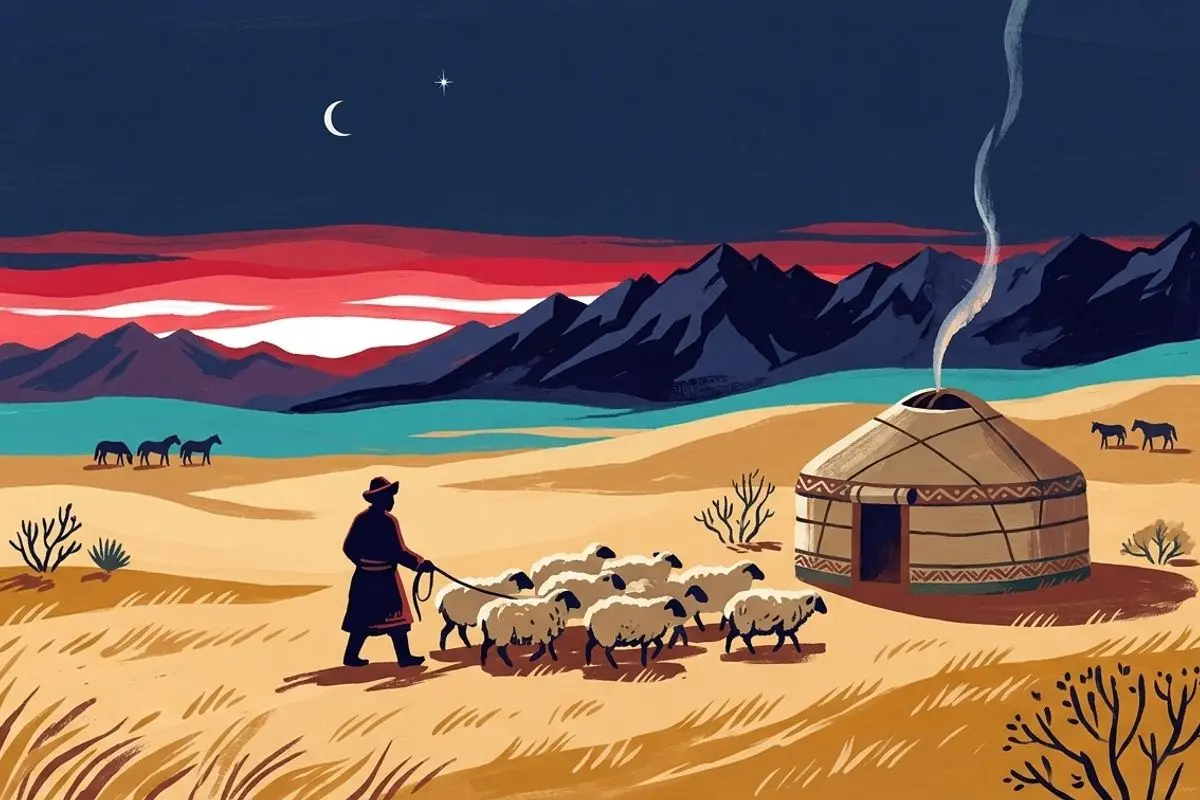
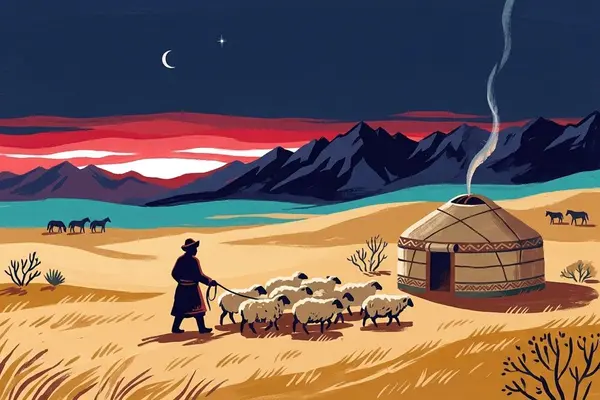
Dusk: the sun has set behind the mountains, red and white bands glow on the horizon, a crescent moon and a star shine in the dark sky, and a shepherd drives sheep to a yurt
Illustration made by AI: Google Generative AI.

Chapter 8 of 12 · 1 min read

Inir and Tun: Words for Evening

Kazakh has many words for evening. Here are two of them.

Inir is the time when the sun has already set but its red light has not yet faded. It is also called kyzyl inir or “the time between white and red”. But the scholar A. Nurmagambetov noticed that in Tuvan imir means “fog, haze”. Perhaps at first inir simply meant “darkness”.

Tun means night. Scholars have several opinions about it. Nurgeldi Uali compares it with Mongolian words: soni, “night”, and sonebe, “gone out”. In Turkic languages the sounds “s” and “t” often swap: mouse is sychkan in Tatar and tyshkan in Kazakh. According to another opinion, tun grew from the Old Turkic verb “tu”, “to close, to block”.

Next Algys: Gratitude Worth More Than GoldRandom legend
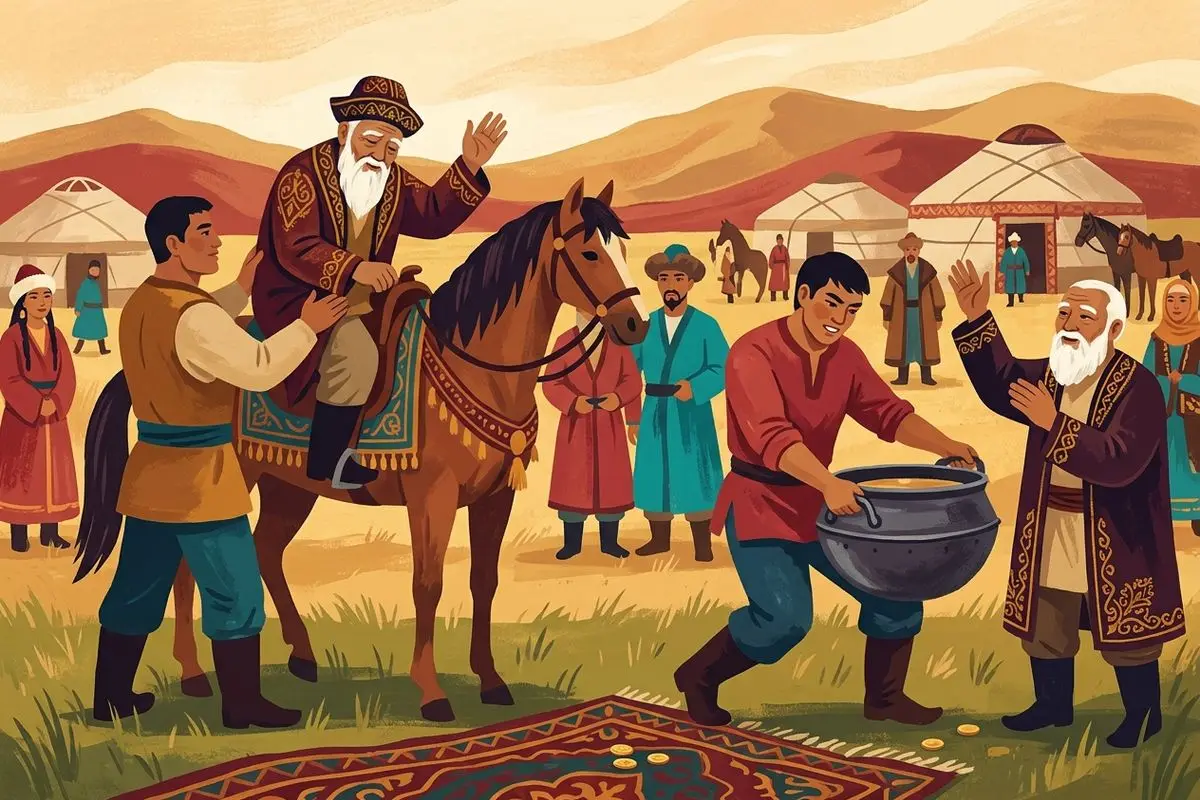
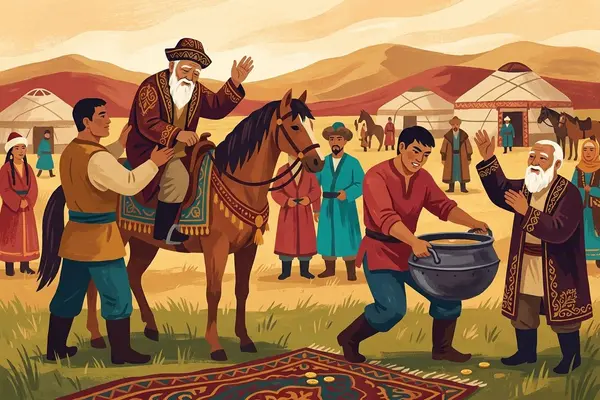
At a festival young men help the elders: one helps an old man onto his horse, another carries a heavy cauldron, the elders thank them, and forgotten coins lie on a rug
Illustration made by AI: Google Generative AI.

Chapter 9 of 12 · 1 min read

Algys: Gratitude Worth More Than Gold

Algys means gratitude. In Old Turkic the word meant “praise, a good wish”. People believed that gratitude helps to get rid of evil.

In Kazakh custom algys is first of all thanks to a person for a good deed, an honest recognition of what they did. Young people tried to earn algys from their elders: at celebrations young men helped the old and received wishes of strength and happiness in return.

Over time the word bataA blessing spoken by elders., blessing, came to stand beside algys. But algys did not disappear.

Next Uiat and Ot: Shame and FireRandom legend
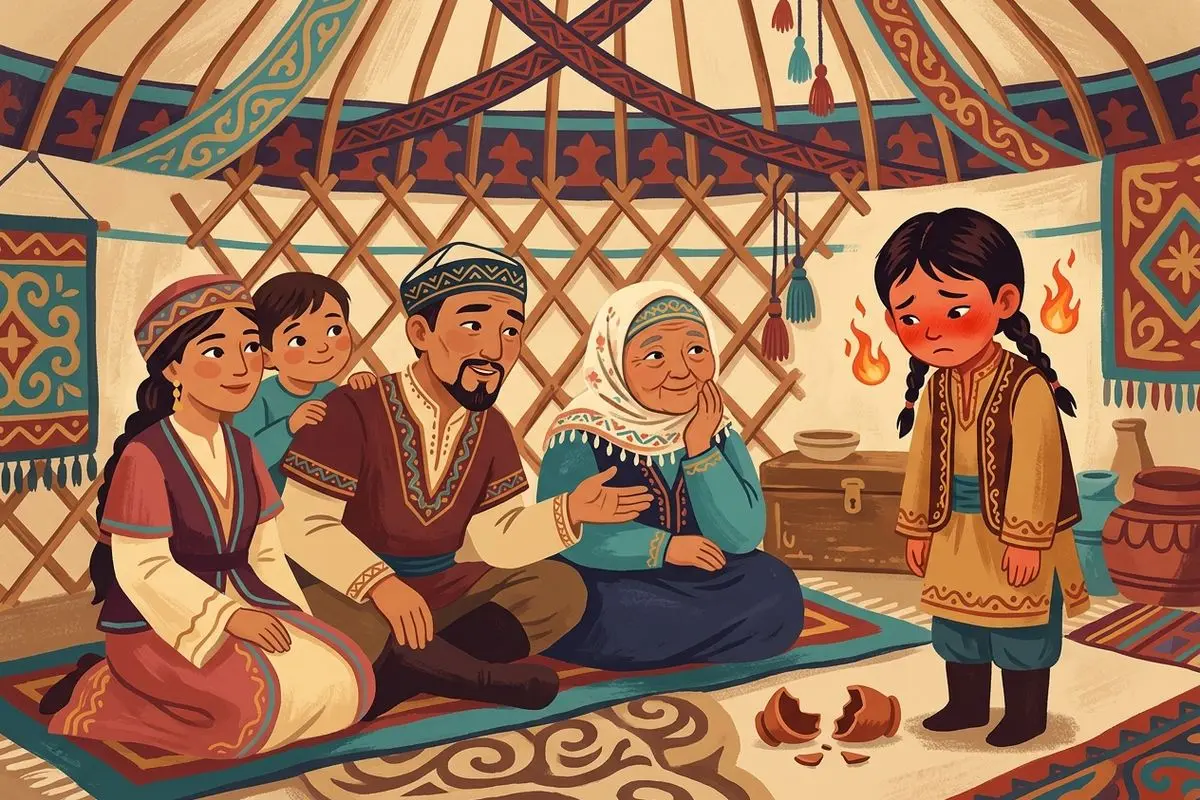
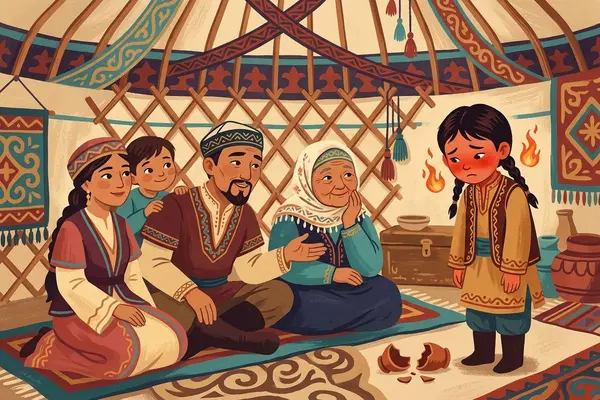
A girl with cheeks burning with shame stands by a broken cup with little flames by her face, and her family looks at her calmly and kindly
Illustration made by AI: Google Generative AI.

Chapter 10 of 12 · 1 min read

Uiat and Ot: Shame and Fire

Uiat in Kazakh means “shame”. Scholars argue about where the word came from.

Professor Kudaibergen Zhubanov believed it grew from an ancient root, uia.

And the scholar Abduali Kaidar noticed that uiat and ot, “fire”, may come from the same root. But ot here is not the fire in the hearth. In old Kipchak records ot or ut meant exactly “shame”.

This meaning still lives in the expression betinen oty shykty, literally “fire came out of the face”. People say it when someone is very ashamed and their face is burning.

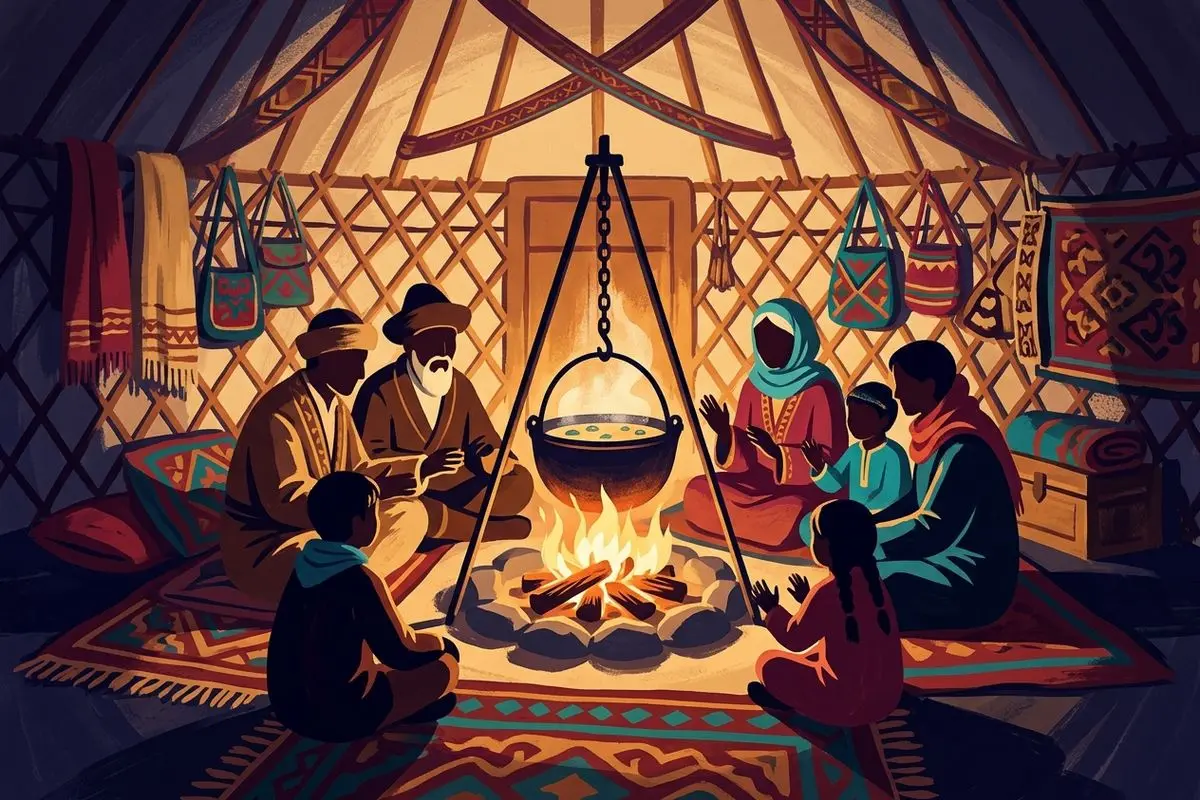
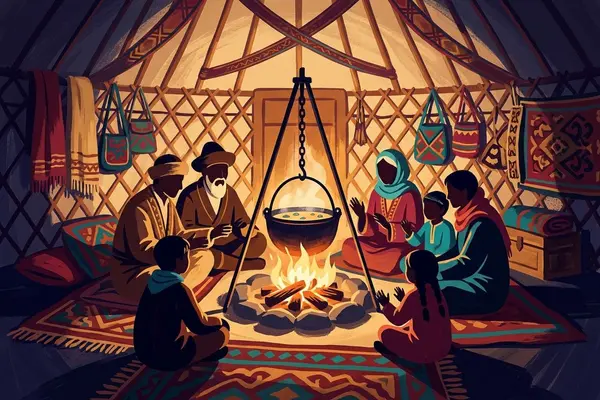
Evening in a yurt: a cauldron hangs over the fire on a tripod, and the family sits around the hearth
Illustration made by AI: Google Generative AI.

Chapter 11 of 12 · 1 min read

Oshak: a Little Fire That Means “Home”

The Russian word “ochag”, hearth, came from Turkic languages, from oshak.

At first oshak meant a hearth or a stand from which a cauldron hangs. Later the word came to mean home, family, household. If people say someone’s oshak was struck, it means trouble came to the home itself.

Fire in Kazakh is ot. The words oshak and ot sound alike, and not by chance: the fire in the hearth is the heart of the home.

Next Kus Zholy: the Road of BirdsRandom legend
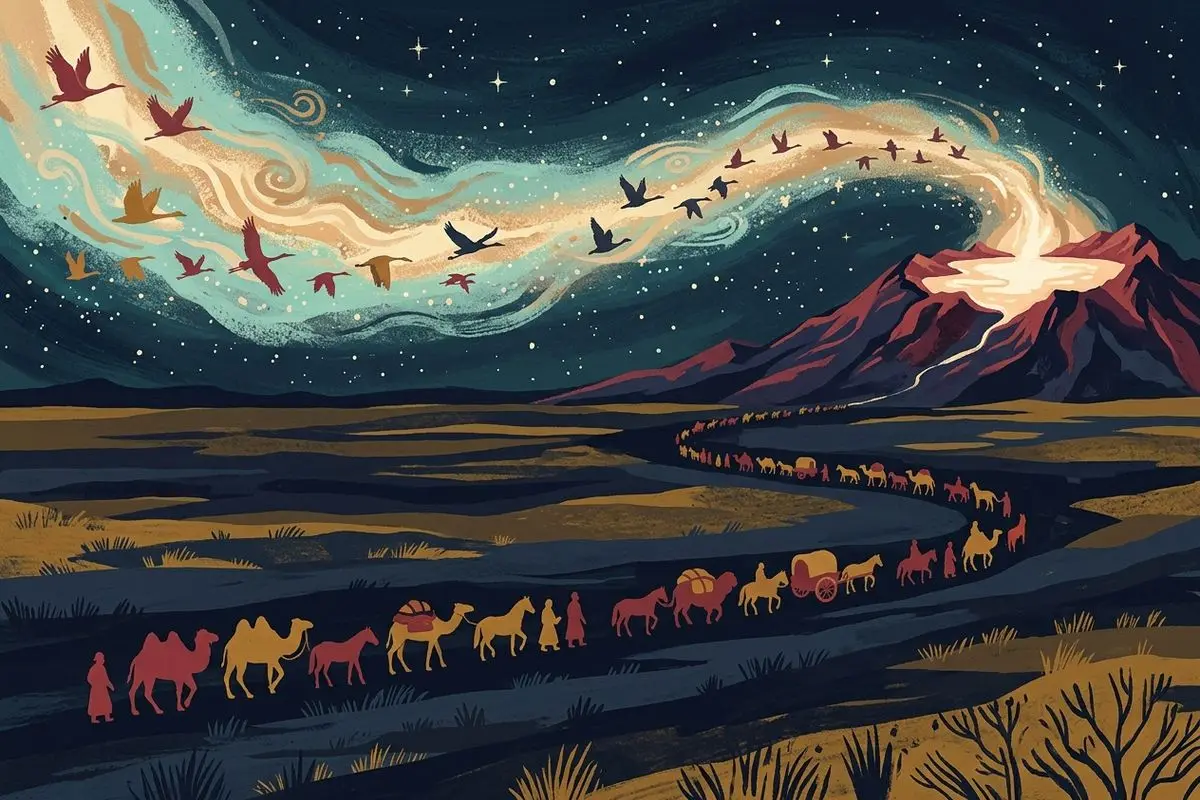
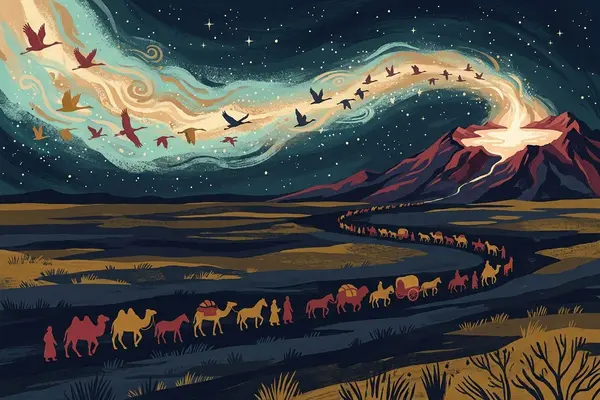
The Milky Way glows across the night sky, cranes, swans and geese fly along it, a lake shines on a mountain top, and a caravan moves across the steppe below
Illustration made by AI: Google Generative AI.

Chapter 12 of 12 · 1 min read

Kus Zholy: the Road of Birds

Kazakhs call the Milky Way Kus zholy, “the road of birds”.

The legend says that TengriThe supreme god of the sky. girded the sky with his belt to show the birds their way. In autumn they fly along it to the south, and in spring they come back.

The myth collector O. Zhanaidarov adds that the Milky Way flows into Sutti kol, “the lake of milk”, on top of the world mountain. And over time Kus zholy also came to be called Kosh zholy, “the road of nomad migrations”.

Next Check yourselfRandom legend

Check yourself

Three questions about this section. Each answer shows where the story tells it.

1. According to Shokan Valikhanov, what does kempirkosak mean?
2. Which word hides inside aksha?
3. According to the legend, how did the Milky Way get the name Kus zholy?