Аңыз

Where Legends Live

Lakes, mountains, springs, caves and trees of Kazakhstan that have their own legends: Burabay, Balkhash, Shaitankol, Akbet, the Singing Dune and more.

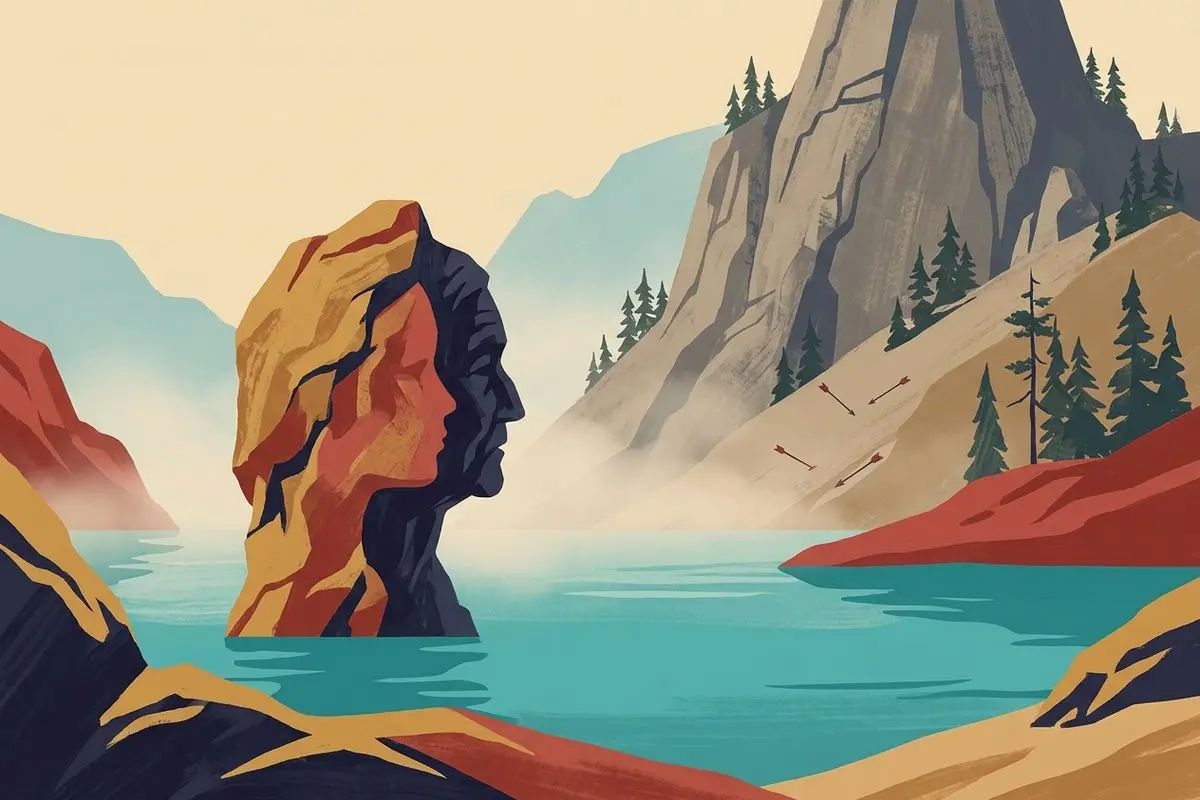
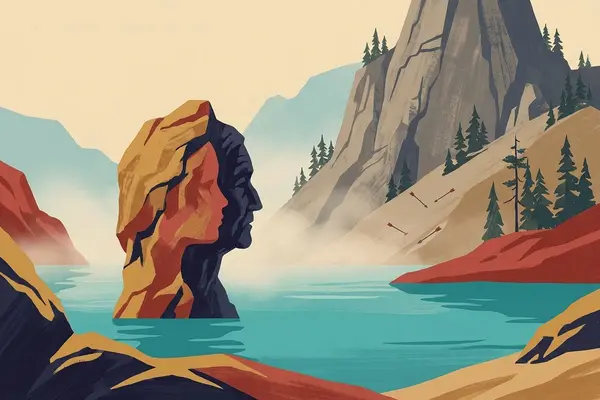
They say the Zhumbaktas rock looks like an old woman from one side and like a girl from the other.

Text by: Bekzada ISHEKENOVA, Dias KUMARBEKOV

Map of legends

A mountain above the waves, a tree, stars and a person with raised arms

In this section

  1. The Dancing Birches of BurabayLegend · 2 min
  2. Zhumbaktas, the Riddle RockLegend · 3 min
  3. Akbet and the Seven BrothersLegend · 2 min
  4. Shaitankol and the Mistress of the LakeLegend · 2 min
  5. Balkhash, Ile and KaratalLegend · 2 min
  6. Konyr Aulie CaveLegend · 1 min
  7. Tolagai, the Mountain on a Batyr’s ShouldersLegend · 2 min
  8. Almasai: Where the Old Horse LedLegend · 2 min
  9. Ertis: the Owl LetterLegend · 3 min
  10. Manyrak: the Mountain Where a Sheep BleatedLegend · 2 min
  11. Tamshybulak, the Tears of the EarthLegend · 2 min
  12. Auliegash, the Tree from a StaffLegend · 1 min
  13. The Singing DuneLegend · 2 min
  14. Kokkol: Who Is Roaring in the Lake?Legend · 1 min
  15. The Aisha Bibi MausoleumLegend · 2 min
  16. Kelinshektau, the Sleeping BeautyLegend · 2 min
  17. Mangystau: a Land of a Thousand Winter Camps or of a Dragon?Legend · 2 min
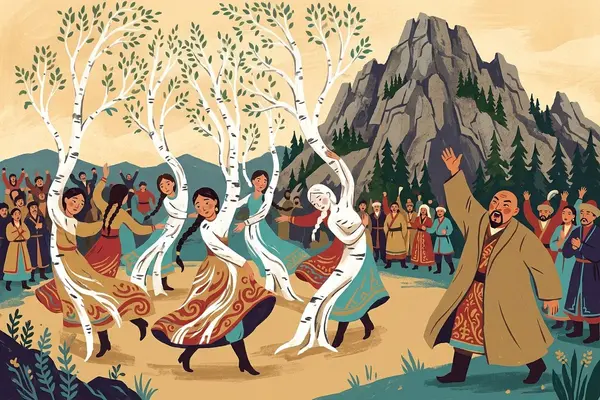
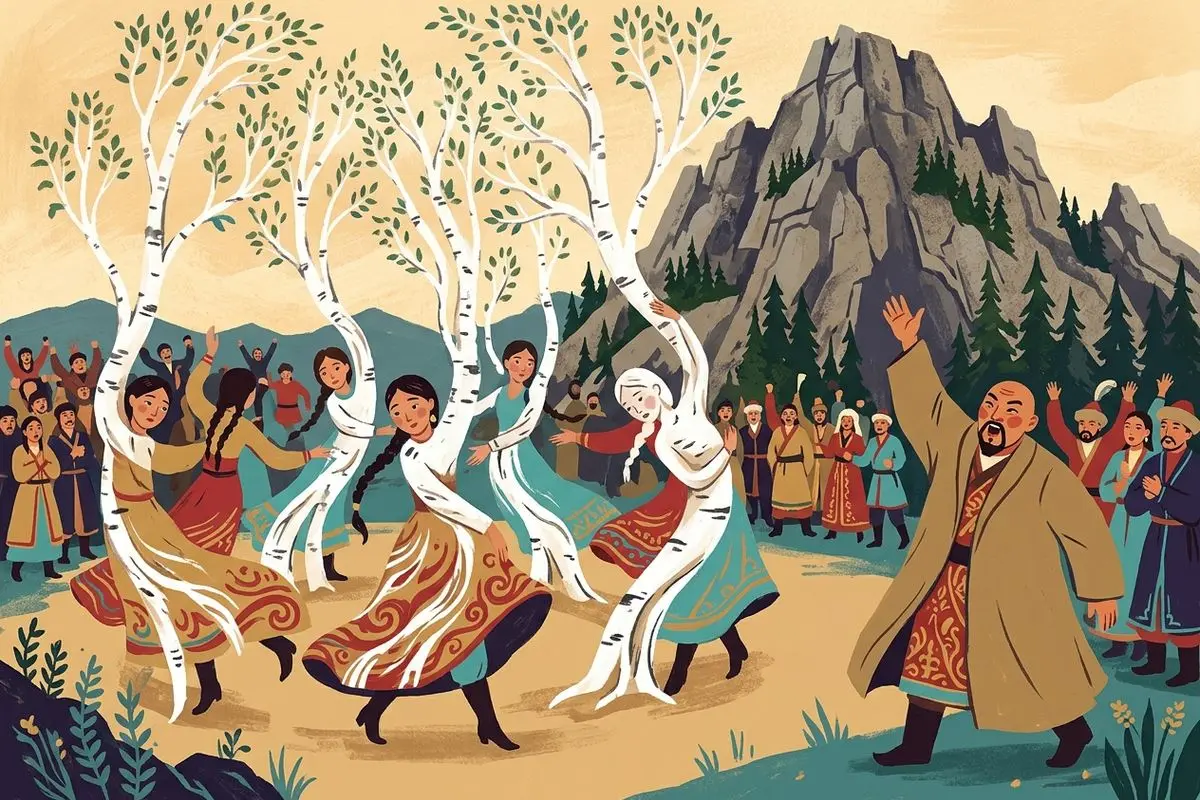
A festival by a granite mountain: dancing girls turn into white birches with curved trunks, a man in a plain robe raises his hand, people cheer around them
Illustration made by AI: Google Generative AI.

Chapter 1 of 17 · 2 min read

The Dancing Birches of Burabay

In Burabay National Park in the Akmola Region there is a grove of birches with curved trunks. The trees look as if they froze in the middle of a dance. That is why it is called the grove of dancing birches.

The legend says that at the foot of the mountain lived people who held merry festivals with songs and dances. Once the khan wanted to see such a toi. He was afraid that people would feel shy in front of him and stop having fun, so he dressed as an ordinary man and came unnoticed.

At the height of the festival, girls ran out into the clearing, each more beautiful than the last. The khan forgot that he was hiding and exclaimed: “Long life to your beauty!” The girls recognised the khan, felt shy and froze on the spot. And so they turned into white birches.

The khan’s wish came true: their beauty has lived for many, many years.

A rock in the turquoise bay of a mountain lake: on one side it has the profile of a girl, on the other a dark profile; fallen arrows lie on the slope of a tall mountain
Illustration made by AI: Google Generative AI.

Chapter 2 of 17 · 3 min read

Zhumbaktas, the Riddle Rock

In the middle of Lake Burabay, in the Blue Bay, the Zhumbaktas rock rises from the water. Its name means “riddle rock”. It looks different from every side: sometimes like the profile of an old woman, sometimes like the profile of a girl. Several legends are told about it.

Both stories are legends, not a description of events. But you can still see the tall Okzhetpes mountain above the lake and the rock in the bay today.

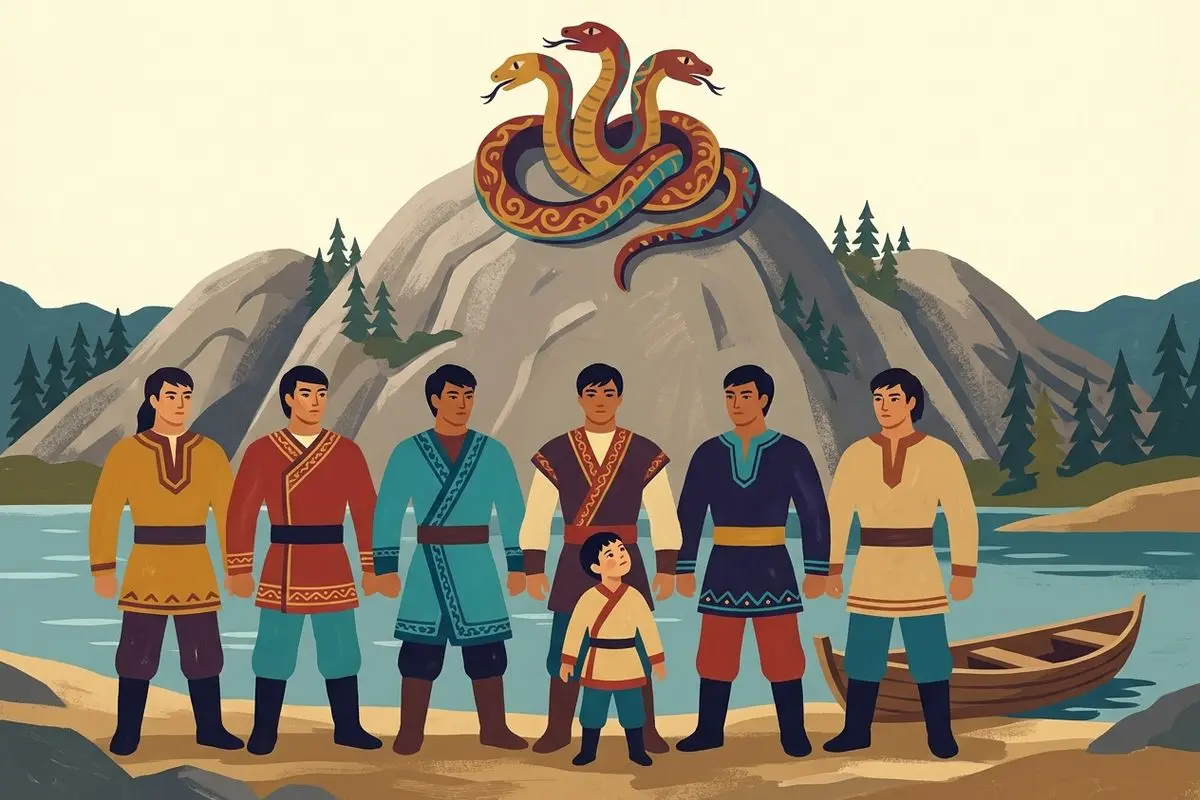
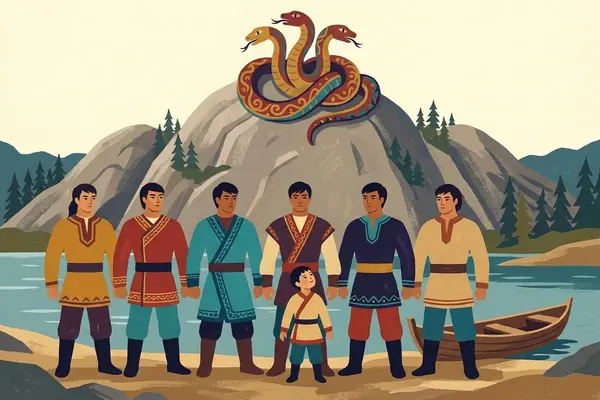
Seven brothers, six young men and a boy, stand on the shore of a mountain lake by a boat, and a three-headed serpent is coiled on top of the granite mountain
Illustration made by AI: Google Generative AI.

Chapter 3 of 17 · 2 min read

Akbet and the Seven Brothers

Akbet is the highest peak of the Bayanaul Mountains in the Pavlodar Region: it is 1,022 metres high. Lake Toraigyr lies at its foot. Three legends are told about Akbet.

There is also a third, sad legend about a girl named Akbet and the batyrA hero. The title was usually given by the people themselves. Zhalantos, who were parted. All three stories were told by the teacher and local historian Nina Kotlyarova.

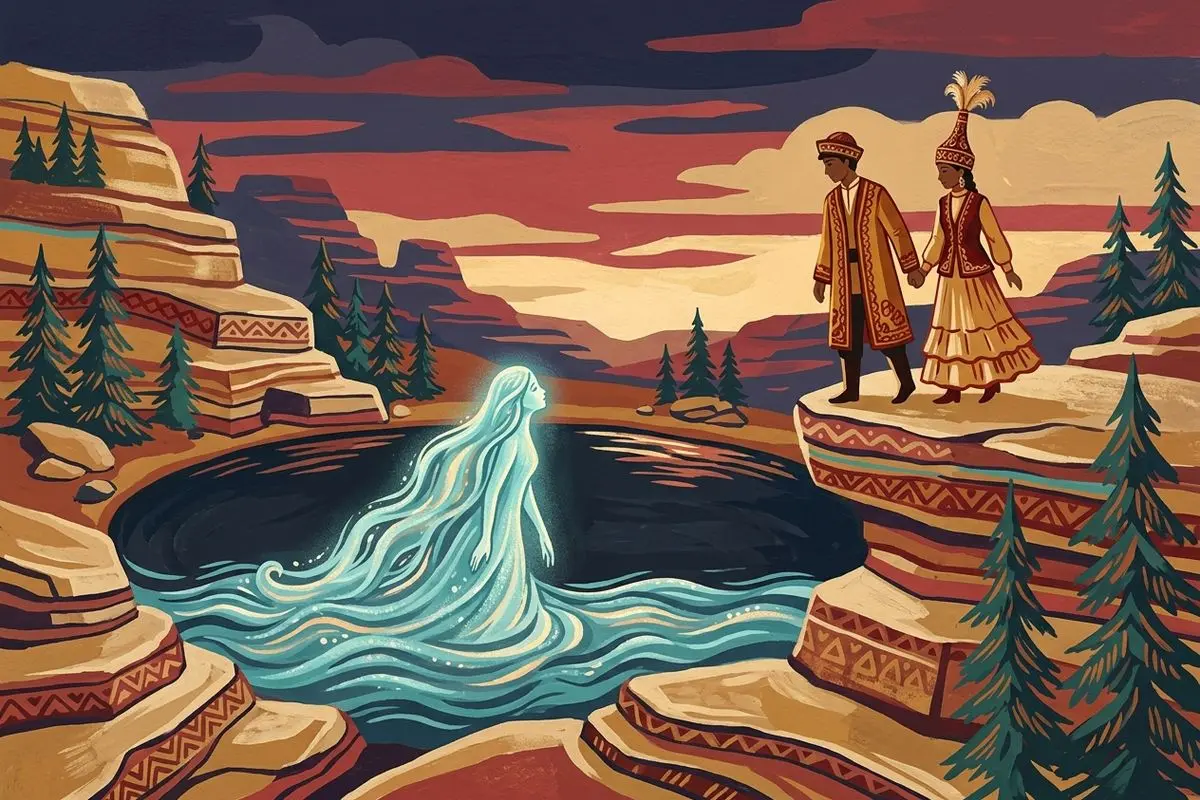
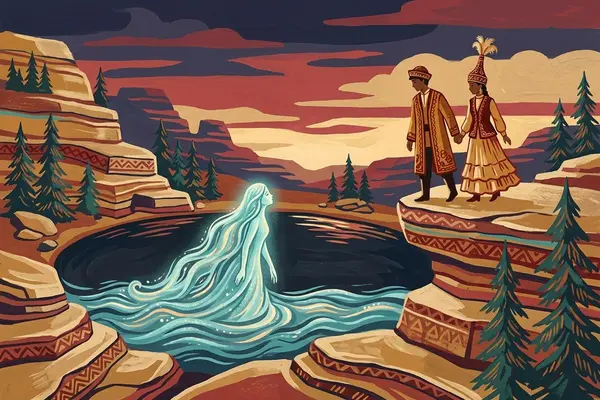
A dark lake among layered rocks and pines at sunset: the bright mistress of the lake rises from the water, and a young man and a young woman stand hand in hand on a rock above her
Illustration made by AI: Google Generative AI.

Chapter 4 of 17 · 2 min read

Shaitankol and the Mistress of the Lake

Five kilometres from Karkaraly, among granite rocks and pines, lies Lake Shaitankol, the “devil’s lake”. Local people tell three stories about it.

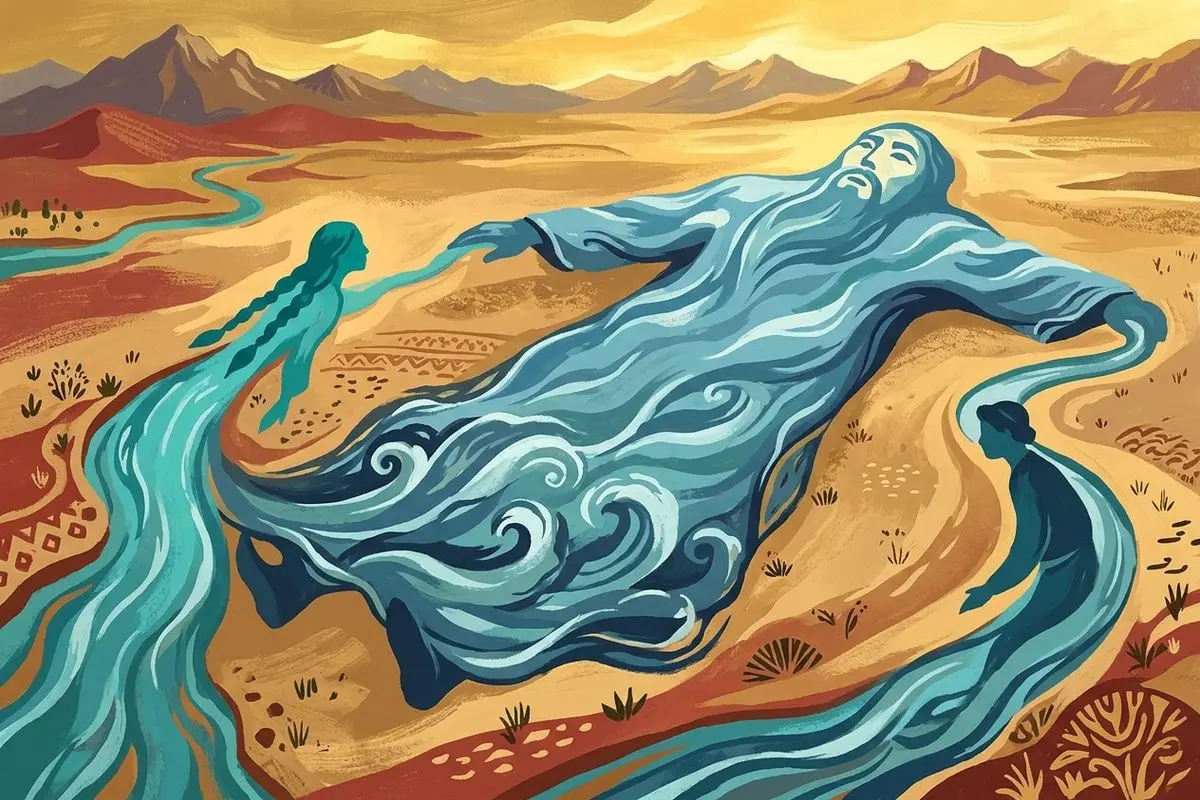
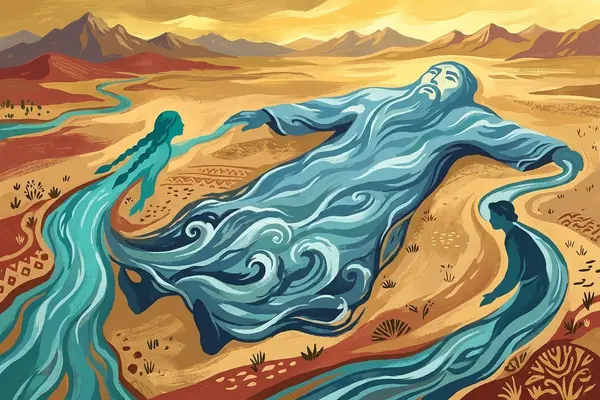
The steppe from above: a giant made of waves lies across it like a long lake, and rivers shaped like a girl with braids and a young man flow toward him from both sides
Illustration made by AI: Google Generative AI.

Chapter 5 of 17 · 2 min read

Balkhash, Ile and Karatal

The Ile (Ili) and Karatal rivers flow into Lake Balkhash. A legend explains why they meet exactly here.

Long ago a powerful sorcerer named Balkhash lived in these lands. He had an only daughter, Ile, who was clever, beautiful and good at everything. The sons of the Chinese emperor and of the Mongol khan, and rich merchants from Bukhara came to ask for her hand.

Balkhash held a contest for the suitors. It was won by a simple shepherd, Karatal, whom Ile loved. But the father did not want to give his daughter to a poor man and drove the young man away. Then Ile left home at night together with Karatal.

The angry father put a spell on the runaways and turned them into rivers. But the rivers still flowed towards each other. Then Balkhash himself lay down between them and became a lake. Yet he could not stop them: Ile and Karatal met in his waters.

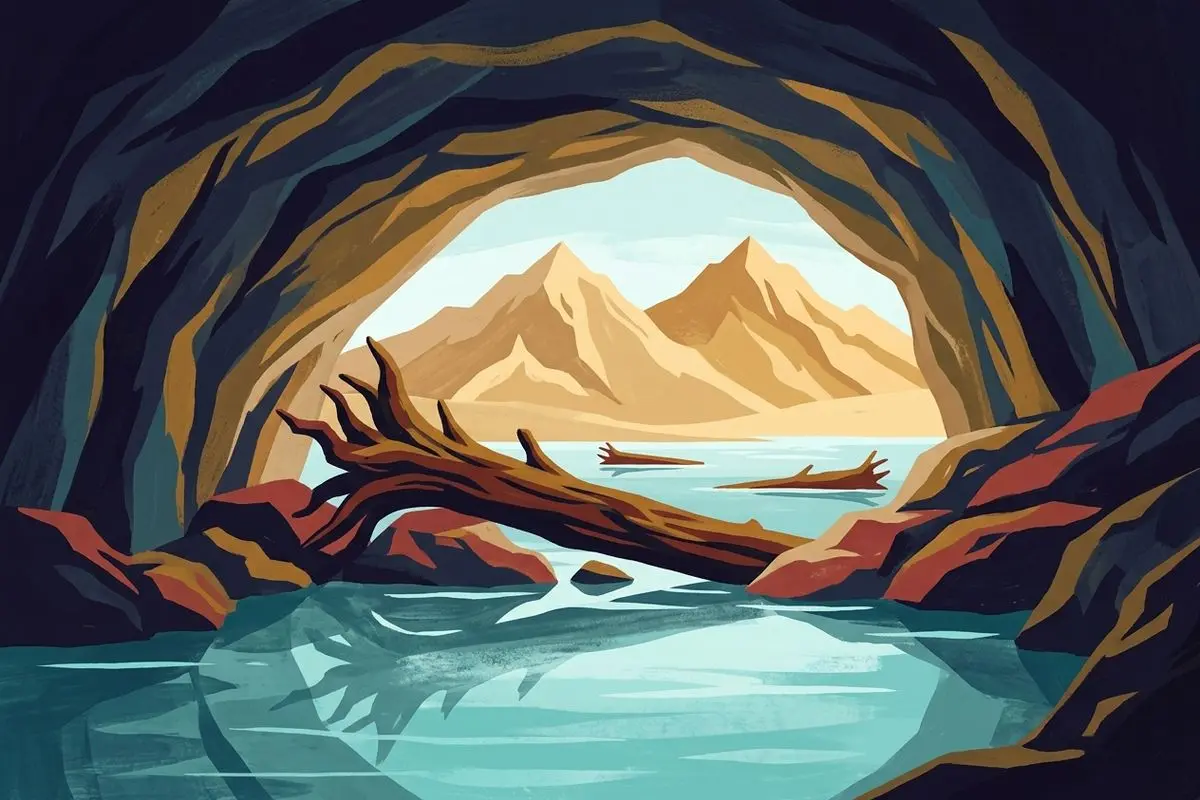
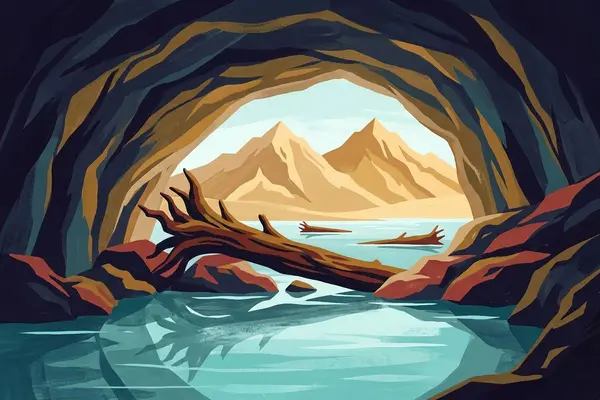
A cave with an underground lake: a big log lies on the rocks at the entrance, and two more logs float away over the water toward the mountains
Illustration made by AI: Google Generative AI.

Chapter 6 of 17 · 1 min read

Konyr Aulie Cave

In Mount Aktas, 20 kilometres from the village of Toktamys in the Abai Region, there is a cave called Konyr AulieA saint. That’s what Zhirensakal is called in the story about the mountain.. It stretches for 115–120 metres, and inside there is an underground lake up to 5 metres deep. Its water is icy, about +4 degrees.

According to one legend, during the great flood the Almighty saved the lives of three brothers: Konyr, Kyran and Kulan. They always cared more about others than about themselves, so they did not take places in the ark of Nuh (Noah). Instead they tied a few logs to it and were saved on them.

A strong current tore the logs away and carried them off in different directions. When the water went down, the logs caught on three mountains. Konyr’s log was the last to stop, at the entrance to this cave.

Today Konyr Aulie is a place of pilgrimage and tourism. There is electric lighting inside.

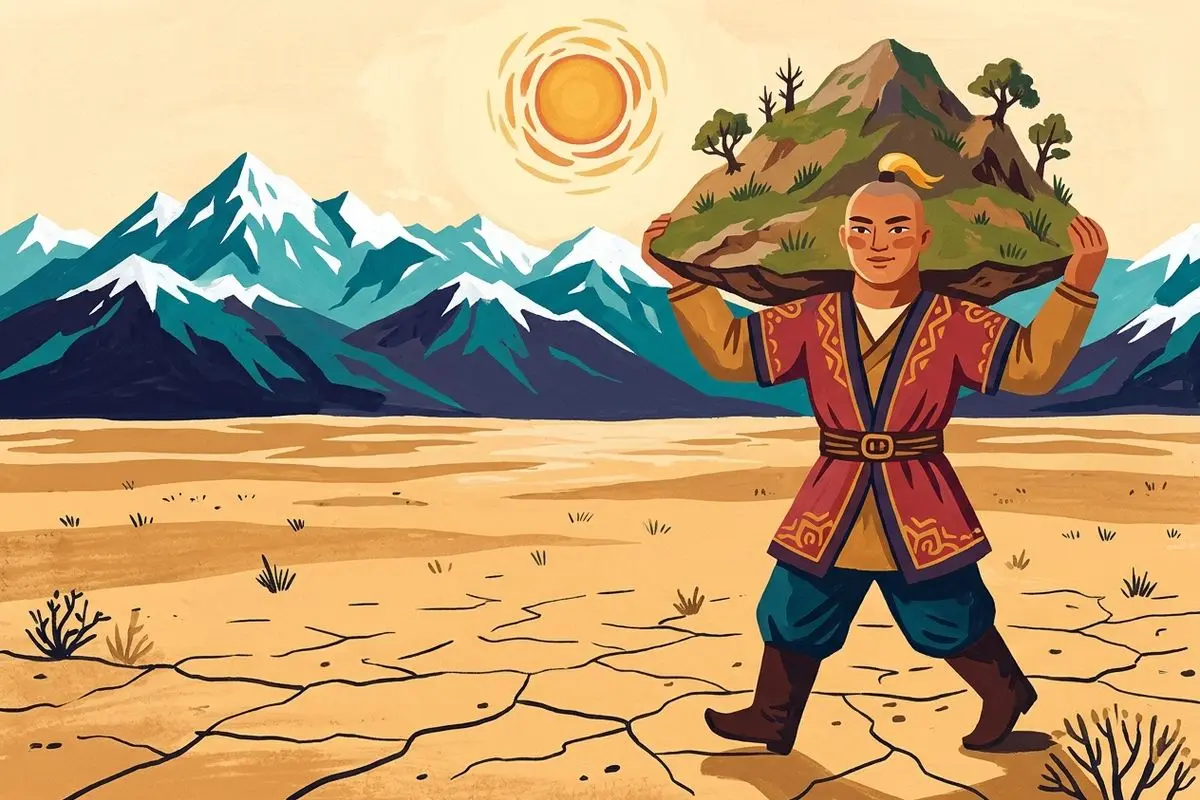
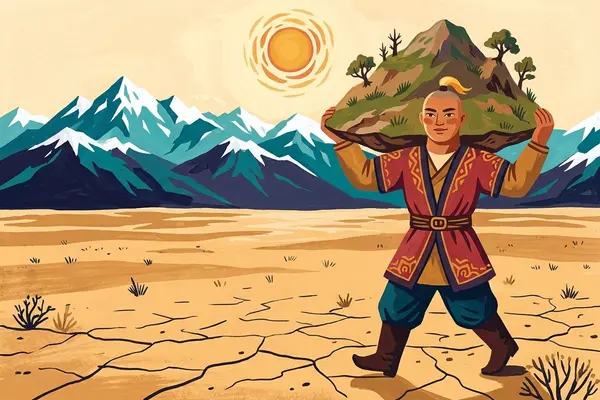
A batyr with a golden tuft of hair carries a small green mountain on his shoulders across steppe cracked by drought, with snowy mountains behind and a blazing sun in the sky
Illustration made by AI: Google Generative AI.

Chapter 7 of 17 · 2 min read

Tolagai, the Mountain on a Batyr’s Shoulders

Long ago nomadic tribes lived in the steppes of Saryarka. They had plenty of everything; only a batyrA hero. The title was usually given by the people themselves. to protect them was missing. Then in one family a boy was born with a golden tuft of hair on his head. He grew not by the day but by the hour and became a true hero.

So that no one would put the evil eye on him, his relatives called him not by his real name but by a nickname: Tolagai.

One year a drought came: the rains stopped and the heat dried out the land. Tolagai went for advice to a wise old man named Dana. “We live on open land,” said the old man. “There are no mountains nearby where clouds could stop. That is why there is no rain.”

Tolagai went to the great Alatau mountains and asked them for a mountain. The mountains understood him and placed a young mountain on his shoulders, still a child among mountains. The batyr carried it home for a long time. When he reached the edge of his native land, he was so tired that he fell asleep, and the mountain covered him. Since then Tolagai has been sleeping under the mountain, and the child mountain has grown up and bears his name.

On the map the pin stands by the village of Tolagai in Kokpekty District.

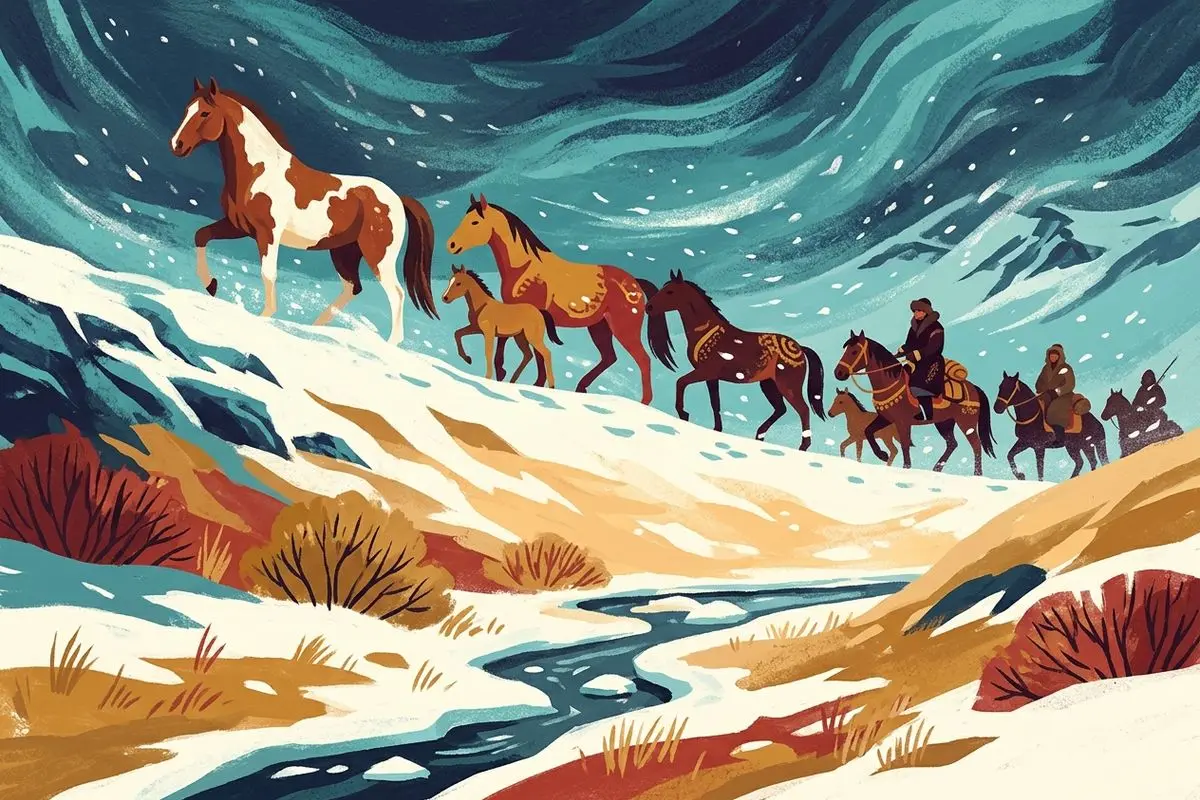
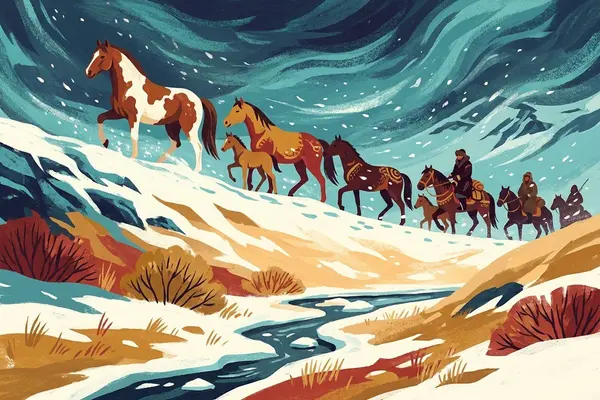
A chestnut-and-white stallion leads the herd through a blizzard down to a valley with a stream, with riders following the herd
Illustration made by AI: Google Generative AI.

Chapter 8 of 17 · 2 min read

Almasai: Where the Old Horse Led

Not far from Oskemen (Ust-Kamenogorsk), in Ulan District, there is a village called Almasai. They say a horse chose the place for it.

Long ago shepherds and horse herders roamed these foothills. The herds belonged to Sarykul, and their leader was a chestnut-and-white stallion called Saryala Aigyr. The leader made sure the mares did not scatter and that wolves did not attack.

But the most terrible disaster for nomads was the zhut. That is what they call a winter when the ground is covered with ice and the animals cannot get to the grass. In such years many animals died.

Experienced stallions sensed in advance what the winter would be like and led the herd to places where the disaster could be survived. That year Sarykul trusted his old horse. Saryala Aigyr went off to look for a valley himself and led the herd to the Saryozek stream, to the place called Almasai.

The leader’s instinct did not fail. Here the herd survived the zhut, and people set up an aul, which later grew into the village.

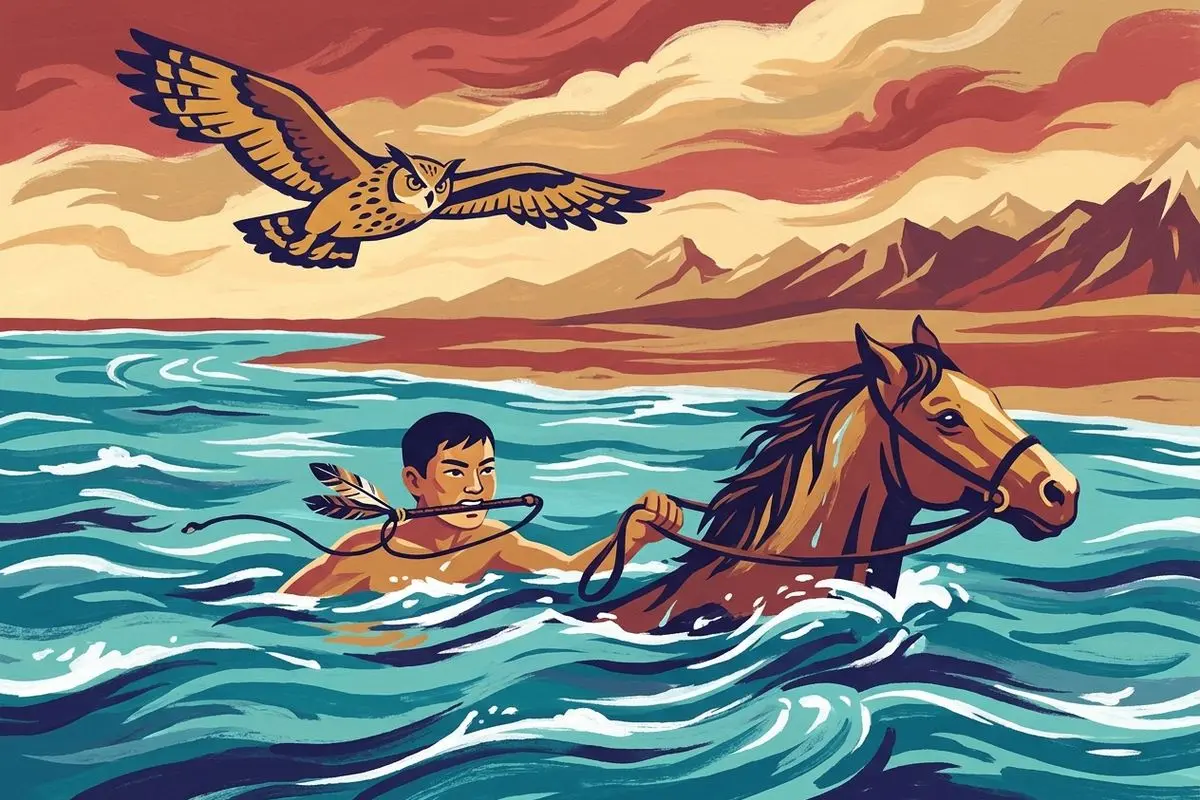
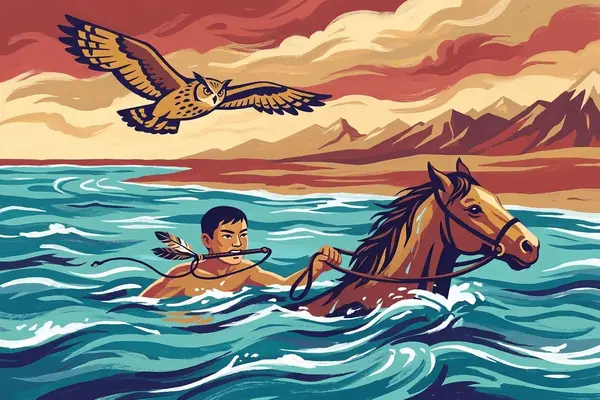
A messenger swims across a rough river beside his horse, holding its rein, a whip with a bunch of feathers in his teeth; an eagle-owl flies over the river
Illustration made by AI: Google Generative AI.

Chapter 9 of 17 · 3 min read

Ertis: the Owl Letter

The Ertis (Irtysh) is one of the main rivers of Kazakhstan. It flows from China through East Kazakhstan into Russia. Several legends are told about its name.

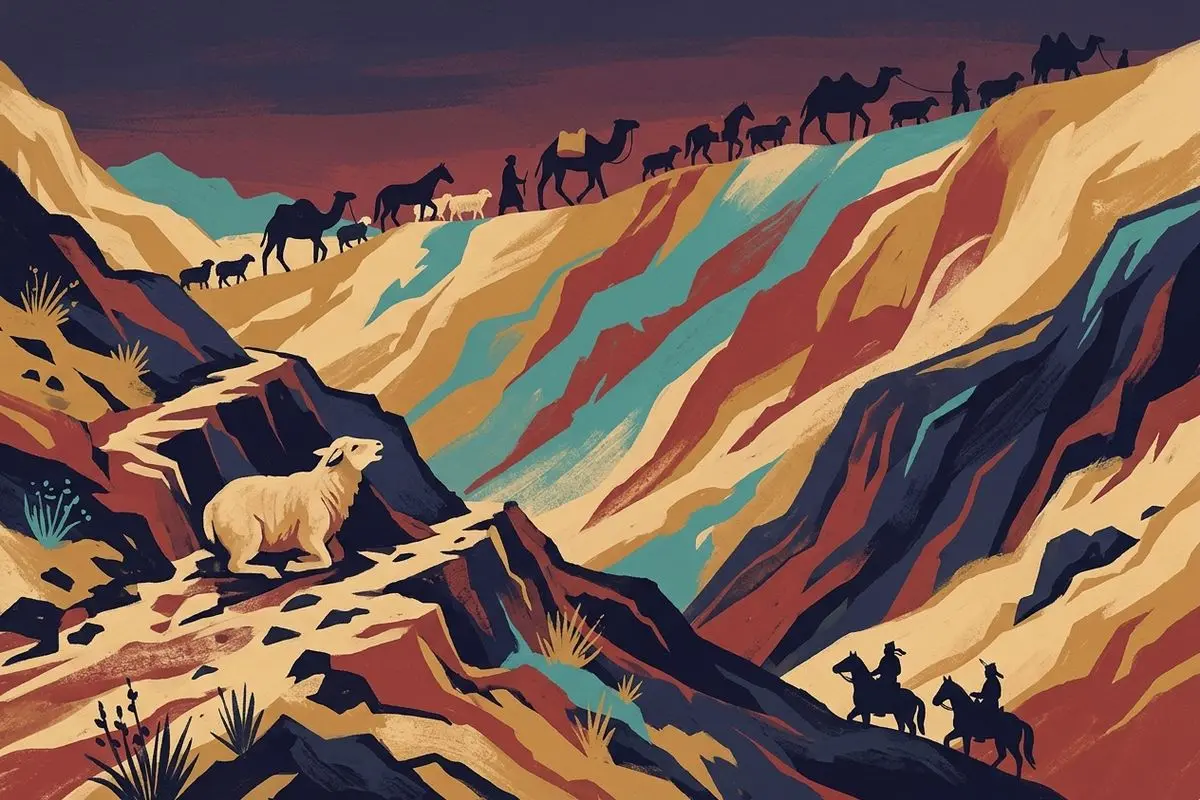
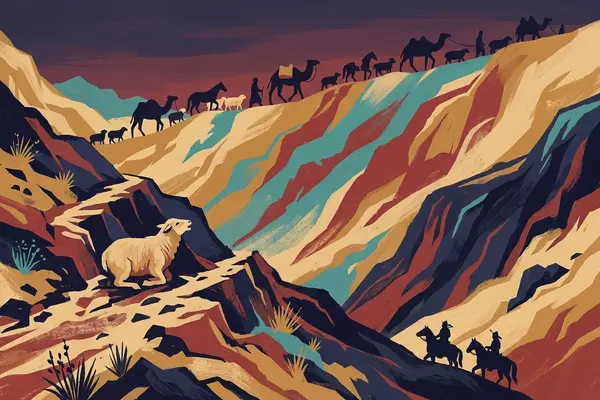
A nomad caravan with camels and sheep has climbed to the mountain ridge, one sheep has fallen behind on the slope, and riders in the valley below look around
Illustration made by AI: Google Generative AI.

Chapter 10 of 17 · 2 min read

Manyrak: the Mountain Where a Sheep Bleated

Near Zaisan there is a mountain with an unusual name: Manyrak. In Kazakh, “manyrau” means “to bleat”. This is how the mountain got its name.

Long ago a large clan roamed the rich pastures here. One day enemies came into the steppe, and the people had to go up into the mountains. The climb was steep, and one sheep grew exhausted: it lagged behind and kept falling to its knees.

The shepherds offered to carry it in turns. But a noble rich man was outraged: “The whole clan is in danger, and you are fussing over a sick sheep! Let’s leave it.” The people listened to the rich man.

The camp climbed to the pass and hid in a safe place. Below, enemy troops were riding by. Suddenly the riders heard a sheep bleating pitifully somewhere on the slope. Why would there be a sheep in a deserted place? It meant people were nearby. The enemies found the shelter, and for the camp everything ended in disaster.

Since then the mountain has been called Manyrak.

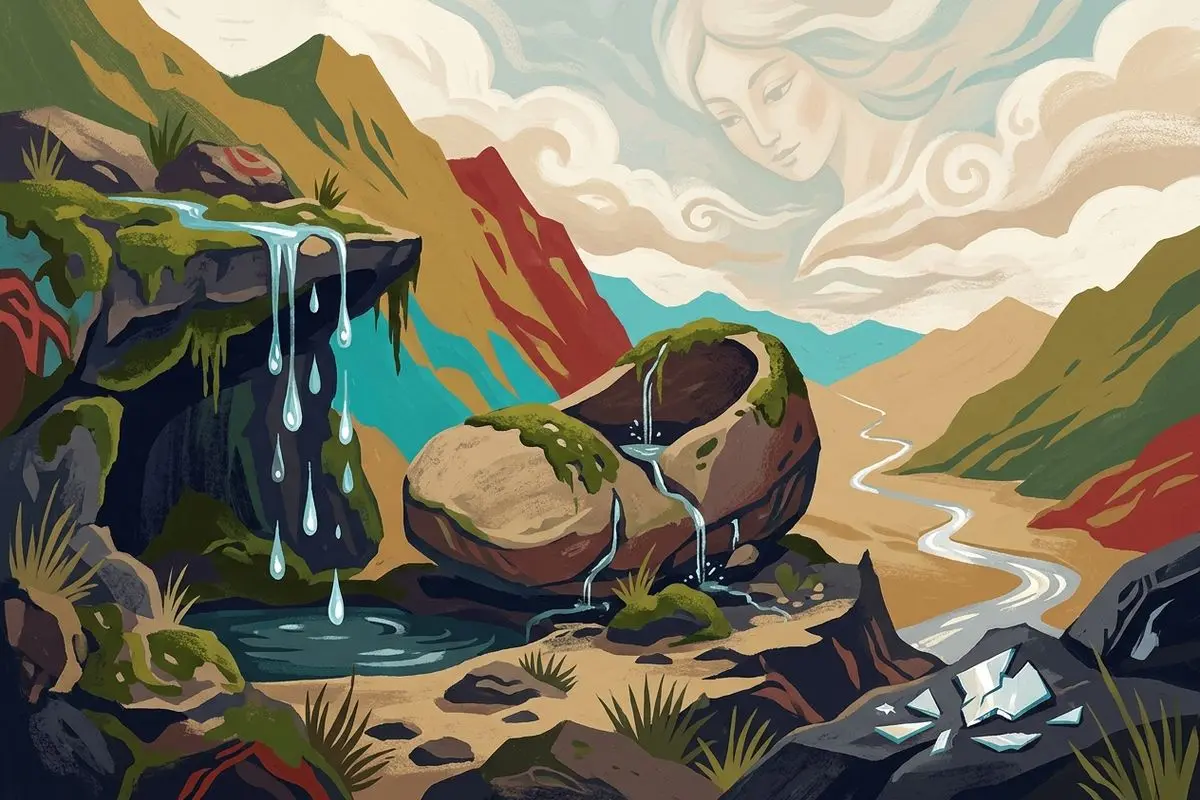
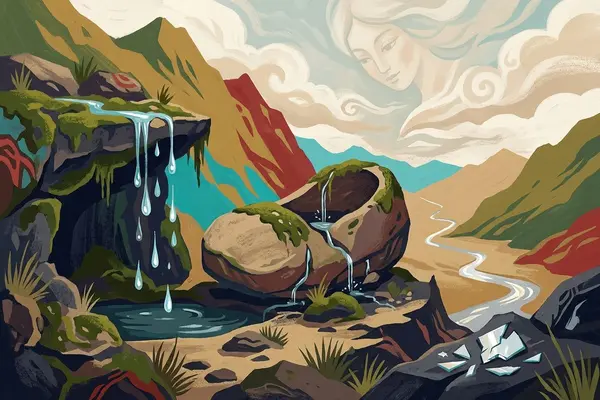
A grotto where water falls in separate drops, a big boulder beside it, a silvery river in the valley with pieces of a mirror where it begins, and the face of a heavenly maiden in the clouds
Illustration made by AI: Google Generative AI.

Chapter 11 of 17 · 2 min read

Tamshybulak, the Tears of the Earth

Near the village of Kapal in the Zhetysu Region there is a spring called Tamshybulak. Its water does not gush out in a stream but falls from the mountain in separate drops, so it was nicknamed “the tears of the earth”. The spring does not freeze even in frost, and the algae in it stay green all year round.

The first to study the spring was Shokan Valikhanov. He also wrote down a legend: at night the beautiful Bayan came here and wept about her fate. There were so many tears that they filled the grotto and spilled out.

In 1848 the English traveller Thomas Atkinson came to Kapal with his wife. Their son was born here, and his parents named him Alatau-Tamshybulak.

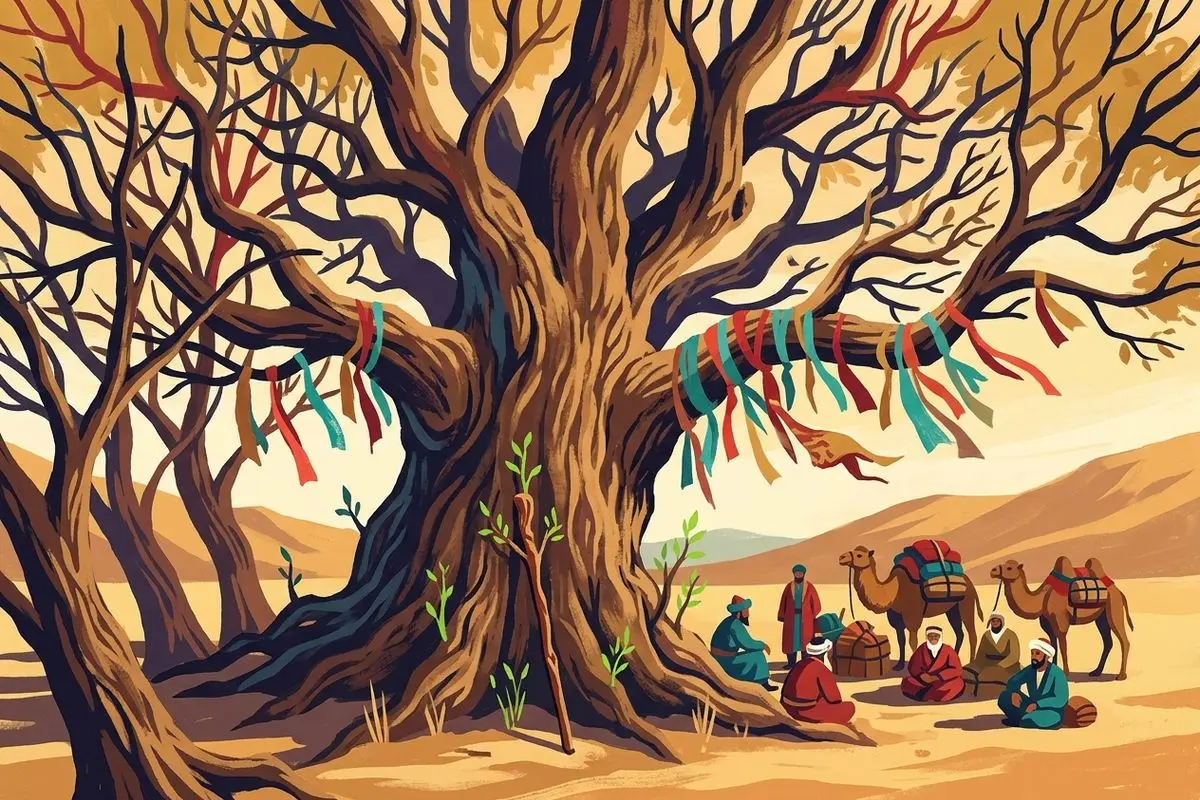
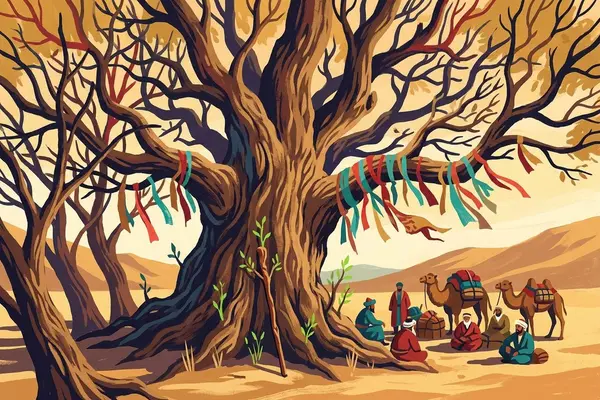
A huge old elm with ribbons on its branches, a young sprout coming up by the trunk, and a camel caravan resting nearby
Illustration made by AI: Google Generative AI.

Chapter 12 of 17 · 1 min read

Auliegash, the Tree from a Staff

In Panfilov District of the Zhetysu Region grows a huge elm called Auliegash, “the holy tree”. It is more than 700 years old. The trunk is 6.5 metres around: it takes six adults to hug it. Seven elms stand around it, their branches intertwined.

The legend says that the merchant Baibosyn led caravans along the Great Silk Road. Once he stopped here for the night and stuck his staff into the ground. In the morning a young elm was growing in place of the staff.

The tree is considered holy. People make wishes by it and tie ribbons and scarves to its branches.

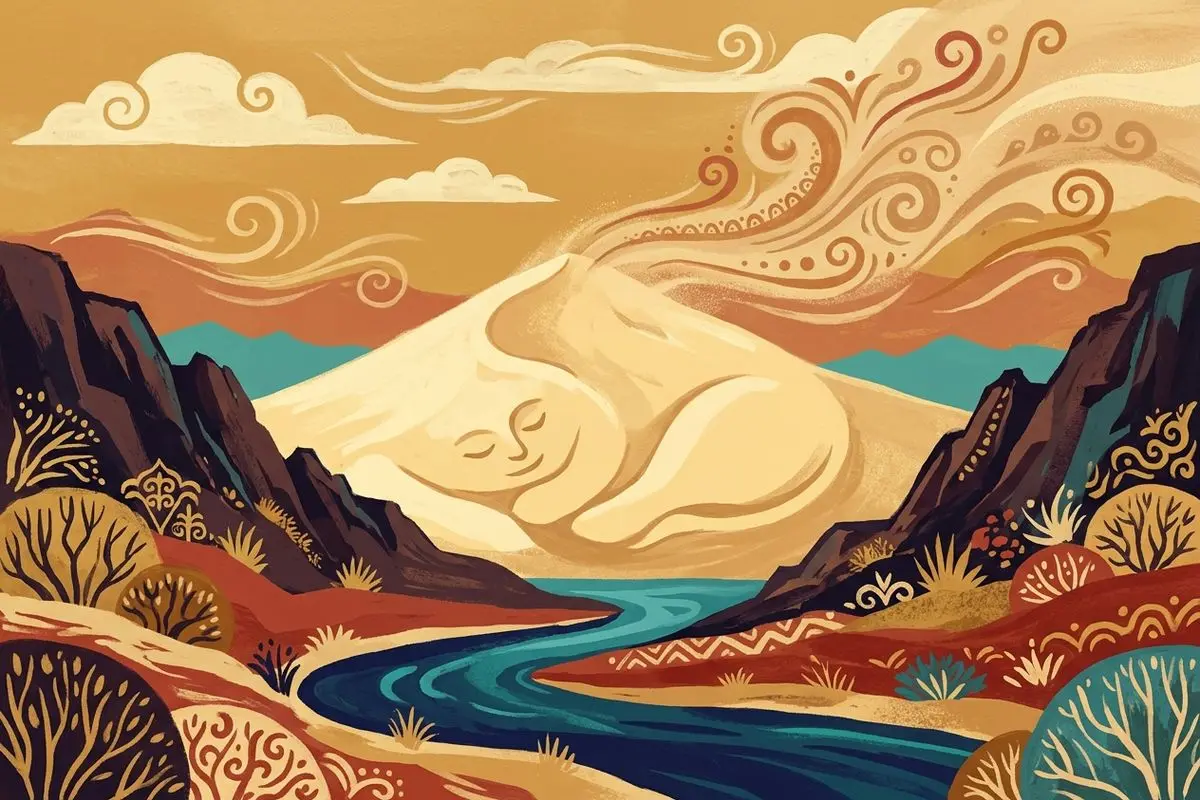
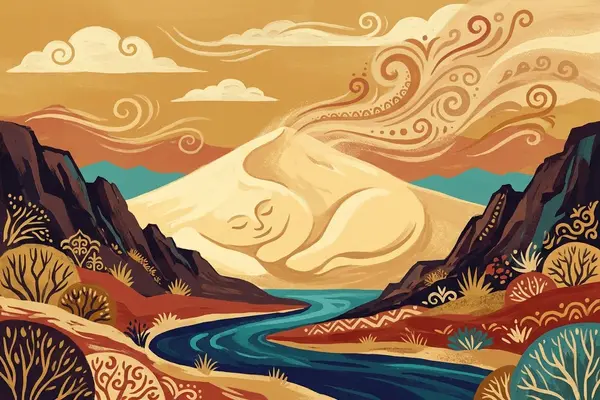
A big pale dune between dark rocks by a river, a sleeping face in the shape of the sand, the wind curling sand into patterns above the crest
Illustration made by AI: Google Generative AI.

Chapter 13 of 17 · 2 min read

The Singing Dune

In Altyn-Emel National Park there is a sandy mountain up to 3 kilometres long and 150 metres high. In dry weather its sand makes sounds: from a faint squeak to the melody of an organ and even a roar. This is the Singing Dune.

Why does it sing? People explain it in different ways. Some say it is the spirits of the desert singing. Others say that bells of buried cities ring under the sand.

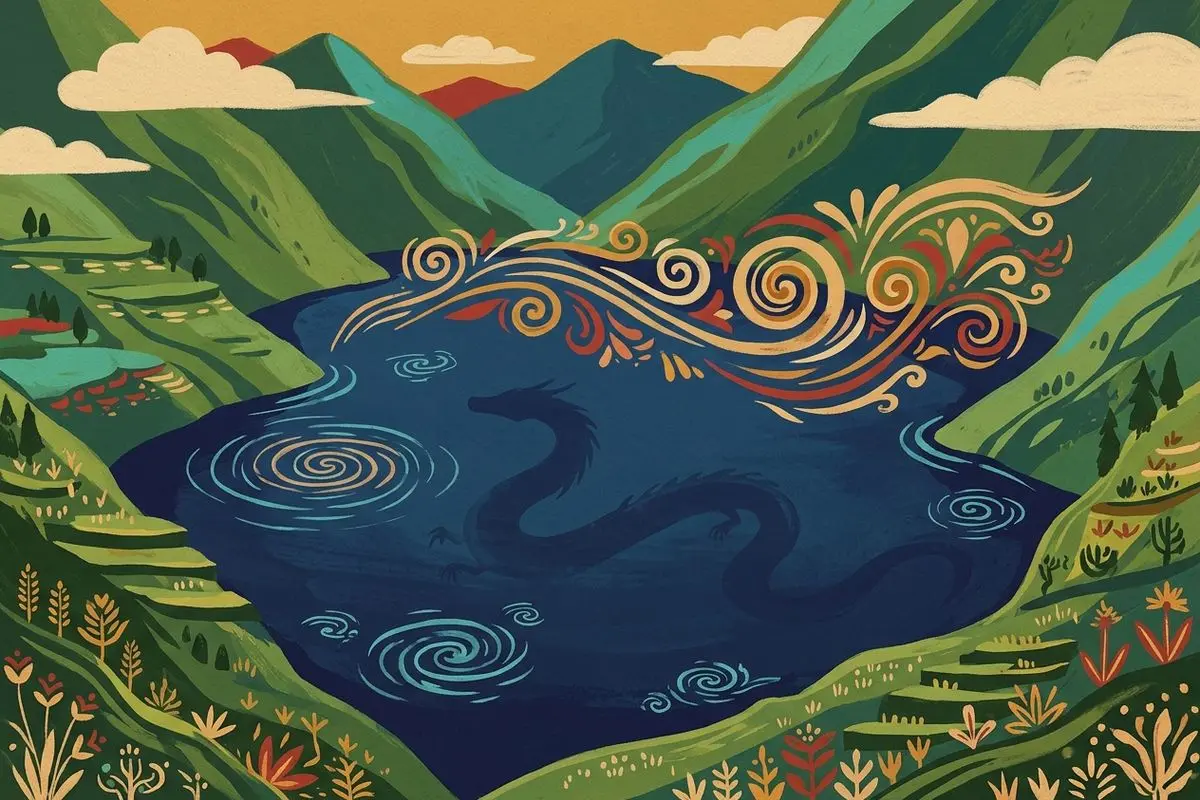
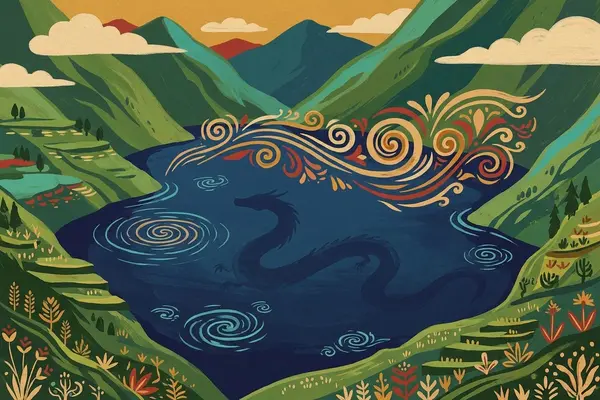
A deep blue lake among green mountains, whirlpools on the water, the shadow of a long serpent under the surface, and ornamental curls above the lake like sound
Illustration made by AI: Google Generative AI.

Chapter 14 of 17 · 1 min read

Kokkol: Who Is Roaring in the Lake?

Among the mountains of the Zhambyl Region, in Merke District, lies Lake Kokkol. Not a single river flows into it or out of it, yet the water stays clean.

According to legends, a water spirit lives in the lake, the serpent aidakharA great serpent, a dragon that lives in the roots of Baiterek., and its voice sounds like the blare of a trumpet. On calm days rings and whirlpools sometimes run across the water, as if something enormous were swimming underneath. Recently people even wrote on social media that a 15-metre “Loch Ness monster” was hiding in Kokkol.

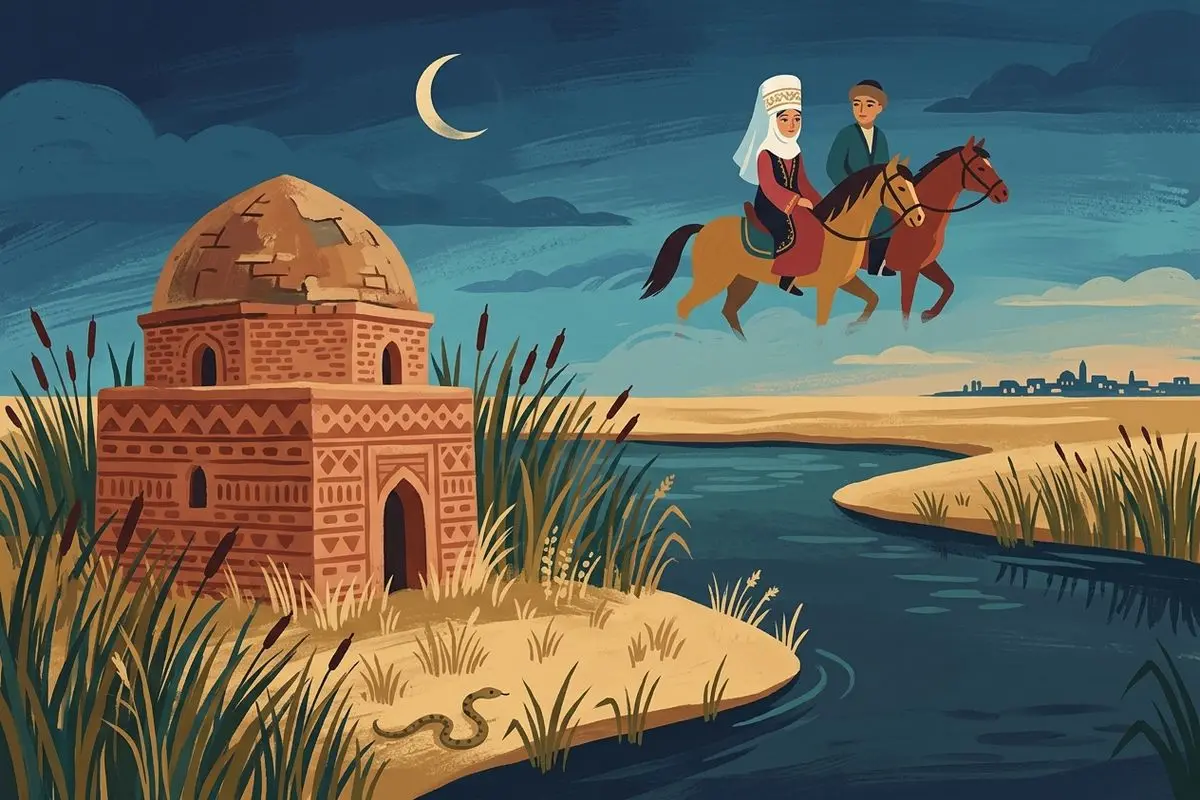
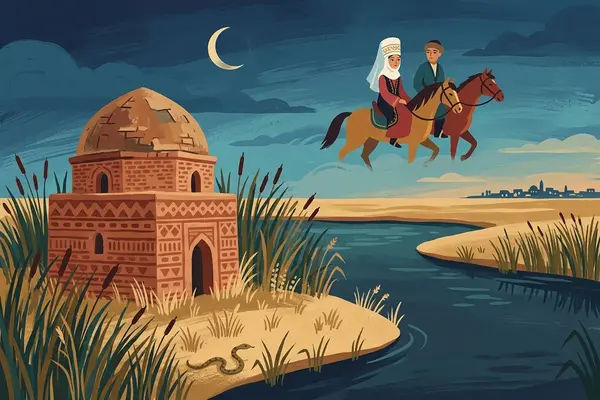
A small conventional domed building with a patterned brick wall by a river in the reeds; in the sky a crescent moon and, like a memory, a girl in a white headdress riding with her companion; a snake in the grass by the water
Illustration made by AI: Google Generative AI. An artistic reconstruction, not a depiction of the real mausoleum.

Chapter 15 of 17 · 2 min read

The Aisha Bibi Mausoleum

In the village of Aisha Bibi, 18 kilometres from Taraz, stands a 12th-century mausoleum from the Karakhanid era. Its walls are decorated with terracotta tiles with patterns: geometric, animal and solar.

The legend of the mausoleum is told in different ways, but the main story is the same.

Aisha was the daughter of the scholar and poet Hakim Suleiman Bakyrgani. Karakhan, the ruler of Taraz, fell in love with her, but the girl’s guardian did not agree to the wedding. Aisha loved Karakhan too and secretly set off to him in Taraz. On the way, on the bank of the Asa River, she was bitten by a snake that had hidden in her headdress.

Karakhan built the mausoleum where she died. Aisha’s companion, Babaja Khatun, became the keeper of the mausoleum. Her own mausoleum stands nearby.

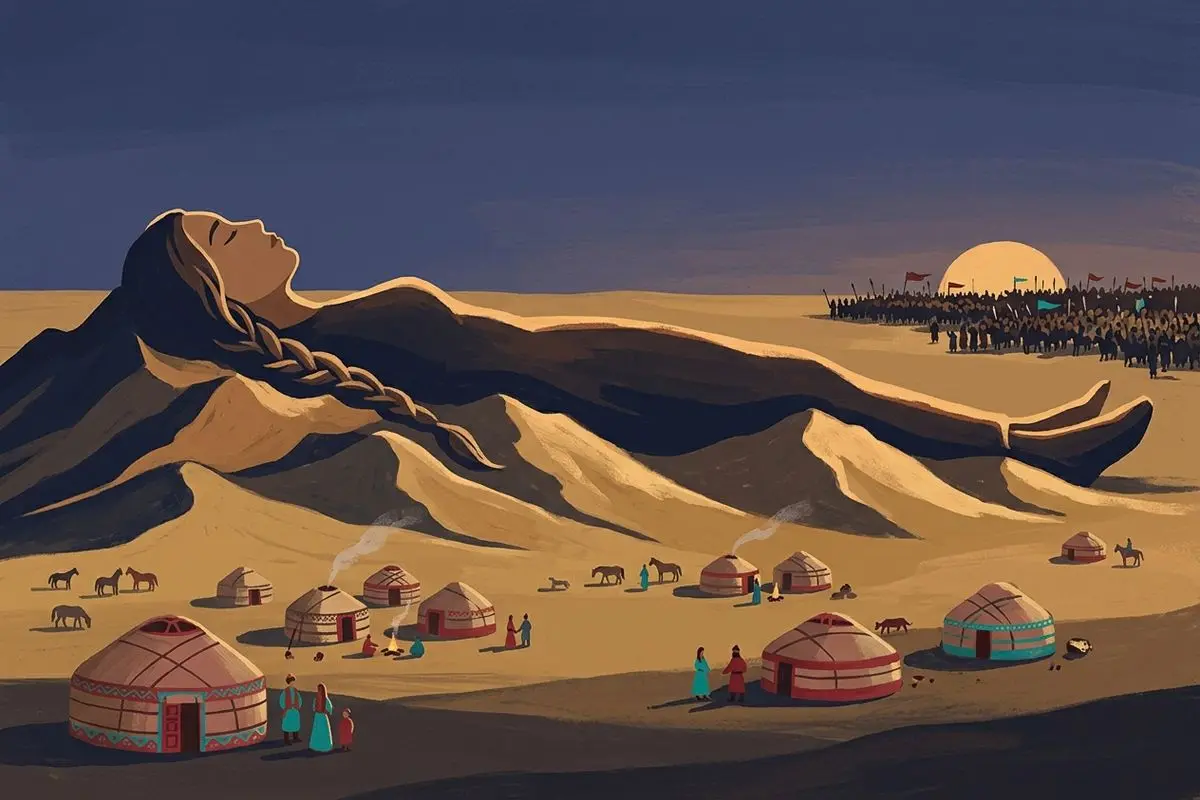
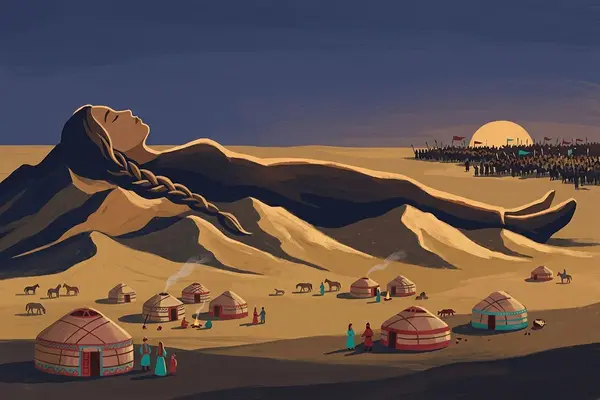
A low ridge shaped like a sleeping girl with a braid, an aul with yurts at its foot, and an army halted far away on the horizon
Illustration made by AI: Google Generative AI.

Chapter 16 of 17 · 2 min read

Kelinshektau, the Sleeping Beauty

Near the town of Karatau in the Zhambyl Region, the Kelinshektau ridge rises above the steppe. Its name means “the bride’s mountain”. Its outline looks like a girl lying down, so local people also call it the Sleeping Beauty.

This version was recorded by the philologist Zhangara Dadebayev and translated into Russian by the writer Fatima Orazbekova.

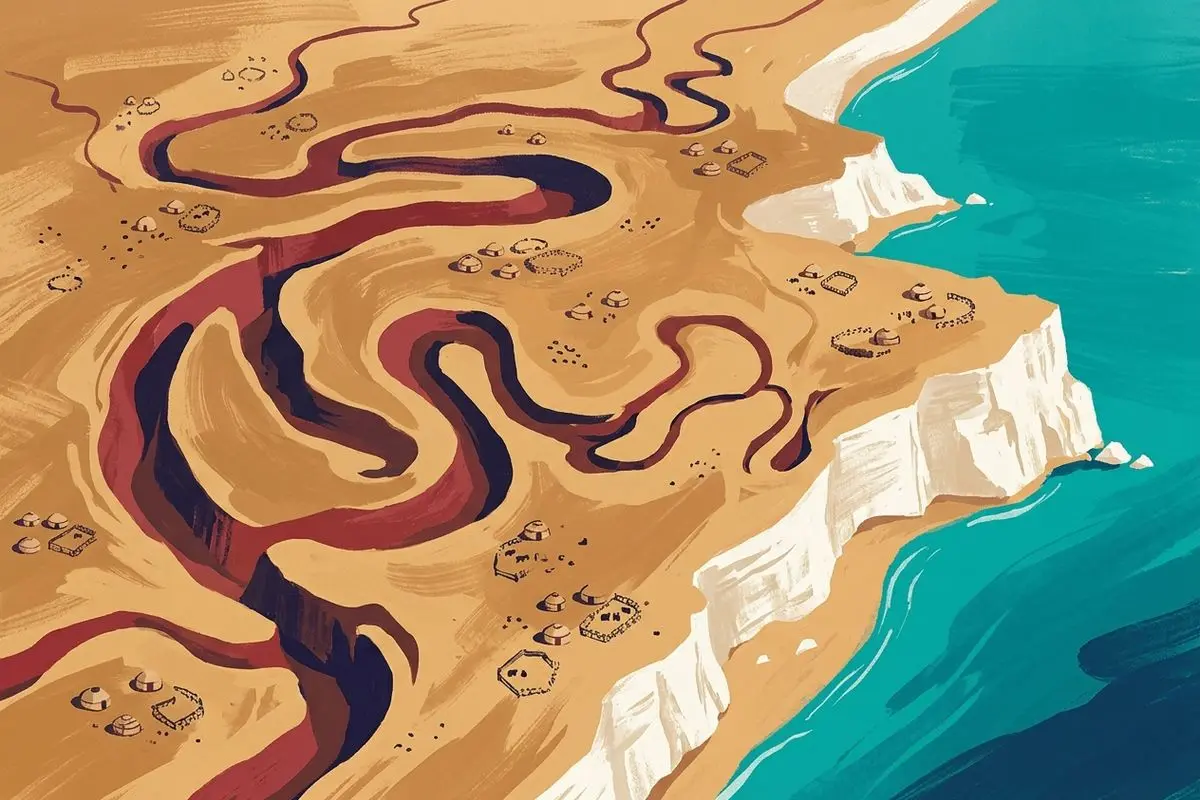
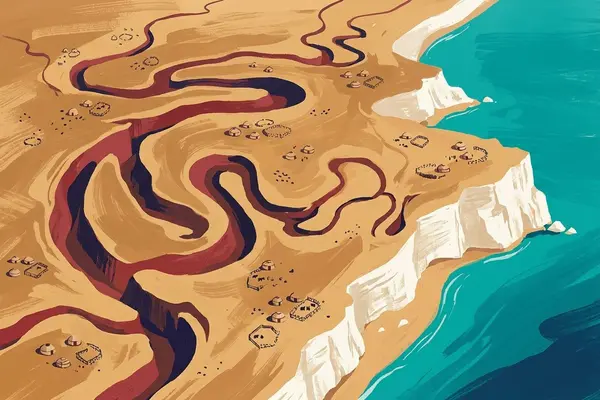
The peninsula from above: winding canyons curve like the body of a dragon, winter camps are scattered across the plateau, and on the right are white cliffs and a turquoise sea
Illustration made by AI: Google Generative AI.

Chapter 17 of 17 · 2 min read

Mangystau: a Land of a Thousand Winter Camps or of a Dragon?

Mangystau is a peninsula on the eastern shore of the Caspian Sea and a region with the same name. Where did the name come from? There are many versions, and scientists choose different ones.

People say that Mangystau means “Myn kystau”, “a thousand winter camps”, or “Myn aul”, “a thousand auls”.

The mythologist Serikbol Kondybai, who came from this land, believed another version was right. In the myths of the eastern Turks and Mongols, “mangys” or “mangus” is a dragon, a terrible monster. For the Mongols it is only evil, but for the Turks it can be both good and evil. Then Mangystau is the land of the dragon.

The “Dictionary of Place Names of Kazakhstan” by Ye. Koishybayev collects more versions. The name is linked to the Nogai tribe Menk, or to the ancient Turkic word “men”, which meant a four-year-old sheep. And the author of the dictionary himself thought that “Mangyshtag” means “the mountain of monsters”.

Check yourself

Three questions about this section. Each answer shows where the story tells it.

1. Why was the mountain by Lake Burabay named Okzhetpes?
2. According to the legend, why is the mountain near Zaisan called Manyrak?
3. According to scientists, why does the Singing Dune sing?