Аңыз

How the World Is Built

The three floors of the universe, the seen and unseen worlds, Baiterek, Samruk and Aidakhar.

Baiterek holds the earth with its roots and props up the sky with its crown.

Text by: Bekzada ISHEKENOVA, Dias KUMARBEKOV

A tree with roots, a bird and the sun above it, a snake below

In this section

  1. The Three Floors of the UniverseLegend · 2 min
  2. The Visible and Invisible WorldsLegend · 1 min
  3. The Four Directions and Their ColorsLegend · 2 min
  4. Baiterek, the Tree of LifeLegend · 1 min
  5. SamrukLegend · 1 min
  6. AidakharLegend · 1 min
  7. The Golden Egg SunLegend · 1 min
  8. The Road to BaiterekLegend · 1 min
  9. Respect for TreesLegend · 1 min
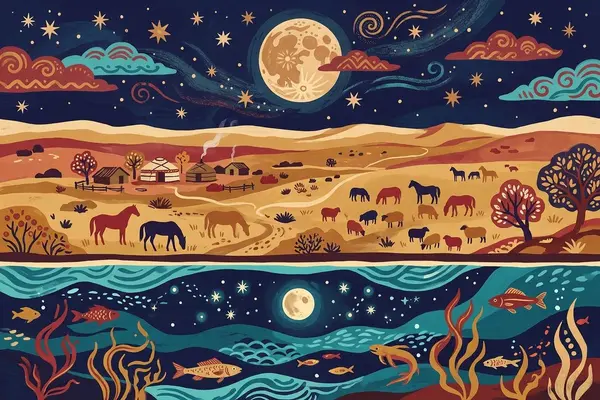
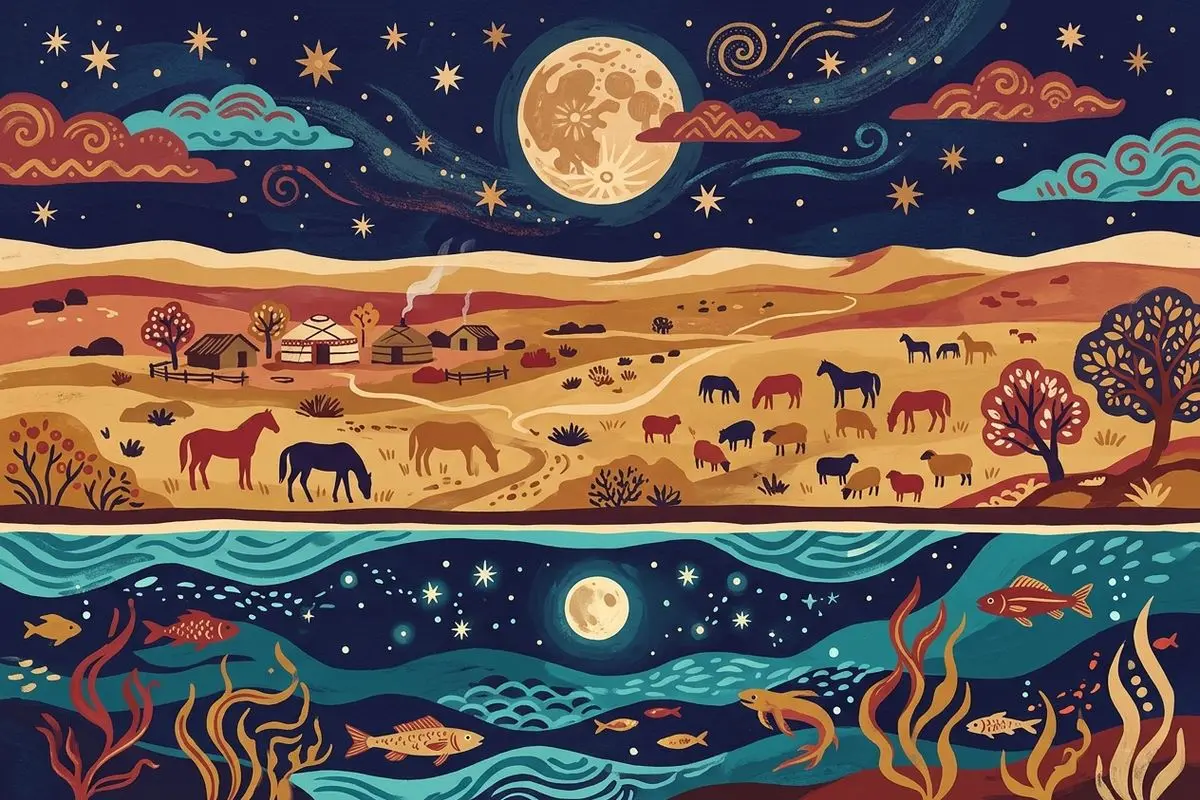
The world in three tiers: a starry sky with a moon, a steppe with horse herds and a village, and an underwater world with its own moon
Illustration made by AI: Google Generative AI.

Chapter 1 of 9 · 2 min read

The Three Floors of the Universe

Of course, you already know that the Earth is round and spins around the Sun. But in myths things work differently, and our ancestors pictured the world in their own way.

To start with, they believed the Universe was split from top to bottom into three worlds: the upper, the middle, and the lower.

The upper world. This is where the heavens and the stars are, and it even has its own sky people. When a rainbow appears, that’s the old woman of the sky leading her little goats and sheep out to the meadow, in the rain or just after it.

She lives on the Moon. That’s why you shouldn’t point your finger at the Earth’s satellite or stare at it for too long: the old woman might count your eyelashes, and then your life will be much shorter than a hundred years.

The periA magical people who look like very beautiful humans. live in the upper world too (they’re a bit like elves). They can turn into birds and fly down to Earth on their own business.

The middle world. This is where we live. We have cities, pastures, and lots of other wonders.

The lower world. This is home to the underground people and the su periWater peri who live in the Lower World., or water peri: lakes and rivers also count as part of the lower world. It has its own day and night, its own Moon and stars.

Want to know how to tell which world someone is from? Sky people wear their belt just under the throat, earth people around the belly and hips, and underground people down by their feet. Maybe some pop idols are actually our neighbors from upstairs or downstairs?
Next The Visible and Invisible WorldsRandom legend
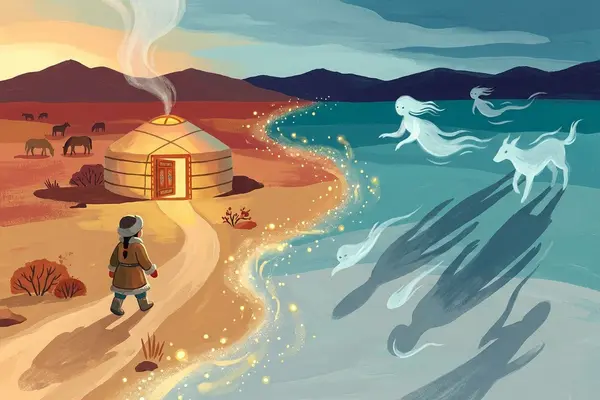
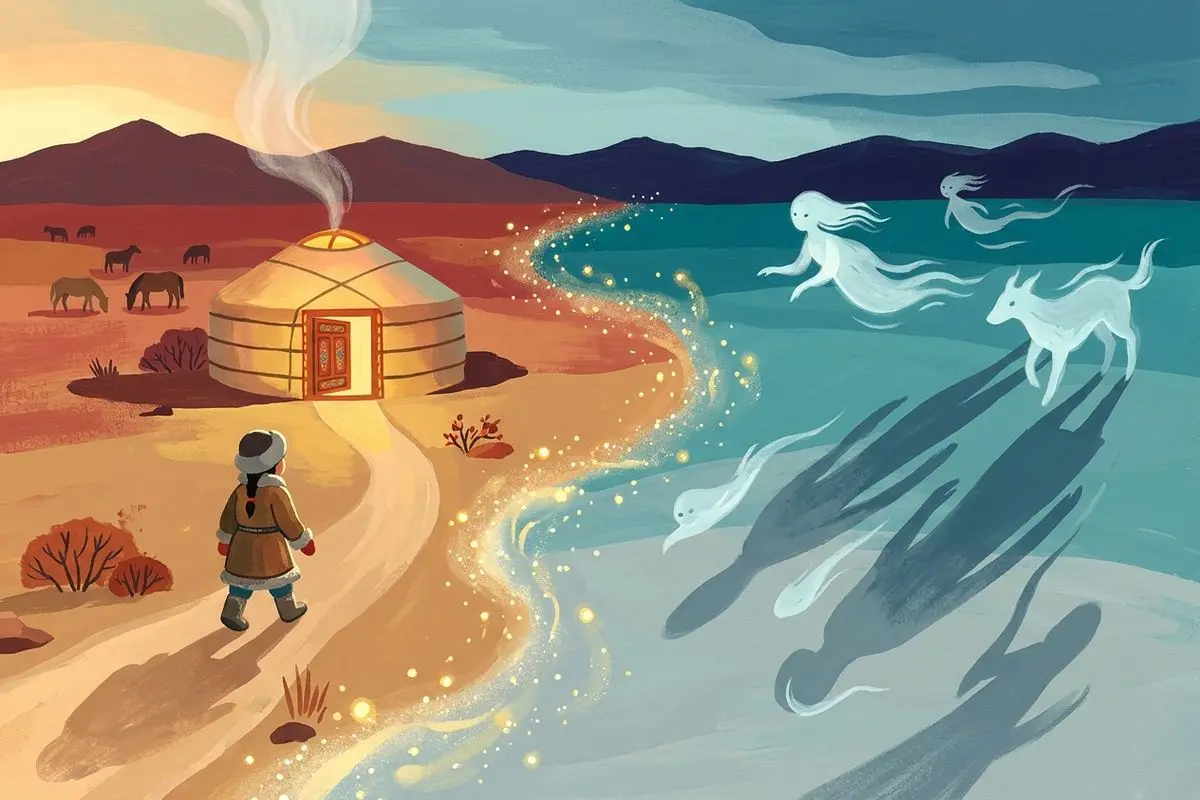
A child walks toward a yurt on the bright side; beyond a glowing line are pale spirits and shadows
Illustration made by AI: Google Generative AI.

Chapter 2 of 9 · 1 min read

The Visible and Invisible Worlds

The worlds are also split into the visible and the invisible (the otherworld). Ghosts and spirits, good and bad, live in the unseen half. You and I walk on the visible side.

Usually the two halves are kept apart, but in the evening and at dawn the border gets very thin, and spirits can slip into our world.

That’s why grown-ups tell you not to sleep in the evening: while a person is wandering through the wide lands of sleep, a spirit could attack their body.

Of course, that’s a superstition. There’s another explanation too: our ancestors noticed that if you sleep in the evening, you get a bad headache afterward, go to bed later, and have a hard time getting up in the morning.

Next The Four Directions and Their ColorsRandom legend
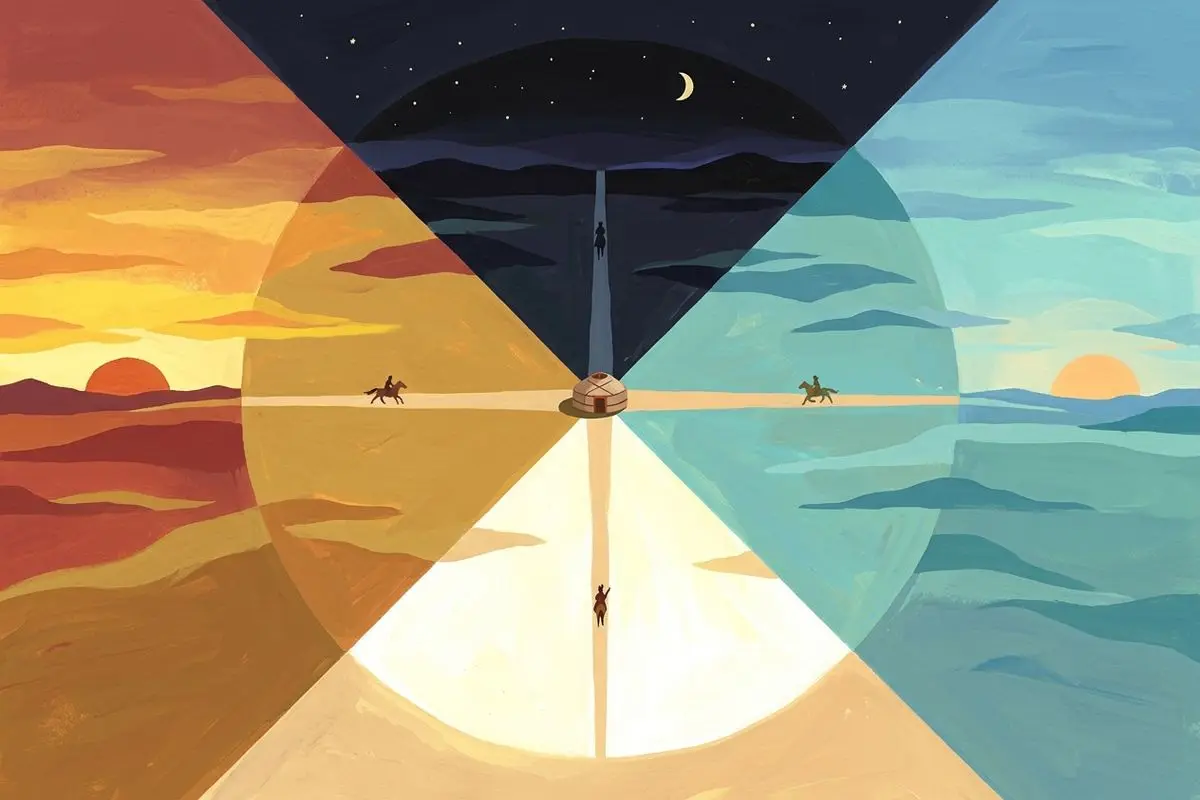
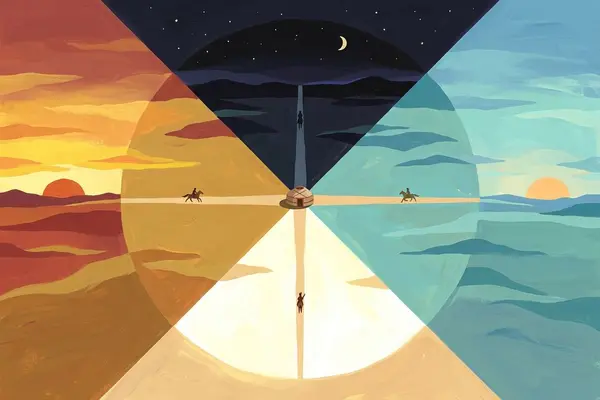
The steppe from above: a yurt in the center and four roads in a cross; the east is blue, the west yellow and red, the north black night, the south white
Illustration made by AI: Google Generative AI.

Chapter 3 of 9 · 2 min read

The Four Directions and Their Colors

Side to side, the world is divided into four directions.

  • Shygys, the side where the Sun rises, is east.
  • Batys, the side where the Sun sets, is west.
  • Ontustik, to the right of east, is south.
  • Soltustik, to the left of east, is north.

The symbol of these four directions was a cross with equal arms. If you see an ornament with a cross like that, you’ll know: it’s a wish for good luck and happiness, whichever way you go.

Each direction has its own color. Black is north, white is south, blue is east, and yellow and red are west. That’s how an article by Sh. S. Turganbaeva gives this Turkic “color map” of the world.

Next Baiterek, the Tree of LifeRandom legend
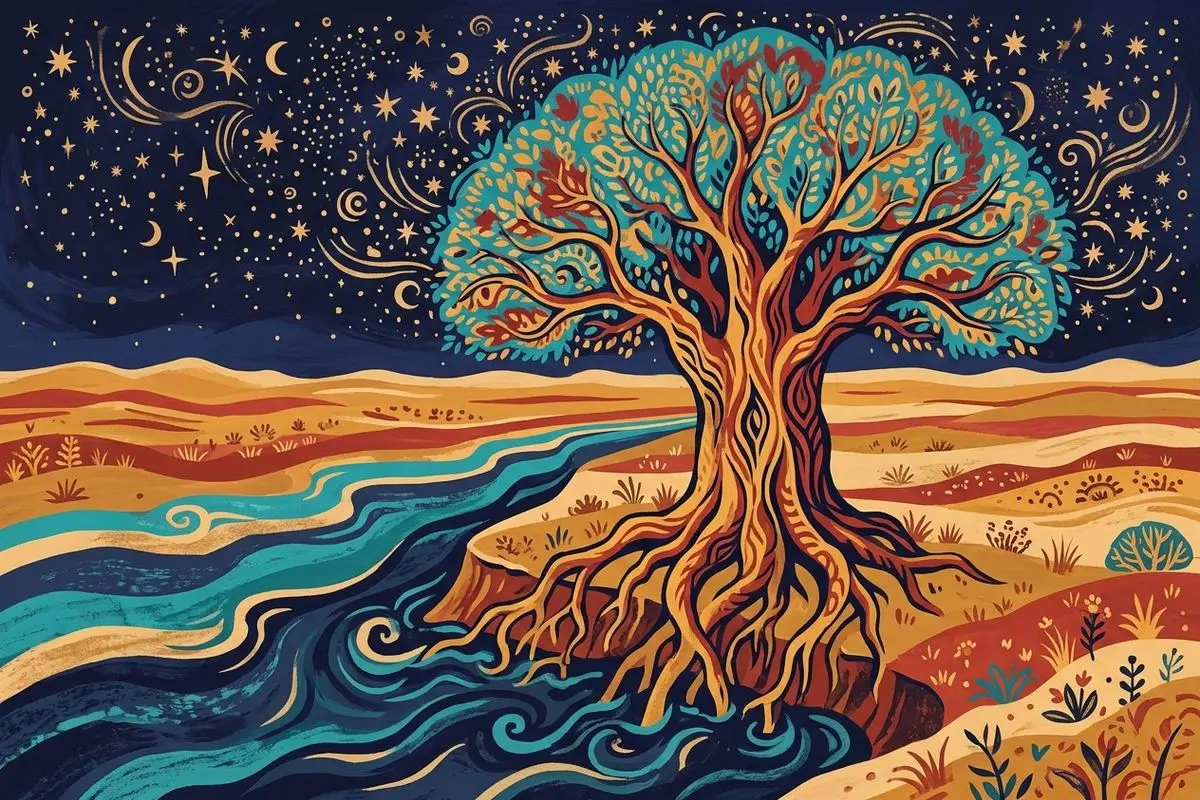
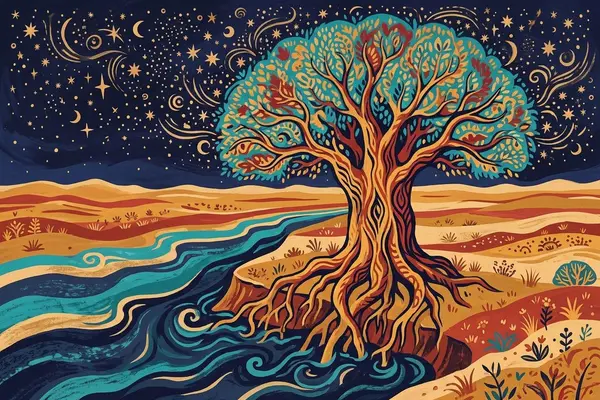
A huge tree on a riverbank: its roots reach into the water, its crown is among the stars
Illustration made by AI: Google Generative AI.

Chapter 4 of 9 · 1 min read

Baiterek, the Tree of Life

Where all the worlds meet stands the world tree, the tree of life, BaiterekThe world tree, the tree of life where all the worlds meet. In Kazakh, it’s also a word for a poplar tree.. In Kazakh, poplar trees have the same name.

Its roots reach down into the underworld, its trunk is in the middle world, and its branches grow up into the upper world. It exists on both the visible and the invisible side, and all four directions come together at this great tree.

Baiterek literally means “great tree” or “tree that gives life.” The name is made of two words: “bai” means “great, first,” and “terek” is related to the Turkic word “tirig,” meaning “giving life, tree, support.”

Baiterek grows in the middle of the endless steppe, on the bank of the World River. With its roots it holds the earth in place, and with its crown it holds up the sky.

Trees like this appear not only in our myths but in other peoples’ myths too. For example, the Scandinavians have Yggdrasil. Does that mean it really exists after all?

Next SamrukRandom legend
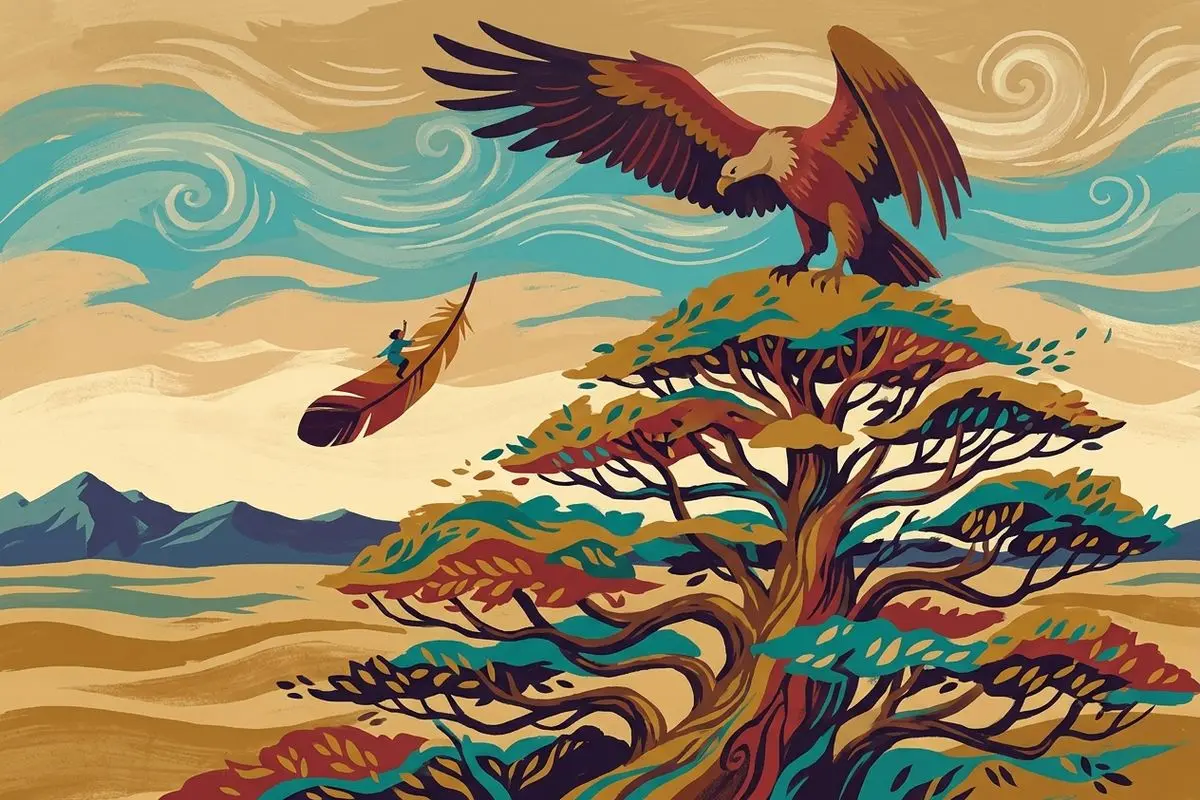
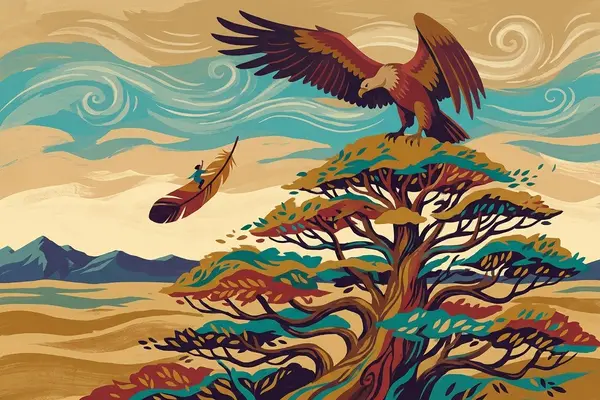
A giant bird at the top of a tree; a person floats down on one of its feathers
Illustration made by AI: Google Generative AI.

Chapter 5 of 9 · 1 min read

Samruk

In the branches of the tree, at the very top, lives the giant bird SamrukA giant bird at the top of Baiterek. (in some tales she’s called Karakus, the great bird). She’s as big as a high-rise building. A grown-up can fit on just one of her feathers and easily glide down to Earth on it.

With one flap of her wing, Samruk stirs up a mighty wind, and her tears are the rain. In a single trip, she brings her chicks several big animals: deer, gazelles.

Samruk loves meat, especially human meat. And yet her wing can heal any wound. One fairy-tale hero, flying on Samruk, fed the bird his own flesh, and she healed him. We don’t recommend trying adventures this dangerous yourself.

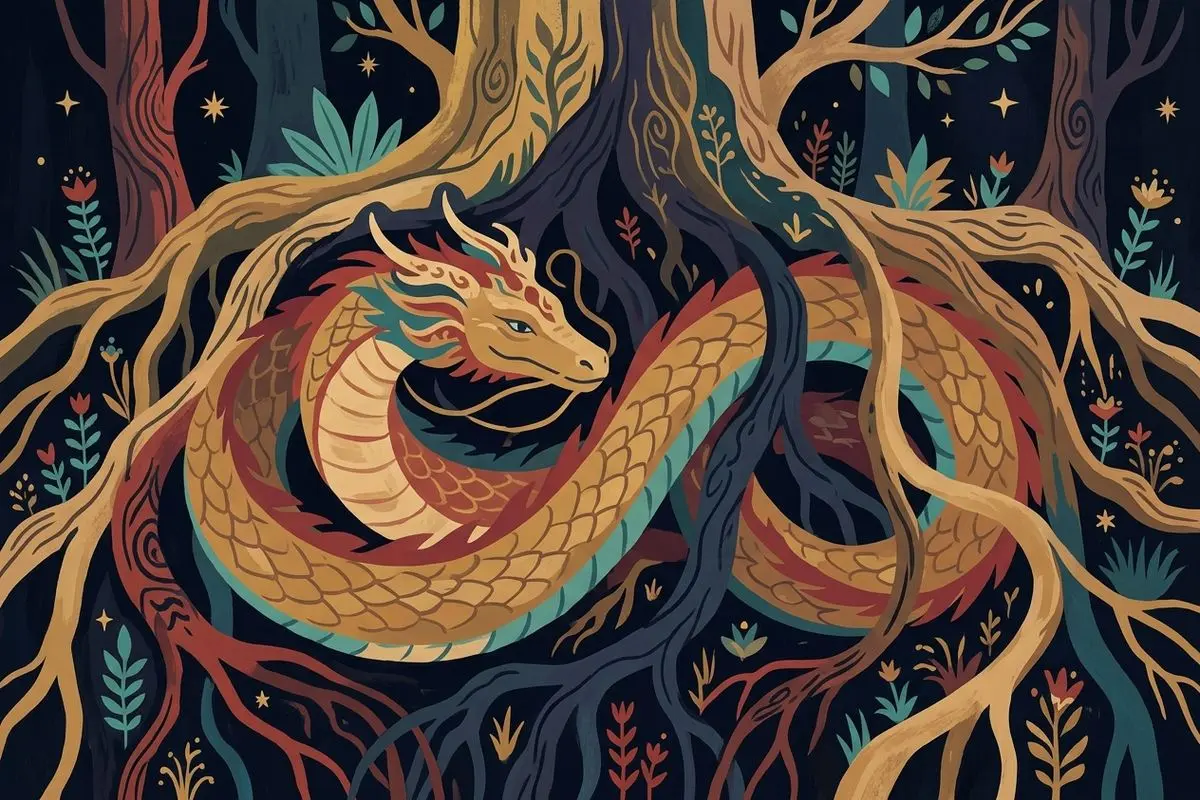
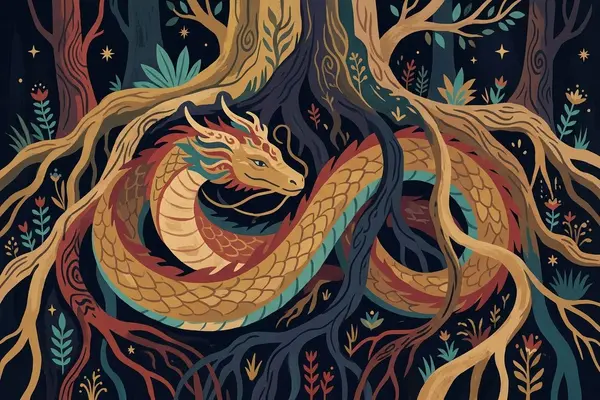
A calm serpent-dragon curled up among the roots of a huge tree
Illustration made by AI: Google Generative AI.

Chapter 6 of 9 · 1 min read

Aidakhar

Down in the roots lives AidakharA great serpent, a dragon that lives in the roots of Baiterek. (a dragon), a great serpent older than the oldest dinosaurs.

People say that if a snake lives for a hundred or a thousand years, it can become an aidakhar too. This matches the mythology dictionary entries by Serikbol Kondybai. And if an aidakhar lives for a hundred or a thousand years, it can turn into a beautiful girl.

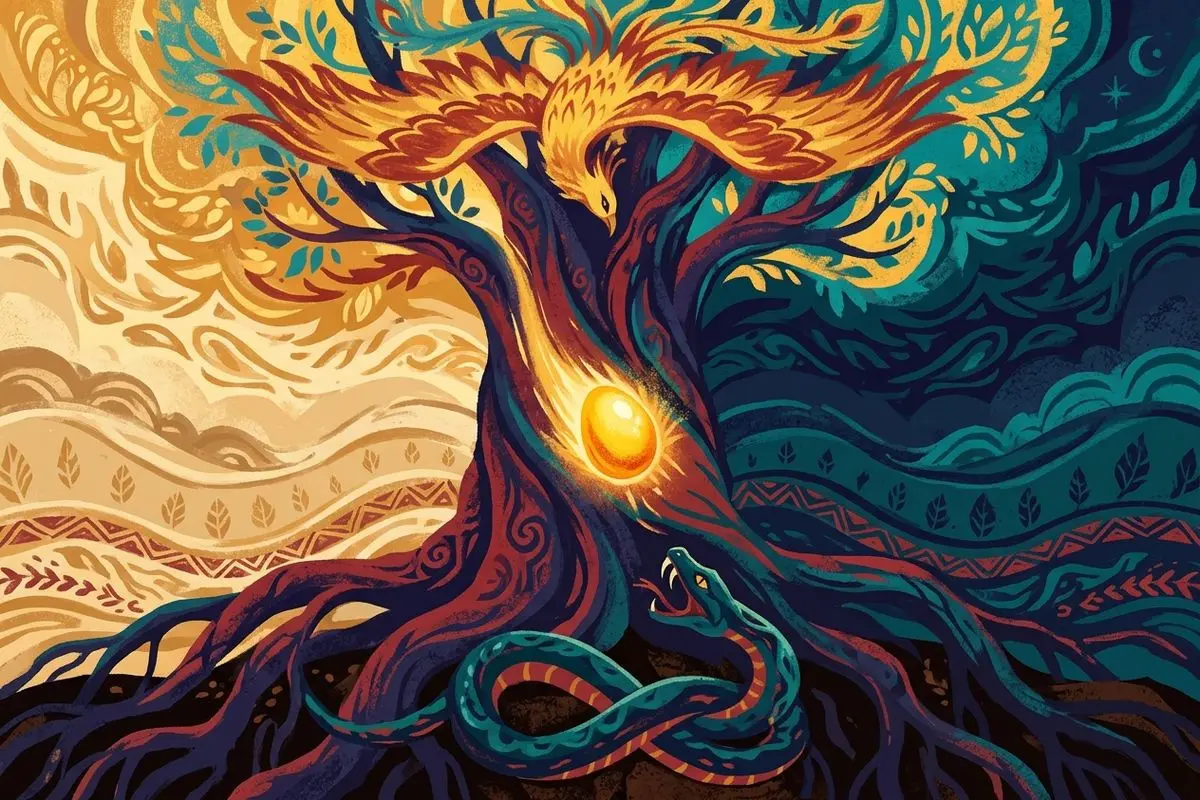
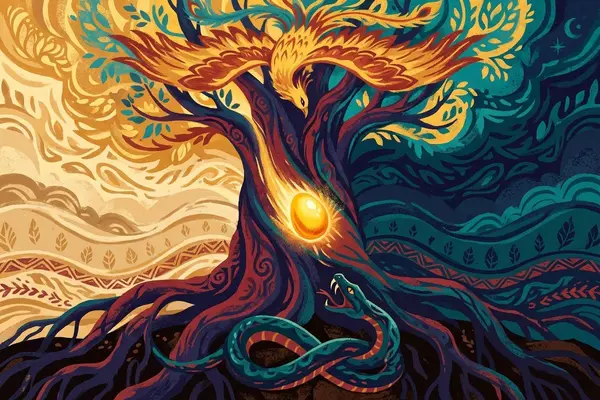
A shining golden egg on a tree trunk: a fiery bird above, a serpent at the roots below
Illustration made by AI: Google Generative AI.

Chapter 7 of 9 · 1 min read

The Golden Egg Sun

Again and again, SamrukA giant bird at the top of Baiterek. lays a golden egg. It rolls down the trunk, and AidakharA great serpent, a dragon that lives in the roots of Baiterek. eats it.

That’s how our ancestors pictured day turning into night and summer into winter, the never-ending dance of light and darkness.

In this legend there’s no pure good and no pure evil. Samruk and Aidakhar need each other to keep the world in balance. Otherwise everything would get way too strange and chaotic.

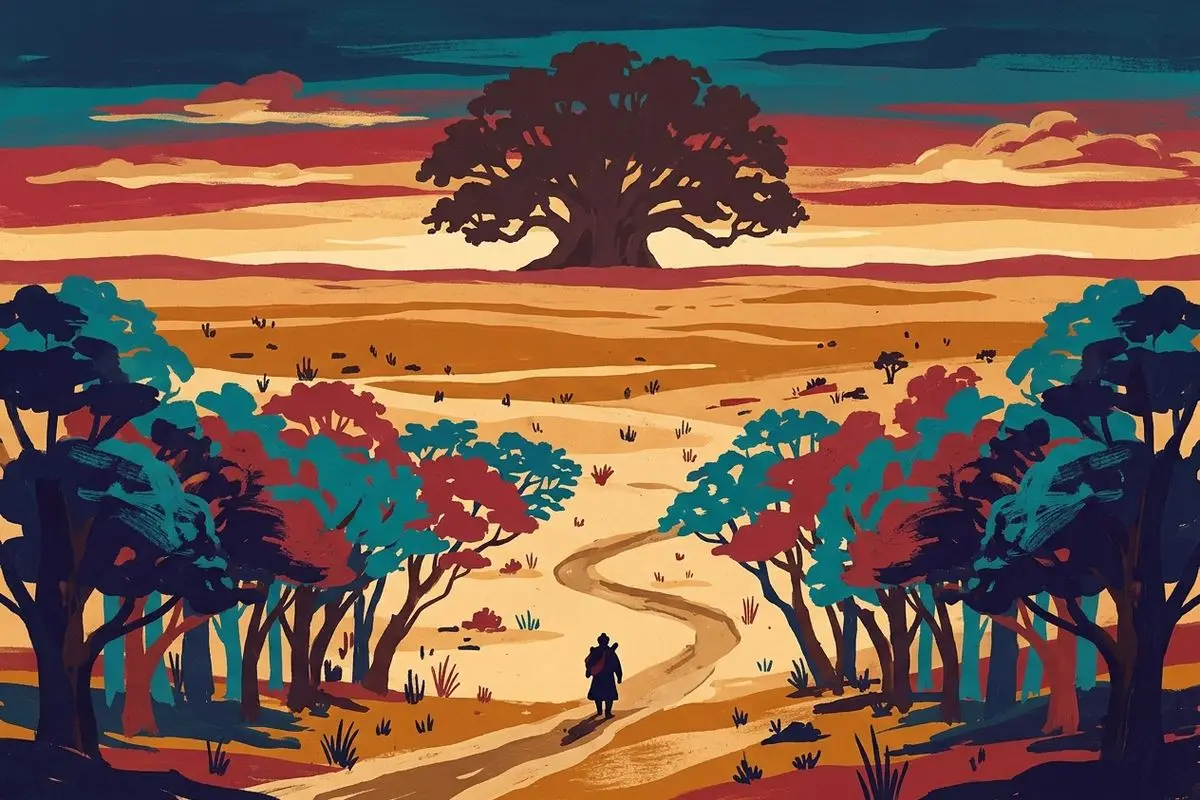
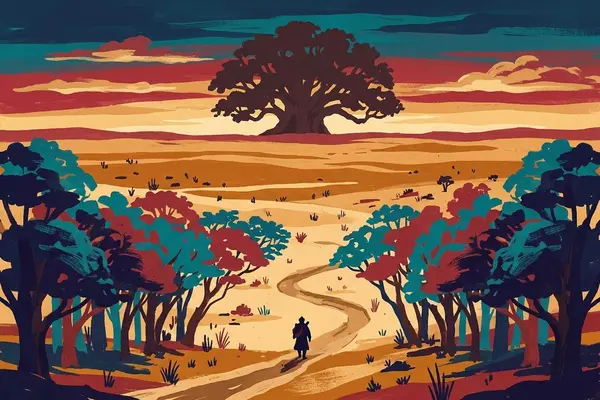
A traveler walks a path across the steppe, the trees part, and a giant tree stands on the horizon
Illustration made by AI: Google Generative AI.

Chapter 8 of 9 · 1 min read

The Road to Baiterek

If someone found BaiterekThe world tree, the tree of life where all the worlds meet. In Kazakh, it’s also a word for a poplar tree. and SamrukA giant bird at the top of Baiterek. and AidakharA great serpent, a dragon that lives in the roots of Baiterek. didn’t eat them, they could gain great knowledge, maybe have a wish come true, or get a magic object.

But the tree of life doesn’t show itself to just anyone. First you have to go through lots of adventures and trials. Once a person proves they’re worthy, nature itself starts guiding them to Baiterek: the trees step aside, and the path leads across the endless steppe to the gigantic tree.

Whoever found the way never told anyone how to get there. This knowledge was carefully guarded so that bad people wouldn’t stumble onto the path by accident: after all, the tree of life has to be protected.

Next Respect for TreesRandom legend
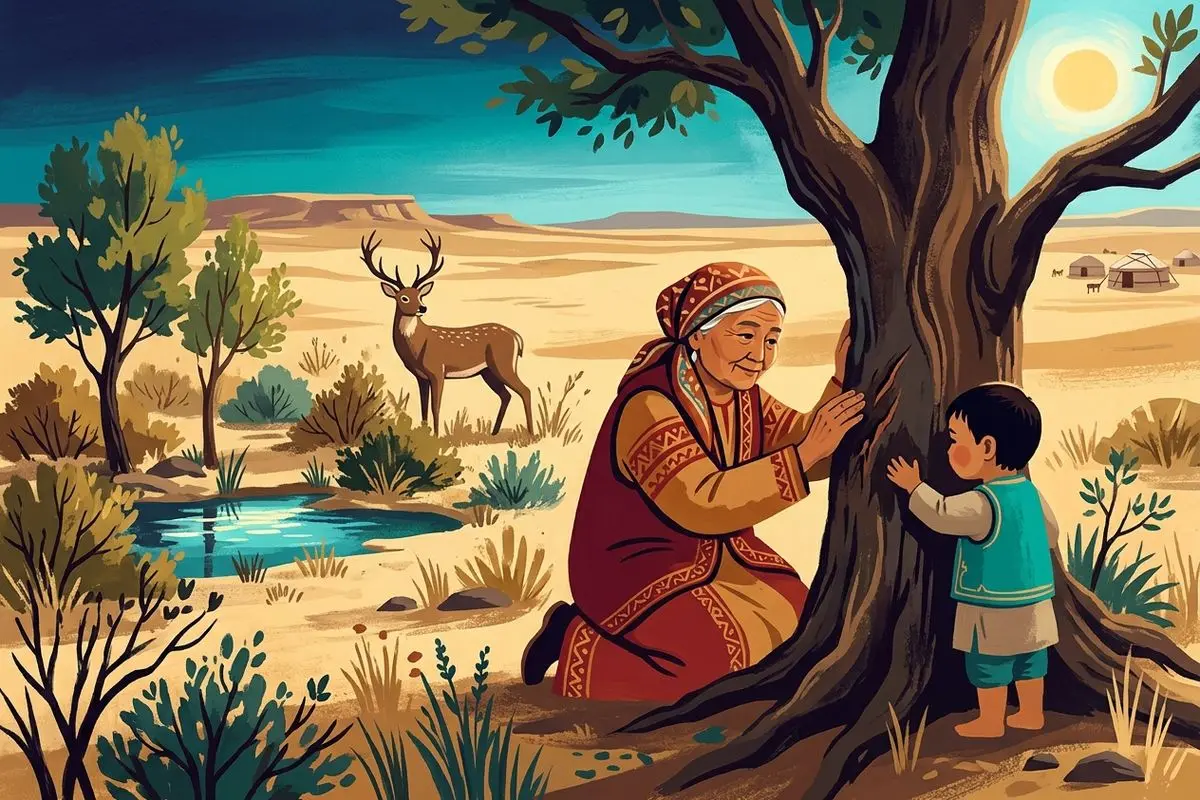
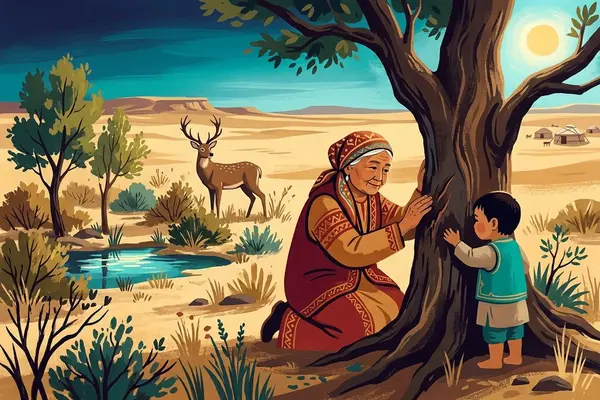
A grandmother and a child seal the bark of a tree, with a deer nearby
Illustration made by AI: Google Generative AI.

Chapter 9 of 9 · 1 min read

Respect for Trees

Kazakhs have a tradition of treating all trees with care.

There’s even a way of telling the future with a tree. If an animal or a bird damaged the bark, people covered the “wound” with clay and watched how fast it healed. If it healed quickly, all would be well in the family: health, happiness, and wealth. If it took a long time, things would still be good, just a little later.

Cutting down a tree was allowed only for everyday needs: for a home, furniture, or weapons. Just for fun? No way. People believed that otherwise the guardian spirits of nature would get angry and everything would end in misfortune.

Next Check yourselfRandom legend

Check yourself

Three questions about this section. Each answer shows where the story tells it.

1. According to the old belief, how can you spot a sky person?
2. In the legend, what happens when Samruk cries?
3. What did our ancestors see in the legend of Samruk's golden egg and Aidakhar?