Аңыз

Customs and Omens

How people on the steppe shared their joy, made peace, welcomed spring and saw a toddler off on their first steps. And why Mum asks you not to leave the dishes overnight.

On the steppe, good news earned a suiinshi: a gift for the one who brought the joy.

Text by: Bekzada ISHEKENOVA, Dias KUMARBEKOV

A yurt, a person with raised arms, a child and the sun

In this section

  1. Suiinshi, Korimdik and BaigazyHistory · 1 min
  2. Tusaukeser: the First StepsHistory · 2 min
  3. Kolga Su Kuiu: Water for the HandsHistory · 1 min
  4. Zhyr Oku: Evenings of Epic TalesHistory · 1 min
  5. Ala Zhip Kesu: Making Peace on the SteppeHistory · 1 min
  6. Korisu: the Day Everyone Met AgainHistory · 2 min
  7. Shashu: How Joy Was SharedHistory · 1 min
  8. Why the House Is Tidied for the NightLegend · 2 min
  9. Bes Konak: the Five Guests of SpringLegend · 1 min
  10. What Patterns SayHistory · 1 min
  11. Asyks: from Fortune-Telling to a GameHistory · 1 min
  12. Aunatu: a Little Piece of LuckLegend · 1 min
  13. Ak: Why Milk Is Not SpilledLegend · 1 min
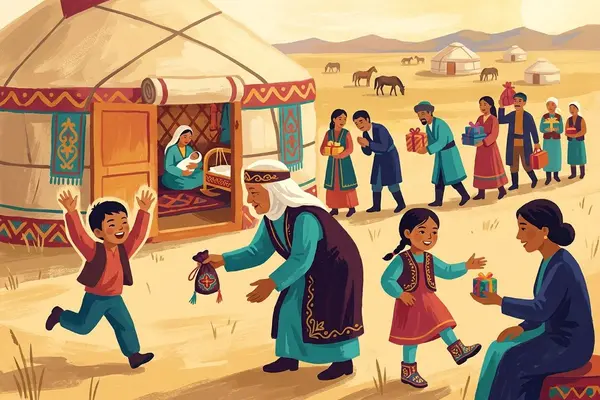
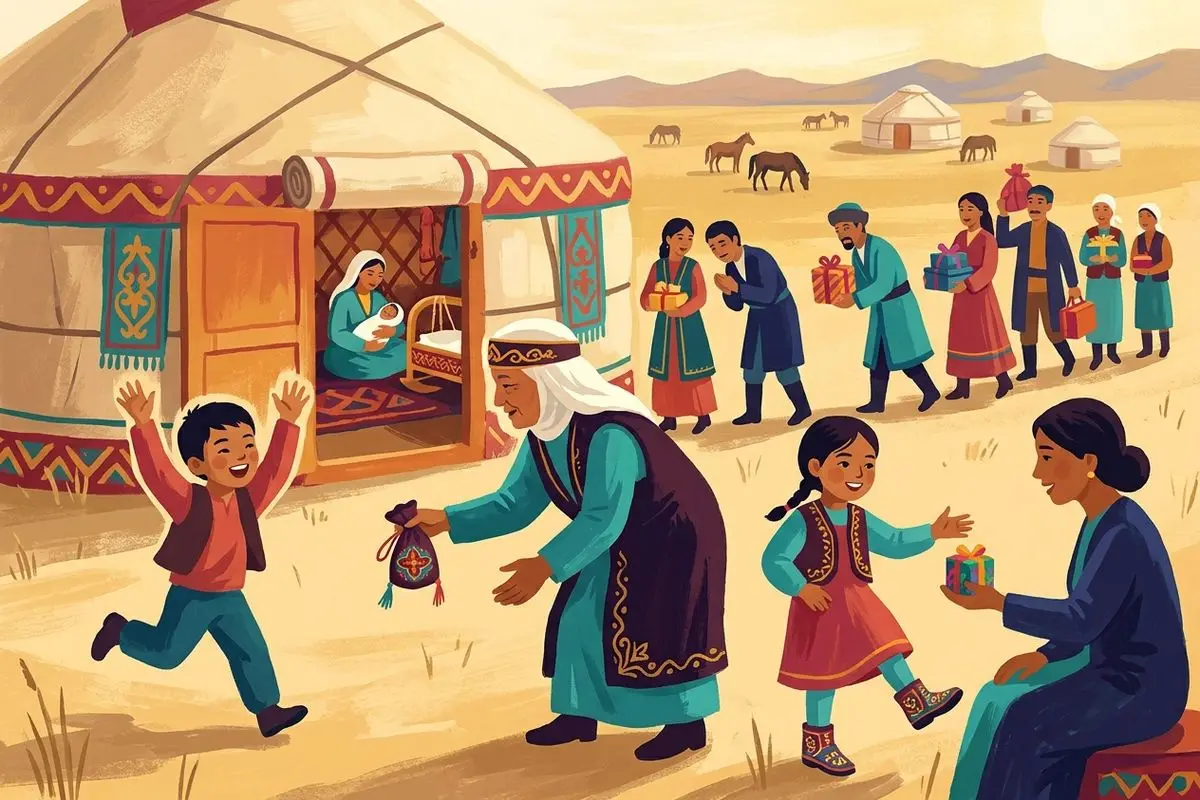
A boy runs happily toward a yurt, an elderly woman holds out a little gift bag to him, guests bring presents to a newborn in a cradle, and a girl is given a gift too
Illustration made by AI: Google Generative AI.

Chapter 1 of 13 · 1 min read

Suiinshi, Korimdik and Baigazy

In Kazakh custom, joy is marked with a gift. Different occasions have their own words.

Suiinshi is a gift for good news. Whoever brings joyful news first can say “Suiinshi!” and get a present. Joy should be shared, especially with the one who brought it.

Korimdik is a gift from someone who comes to see a newborn baby or a new member of the family. This way the guest shows that they came with good intentions and wishes and will not put the evil eye on anyone.

Baigazy is a gift for something new, for seeing a thing for the first time: a new car, a diploma, an award, even new roller skates or socks.

Today people mostly give money on such occasions. But the meaning has stayed the same: notice someone else’s joy and be happy together.

Next Tusaukeser: the First StepsRandom legend
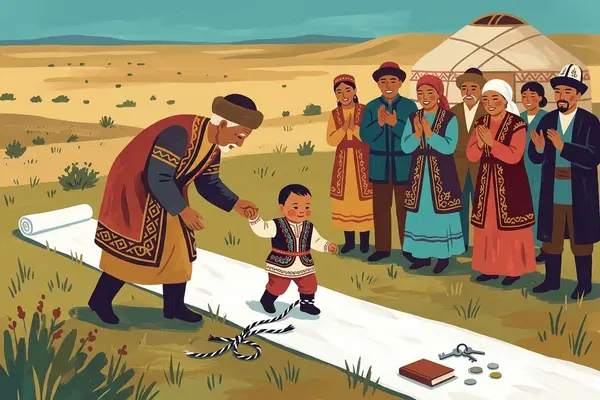
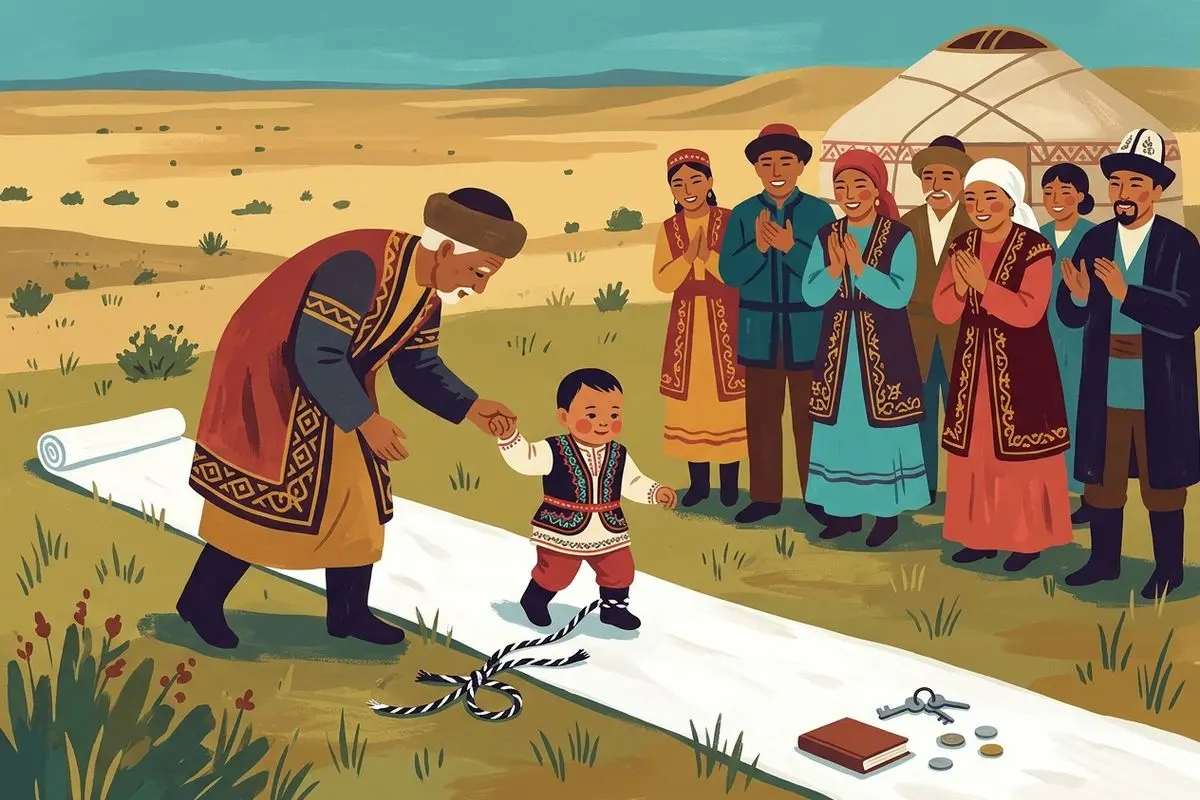
An elder leads a toddler along a white path, a cut black-and-white cord lies at the child’s feet, a book, keys and coins lie at the end of the path, and the family claps
Illustration made by AI: Google Generative AI.

Chapter 2 of 13 · 2 min read

Tusaukeser: the First Steps

When a toddler begins to walk alone, without adults holding on, a tusaukeser, “cutting the fetters”, is held for them. Today it is often celebrated at the age of one.

The child’s legs are tied in a figure of eight with a colourful rope, the ala zhip. A white path is laid out in front of them. A white path is a bright road, full of possibilities.

A special person is asked to cut the fetters: someone trusted, whose good qualities the family would like to pass on to the child. They cut the rope and lead the child along the white cloth. This person receives a gift, and the toddler gets money, toys and sweets.

The meaning of the rite is that there should be no obstacles on the child’s path in life. At the end of the path the toddler sometimes picks one of several objects: a book, keys, money. They say the choice hints at what the child’s future will be.

Today tusaukeser is held in Kazakhstan for children of many different peoples.

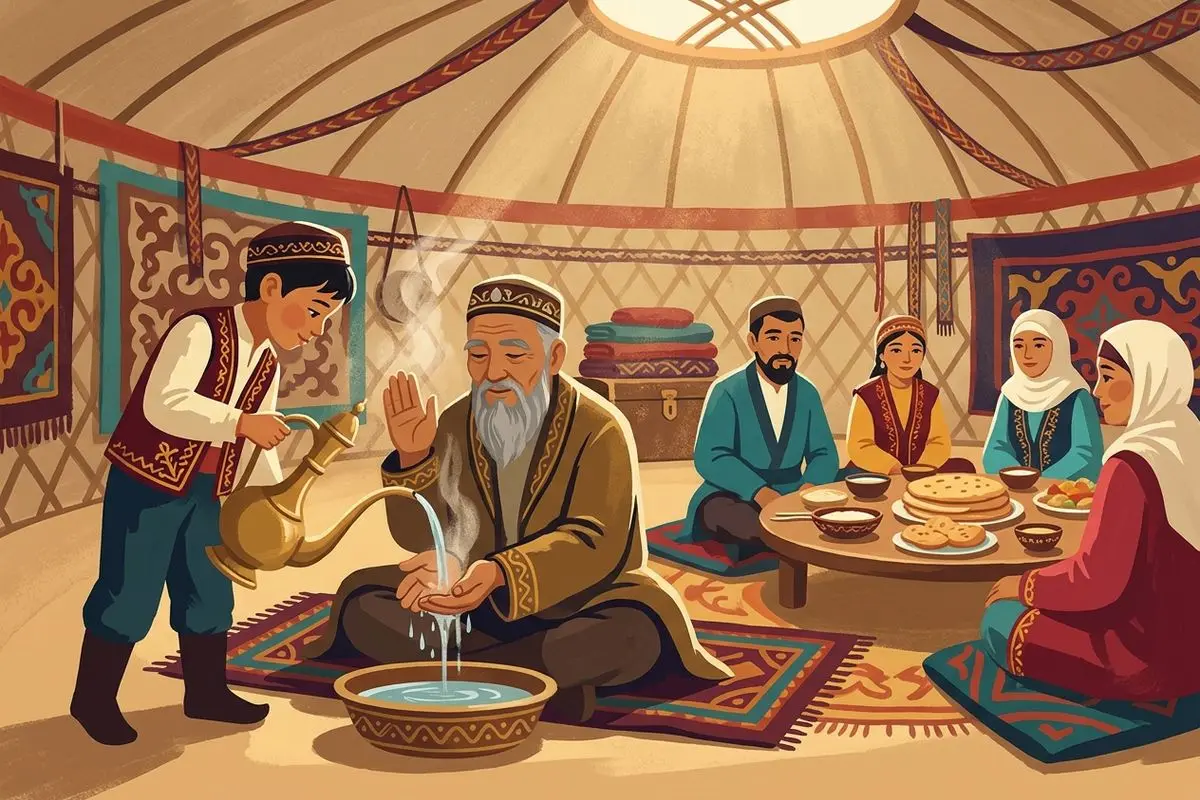
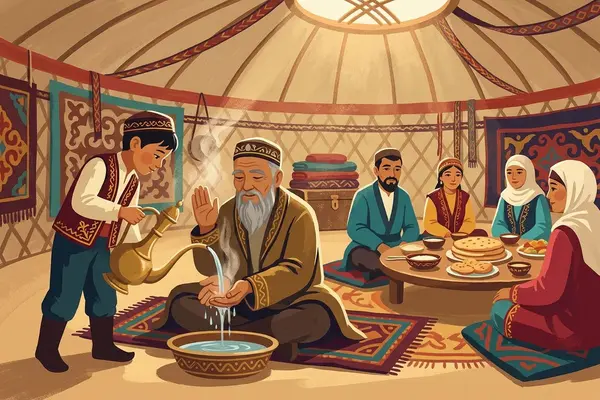
In a yurt a boy pours water from a jug over an old man’s hands above a basin, the old man raises his palm in blessing, and guests sit around a table with food
Illustration made by AI: Google Generative AI.

Chapter 3 of 13 · 1 min read

Kolga Su Kuiu: Water for the Hands

In the past, homes had no running water, and you could not simply wash your hands under a tap before a meal.

So at the dastarkhan, the festive table, there was a tradition called kolga su kuiu, “pouring water on the hands”. Before the meal, guests were brought a jug of water and a basin so that everyone could wash their hands.

Usually the youngest person in the house did this. In return the guests blessed them and wished them goodness and warmth.

It was a very sensible custom: everyone sat down to eat with clean hands and fell ill less often. And the youngest received a blessing and learned to look after guests.

Next Zhyr Oku: Evenings of Epic TalesRandom legend
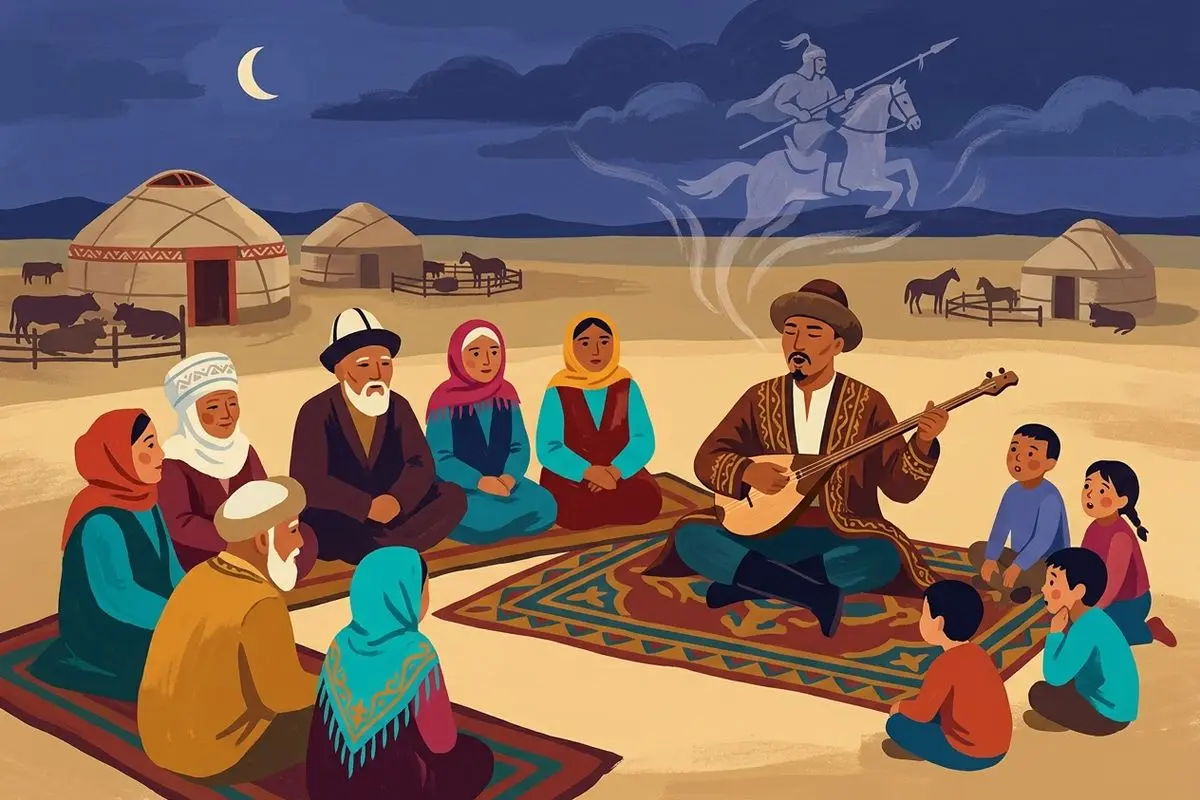
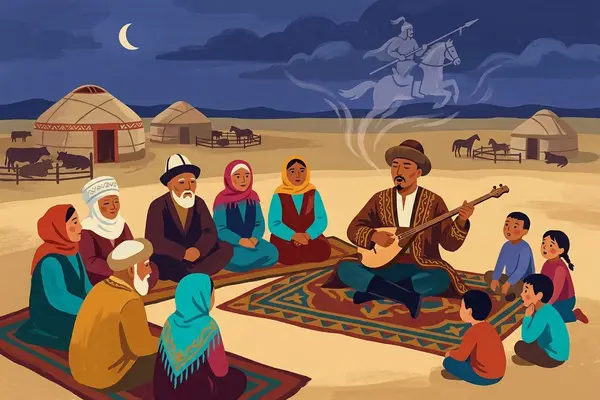
Evening in an aul: a storyteller sings and plays a two-stringed dombra, adults and children listen on rugs around him, a crescent moon hangs over the yurts, and a batyr from the tale gallops in the haze
Illustration made by AI: Google Generative AI.

Chapter 4 of 13 · 1 min read

Zhyr Oku: Evenings of Epic Tales

In the past, in the evening, when the livestock came back from the pastures, the people of the aul gathered together. They talked about the news of the day, played, wrestled and ran races. And then a zhyr, a heroic epic, was heard.

This was called zhyr oku. A talented storyteller chanted tales about batyrsA hero. The title was usually given by the people themselves., and everyone listened with bated breath.

The writer and war hero Baurzhan Momyshuly remembered such evenings in his novella “Our Family”. His uncle read epics at his grandmother’s house, and the young people of the aul came to learn their favourite lines. Many needed to hear them only two or three times, and the next evening they were already chanting the verses in a neighbouring aul.

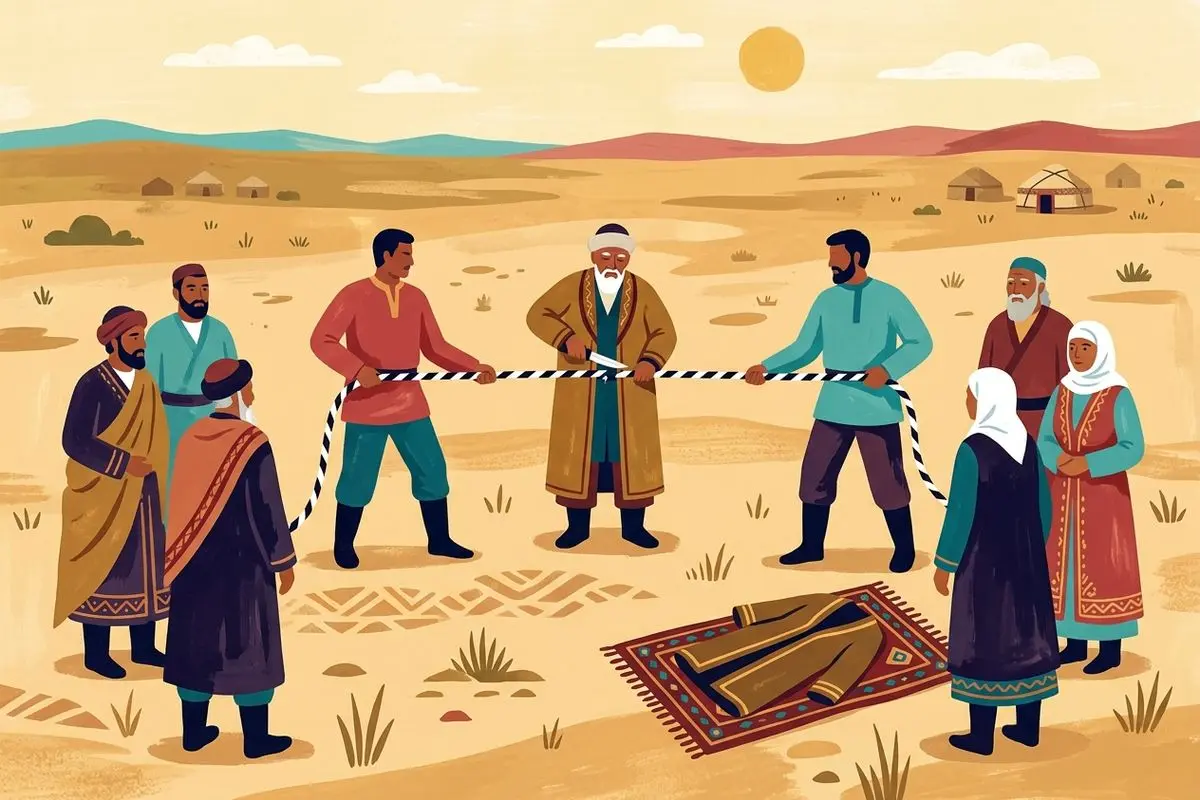
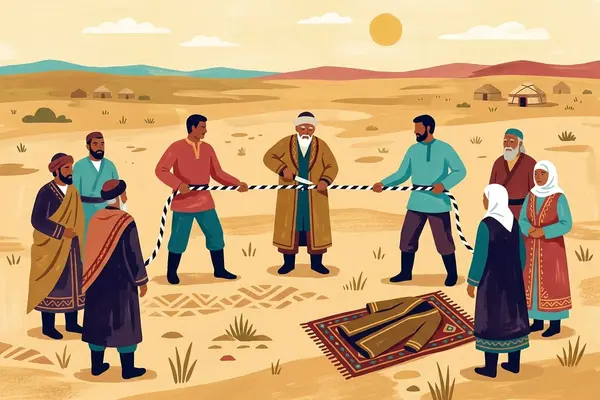
Two men hold the ends of a black-and-white rope, an elder in the middle cuts it, a folded robe lies on a rug nearby, and people watch calmly
Illustration made by AI: Google Generative AI.

Chapter 5 of 13 · 1 min read

Ala Zhip Kesu: Making Peace on the Steppe

When a dispute on the steppe was settled, it was sealed with the rite of ala zhip kesu, “cutting the colourful rope”.

In 1846 the ethnographer Lev D’Andre described how it was done. The two sides of the dispute held a rope by its ends. Together they chose a respected person, who cut it in half with a knife. As he cut, he said: let whoever reopens this finished dispute be cut into pieces like this rope. After this rite, there was no way to go back to the dispute.

The person who cut the rope received a gift, for example a chapan, a long robe.

Next Korisu: the Day Everyone Met AgainRandom legend
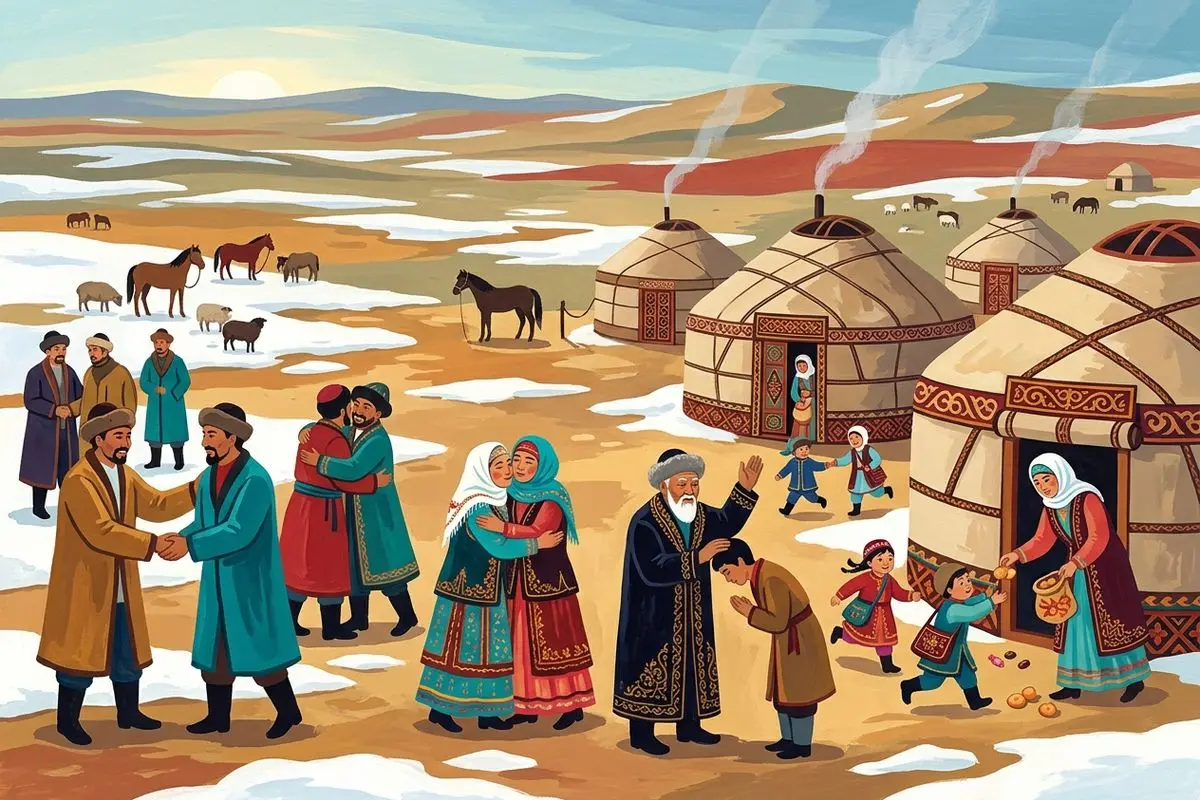
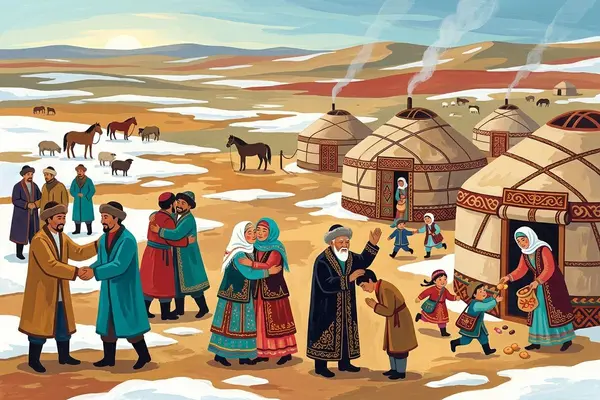
A spring aul with thawed patches: men shake hands and embrace, women hug, an old man blesses a young man, and children with little bags run to the yurts
Illustration made by AI: Google Generative AI.

Chapter 6 of 13 · 2 min read

Korisu: the Day Everyone Met Again

In winter, blizzards cut families on the steppe off from each other for a long time. So when spring came, people could finally see each other again. That is how the festival of Korisu, “meeting each other”, appeared. In some regions it is called Amal.

In the past Korisu was celebrated mostly in the west of Kazakhstan, but now it is celebrated across the whole country. It falls on 14 March, a little before NauryzThe spring equinox holiday, March 22..

From early morning the younger people go to greet their elders: “Bir zhasynyzben!”, “Happy new year of your life!” In return the elders give a bataA blessing spoken by elders., a blessing. Men shake hands and embrace, women hug, touching cheeks.

There is a custom of visiting at least three homes before noon, to share the joy of the festival with as many people as possible. For children it is a real adventure: they are given little bags, and in every home sweets and baursaks, fried dough treats, are poured into them.

On this day people make peace with those they quarrelled with. What better new beginning could there be?

Next Shashu: How Joy Was SharedRandom legend
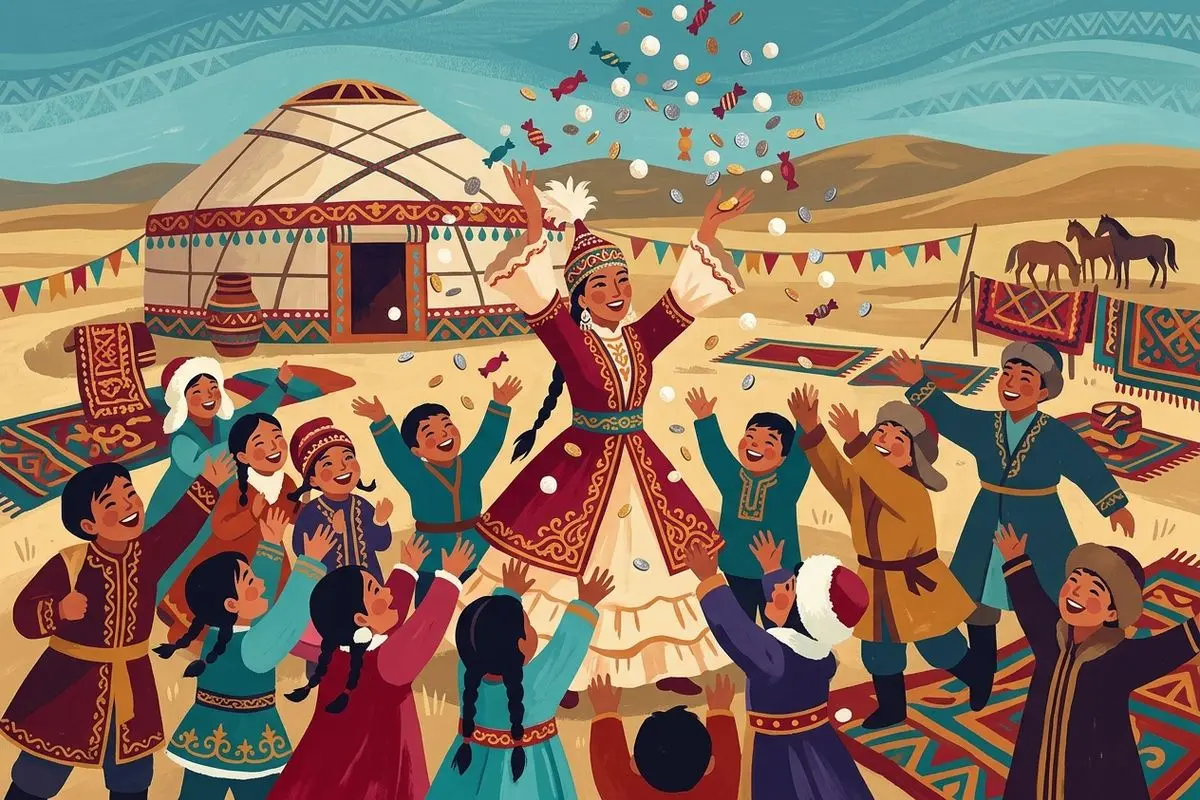
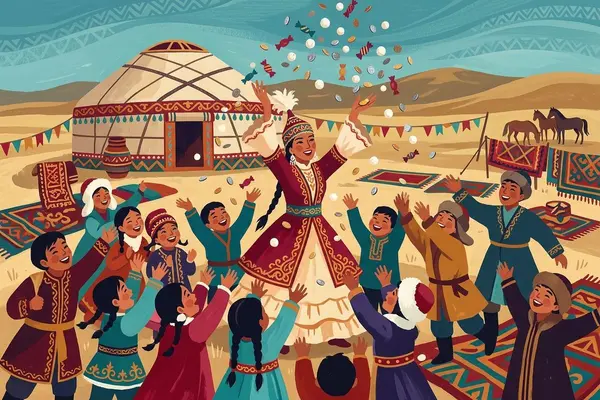
A woman in a festive dress throws sweets, little white balls of kurt and coins into the air, and children and guests catch them by the yurt
Illustration made by AI: Google Generative AI.

Chapter 7 of 13 · 1 min read

Shashu: How Joy Was Shared

On the steppe people believed that happiness should be shared: then luck would come not only to you but to those around you too. And whoever shares will have even more joy.

One such custom is shashu. The word means “to scatter, to toss”. When a child is born, when there is a housewarming, when dear guests arrive or a big purchase is made, sweets and coins are scattered over the people. Usually women do it: the woman of the house or her close female relatives.

The treats are thrown upwards so that they fall on the guests as if from the sky. Among the sweets there is always something white, such as kurt, dried cheese balls: this is a wish for a bright life. And the sweets are a wish for life to be as sweet as honey.

Everyone at the celebration picks up the shashu. It is believed that a little of someone else’s joy will pass to them this way.

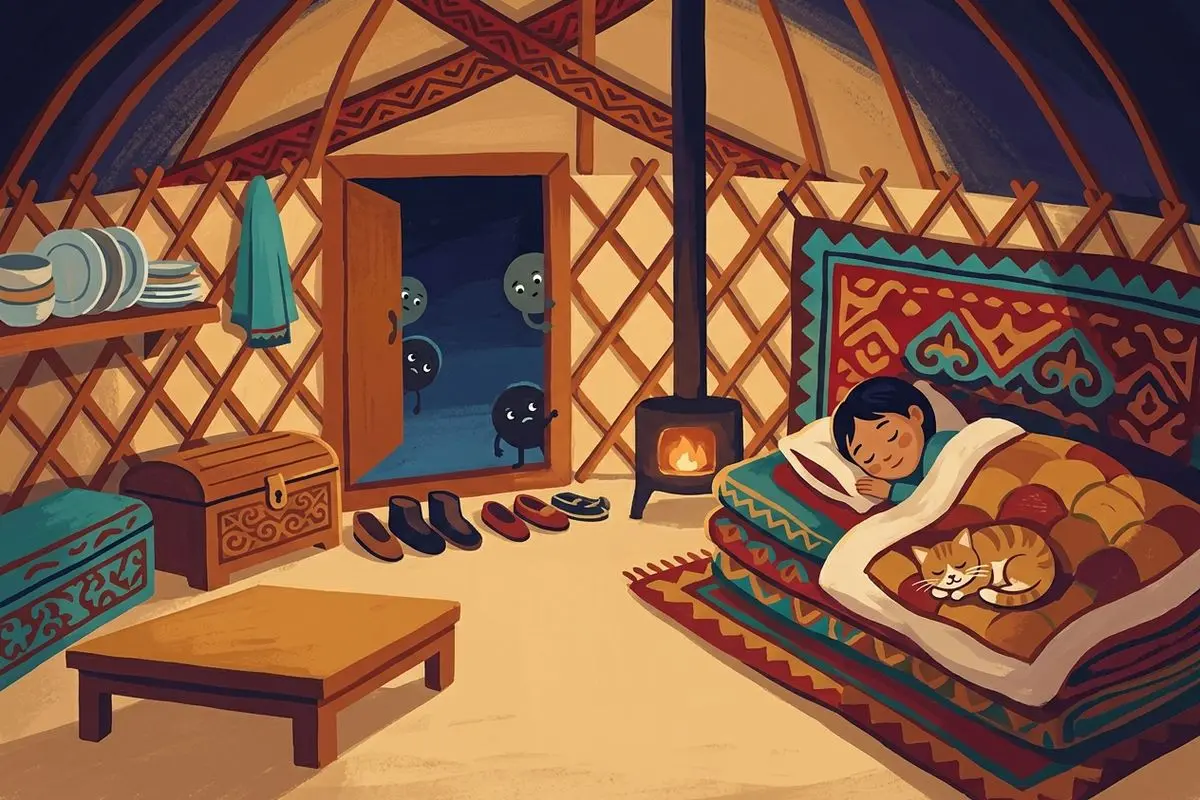
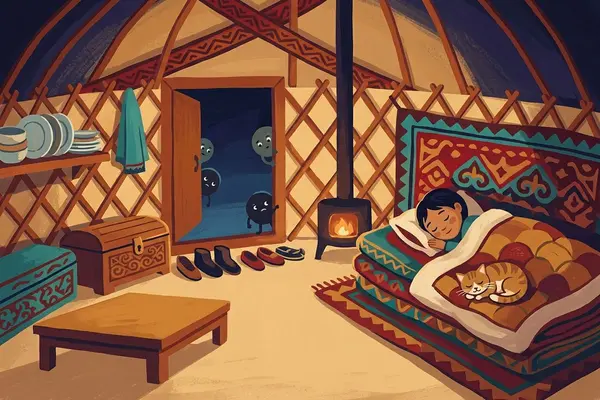
A tidy yurt at night: dishes on the shelf, the table empty, shoes standing neatly, the chest closed; small dark spirits peek through the door, and a child sleeps next to a cat
Illustration made by AI: Google Generative AI.

Chapter 8 of 13 · 2 min read

Why the House Is Tidied for the Night

Many of the omens our mums and grannies repeat come from the distant past. Each one holds a belief, and often simple common sense too.

You must not leave the house untidy, the dishes unwashed or leftovers on the table. According to the belief, evil spirits will hold a feast in the house at night, and misfortune will come to its owners. And according to common sense, dirty dishes and food go bad overnight, and you could get food poisoning.

You must not leave shoes sole up or cupboard doors open: demons are said to climb inside. And the dirt from the soles simply ends up in the house.

Children were scolded for looking out of the window at night: they were told that evil would notice them. In the dark it really is easy to be frightened by your own reflection.

Next Bes Konak: the Five Guests of SpringRandom legend
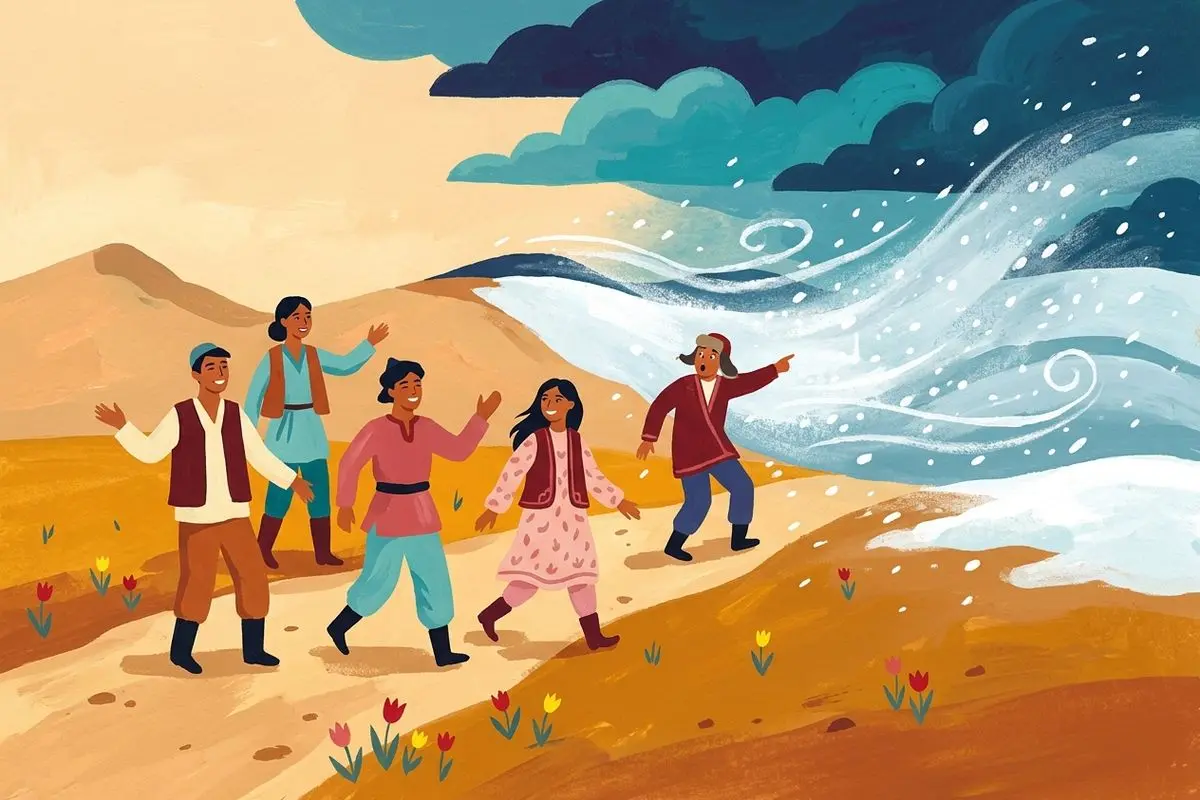
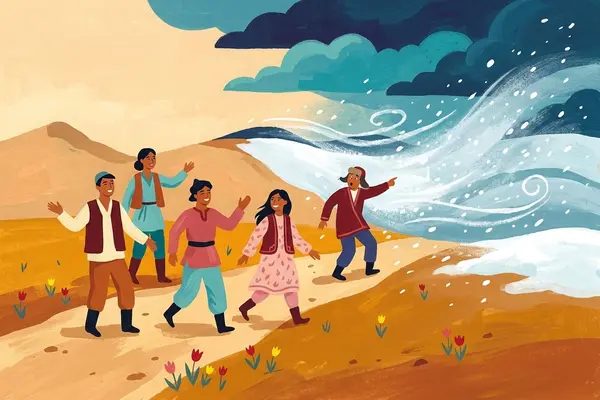
Five travelers in light clothes walk cheerfully across the spring steppe with tulips, while a snowstorm sweeps in behind them
Illustration made by AI: Google Generative AI.

Chapter 9 of 13 · 1 min read

Bes Konak: the Five Guests of Spring

In spring this happens: it has become properly warm, everyone has taken off their warm jackets, and suddenly it turns cold and a blizzard blows in. Such a cold snap in March or April is called bes konak, “five guests”.

Nomads knew the weather well from centuries of observation. They knew that winter does not leave at once and that after the first warmth a frost will surely strike.

Why “five guests”? People explain it in different ways.

Next What Patterns SayRandom legend
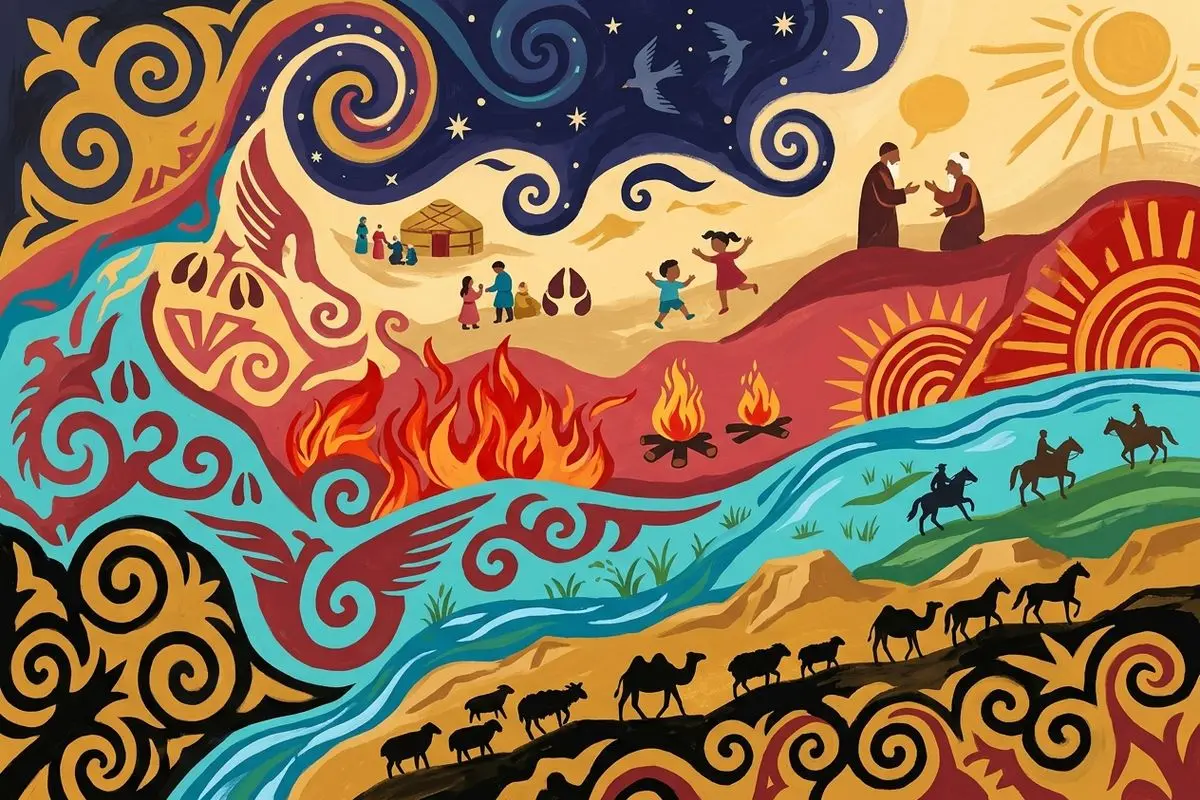
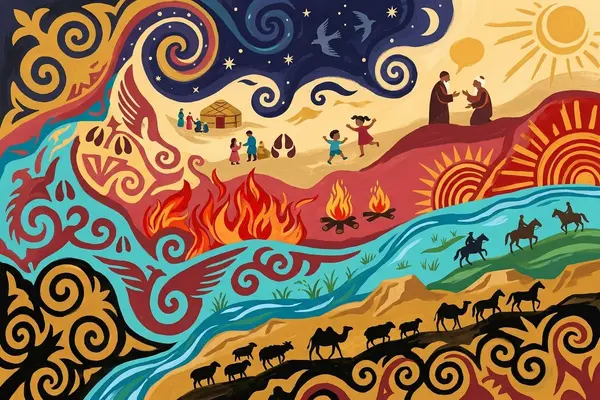
A pattern of ram’s horns, bird wings and camel tracks, with small scenes inside the colored bands: the night sky, the sun, fire, a river with riders and a caravan
Illustration made by AI: Google Generative AI.

Chapter 10 of 13 · 1 min read

What Patterns Say

Kazakh ornament, oyu, is not just decoration. Every pattern wishes for something or protects from something.

Koshkar muiiz, “ram’s horns”, is the best-known pattern. Its curling shape stands for the endless circle of life. It was put on things in the home as a wish for plenty, well-being and family unity. In Central Asia ram’s horns were considered a strong amulet against evil forces.

This pattern is very old. It was found on a felt carpet from the Pazyryk burial mound: the carpet is about 2,500 years old and is now kept in the Hermitage Museum.

Tuietaban, “camel’s footprint”, was embroidered on clothes for a long journey. And the kuskanat patterns, “bird’s wing”, wished for happiness, freedom and independence.

Colours have meanings too:

  • blue: the sky;
  • white: joy and happiness;
  • yellow: knowledge and wisdom;
  • red: fire and the sun;
  • green: youth and spring;
  • black: the earth.
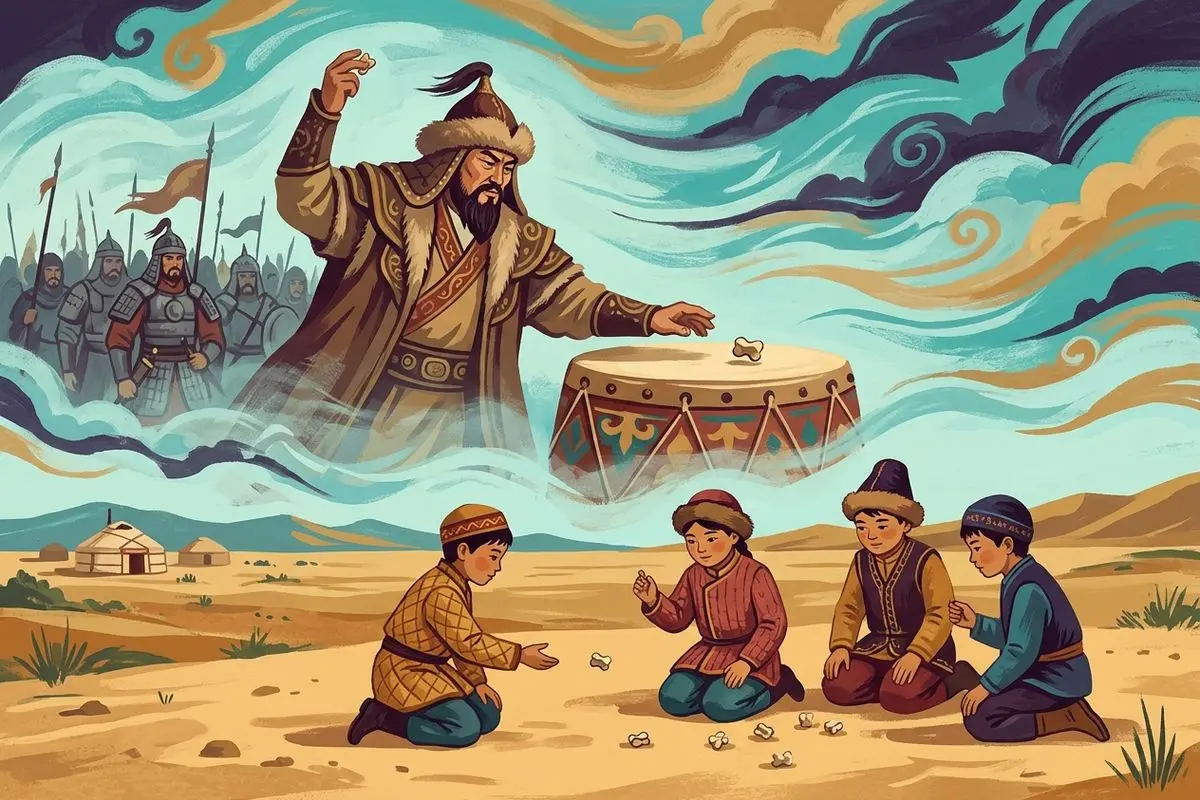
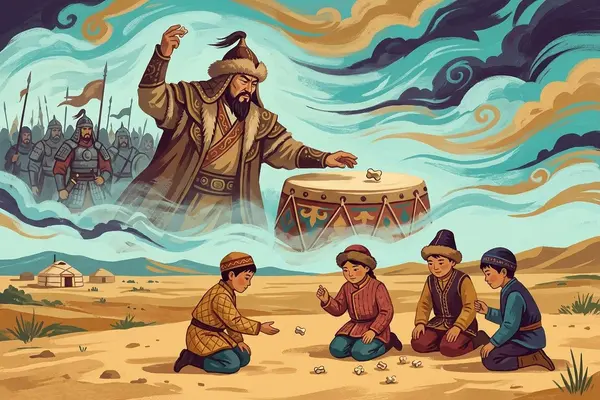
Children on the ground play asyk, and above them, like a vision, a chieftain throws a bone onto a big drum with an army standing behind him
Illustration made by AI: Google Generative AI.

Chapter 11 of 13 · 1 min read

Asyks: from Fortune-Telling to a Game

Asyks are small knucklebones from a sheep’s leg. Many children in Kazakhstan know the game of asyks. But once these bones were used not for play but for telling the future.

Zhumazhan Baizhumin, a professor at the Kazakh Academy of Sport and Tourism, described how people told fortunes with asyks before a battle. The tribe’s leader threw a bone onto the army drum. The prediction depended on which side it landed on: victory, defeat, a good peace, or a peace that favoured the enemy. And if the bone stood on its edge, that was the rarest and worst sign.

Over time the fortune-telling bones turned into game pieces, and asyks became one of the best-known games of ancient times.

Next Aunatu: a Little Piece of LuckRandom legend
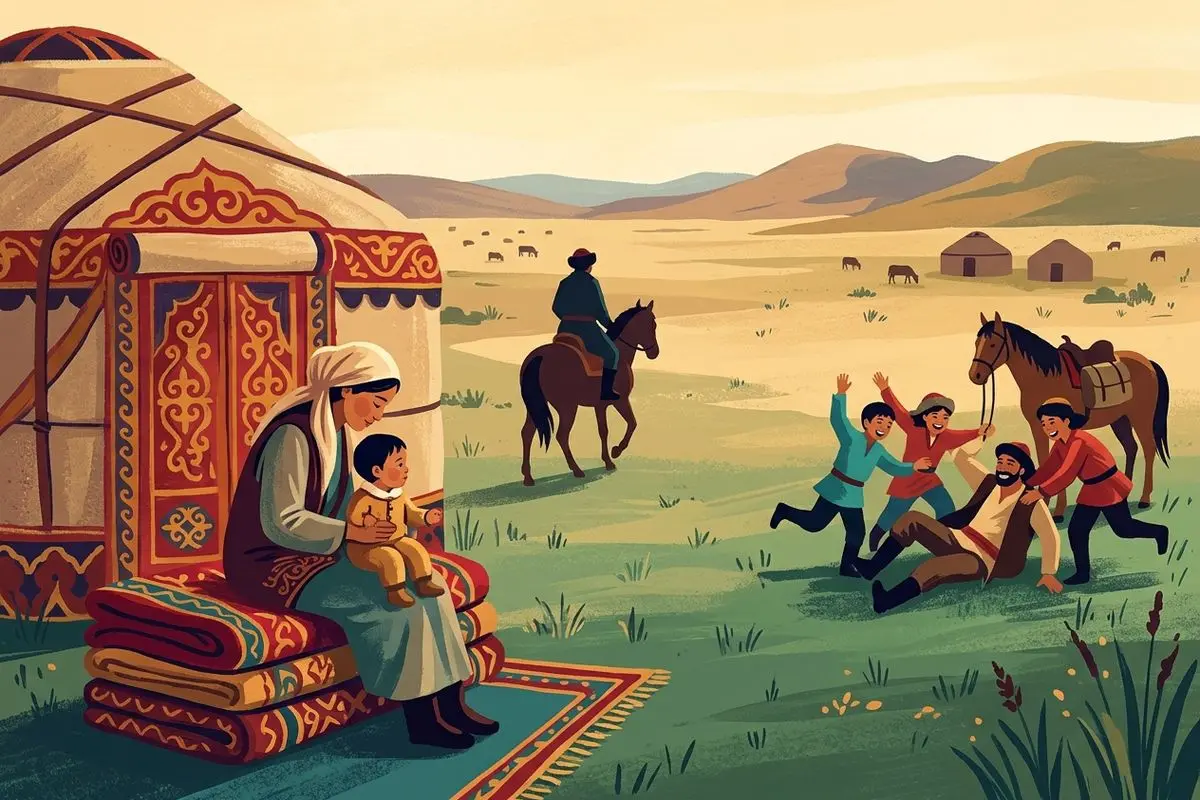
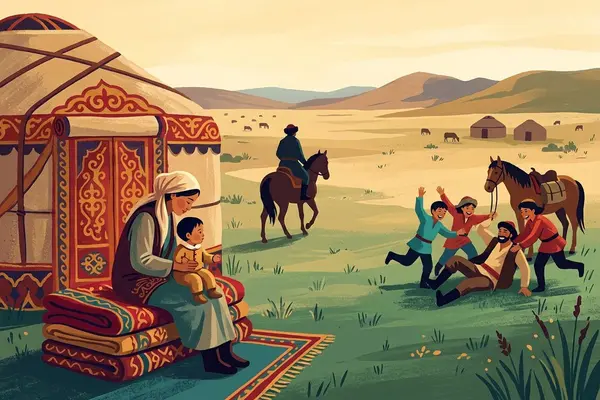
A mother sits her toddler on the guest’s folded bedding by a yurt, the guest rides away, and nearby friends roll a returning traveler on the grass
Illustration made by AI: Google Generative AI.

Chapter 12 of 13 · 1 min read

Aunatu: a Little Piece of Luck

There is a custom called aunatu, or “zhaksynyn ornyna aunatu”, “rolling where a good person has been”.

When a successful, respected guest spent the night in a home, children were later sat in that guest’s place. People believed that a little of the guest’s talent and luck stayed there and would pass to the children. Sometimes a child was even rolled on the ground where such a person had been.

This did the guest no harm at all: luck passes from older to younger, from the present to the future.

There is a similar rite, tugan zherge aunatu, “rolling on your native land”. When someone had lived abroad for a long time and came back home, they were rolled on their native soil so that they would gain its strength.

Next Ak: Why Milk Is Not SpilledRandom legend
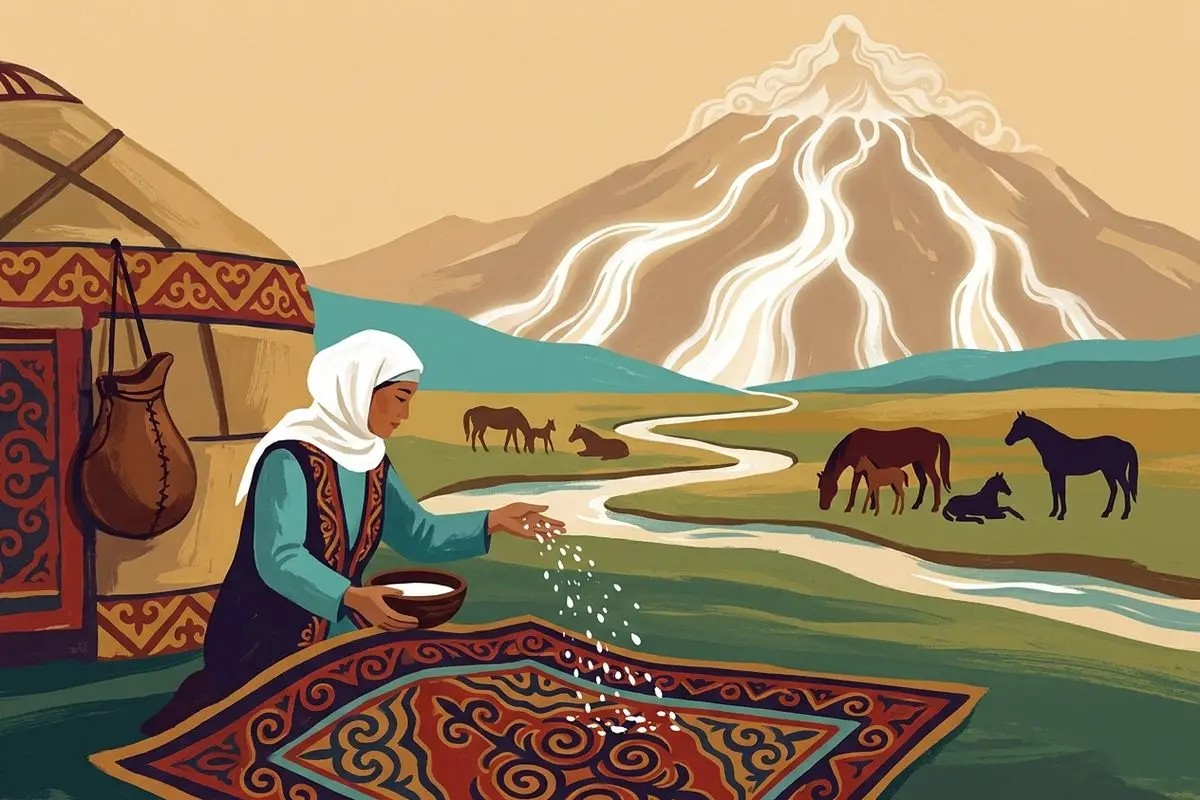
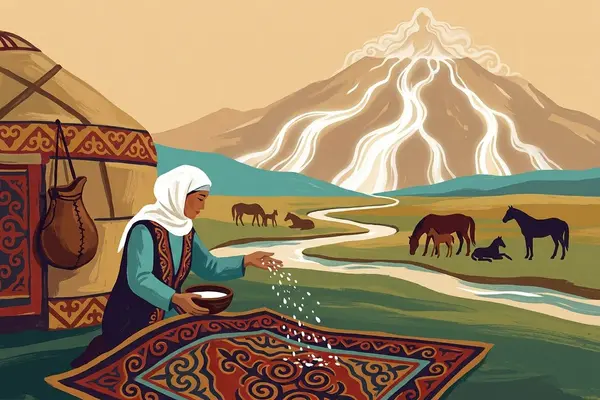
A woman in a white headscarf sprinkles milk on a new felt rug, a leather vessel hangs by the yurt, mares with foals graze by a stream, and white rivers of milk flow from a mountain peak
Illustration made by AI: Google Generative AI.

Chapter 13 of 13 · 1 min read

Ak: Why Milk Is Not Spilled

Many children were scolded for spilling milk. There is a reason for this.

Kazakhs call milk and everything made from it ak, “white”. According to Turkic beliefs, milk must not be spilled on the ground for nothing: it brings misfortune.

On the other hand, milk could be sprinkled on a new thing, for example a carpet that had just been finished. And bathing in milk was believed to give strength.

Spring rites are also linked to milk: the first milking of mares and the making of kumys began with special rites in which people remembered both good spirits and their ancestors.

Next Check yourselfRandom legend

Check yourself

Three questions about this section. Each answer shows where the story tells it.

1. What is suiinshi?
2. Why are children given little bags at Korisu?
3. According to belief, what does the tuietaban pattern on clothes mean?